Showing posts with label Game Master Advice. Show all posts

Sunday, March 20, 2022

Favorite DM Advice of the Week

Writing a blog is a bit outdated.  So is hanging out on FaceBook.  At one point I joined a "Grognards Who Play 5th Edition" FaceBook group, and it can be as cringe as you would expect.  "I played 4th Edition, so I know what D&D was like back in the day".  I have to consciously pause and remember the playing base is huge, and people have encountered the game for their first time across a wide range of editions and play styles.  That means sometimes it's a Gen Z or Millenial 3rd edition or 4th edition player saying they pre-dated 5th Edition, so they're the grognards now.  I don't even care.  We're in week 3 of a brutal invasion of Ukraine by Russia, if you played 4th Edition and now you want to be known as an old timey war gamer, you go for it.  The world could end tomorrow.

In the meantime, here's some great DM advice that popped onto the Grognard's group this week (courtesy of a fellow old timer "Josh S").  They do a good job of distilling far more verbose descriptions of the old school mindset into 3 basic precepts:

1. The story is whatever the player characters do.

2. The DM’s job is to adjudicate the rules and bring the world to life.

3. The dice never lie. Don't ask them questions if you aren't prepared to accept their answers.

Carry on with your regularly scheduled programming.  Let's all be careful out there.

Saturday, March 12, 2022

Death and Skullport (an Undermountain play report)

I'm still playing catch-up on older game reports for our Undermountain campaign.  The objective of the players has been to find a way through the dungeon to the underground pirate city of Skullport, which is home to the headquarters of the secretive Xanathar's Guild, the major thieves' guild in Waterdeep.  The Black Staff, a wizardly protector of Waterdeep, has commissioned the players to eliminate a threat facing Waterdeep - the minds of ordinary citizens are being replaced by intellect controllers under the control of a mind flayer working with the guild.  After months of play, the players are getting close to their objective!  Last game, they agreed to act as ambassadors to the hobgoblin nation of Azrok and take a diplomatic missive to Xanathar's agents.

As an aside on Undermountain (I'm using the 5E Dungeon of the Mad Mage) it really does a fine job of creating a living underworld, with connections between inhabitants, between levels, and story elements that can drive the campaign forward.  I recommend the dungeon master develop story reasons for the players to be interested in Undermountain that fit their own campaign and the play styles of the players.  For my group, the aspiration to be members of the Harpers and the group 'Force Grey' gave them sufficient reason to take on complex quests from figures like the Blackstaff. The books Dragon Heist and Dungeon of the Mad Mage provide you a lot of "lego pieces" to customize a cool exploration based campaign.  It's classic 1970's dungeon crawling, but with 5E systems.

Skullport from Dungeon of the Mad Mage

Skullport is a harbor town located in a large cavern on the shore of an underground lake.  Apparently there used to be locks and waterways to reach the city from a hidden sea cave on the surface, but that way no longer allows large sailing vessels to reach the port, and the population of the town is dwindling.  The mouth of the harbor is guarded by an oppressive fortress squatting atop the aptly named "Skull Island".

There are several cave passages between Undermountain (level 3) and the town of Skullport; the slow moving Sargauth River that flows through level 3 also leads to Skullport harbor.  My players used a passage guarded by the hobgoblin kingdom, the "Ghost Way", where they indeed needed to skirt a haunted cavern to reach Skullport.  We spent 1-2 game sessions with the players carousing around Skullport, visiting pubs such as the Black Tankard and the Dragon and the Flagon, while seeking the location of one of Xanathar's agents to give the wax sealed scroll with a message from the hobgoblin king.  Word reached the commander of Skull Island, an 8' tall half-ogre champion called Sundeth, who flew out of the dark cavern on a wyvern mount to receive the character's message.  Sundeth dispatched a courier to take it to Xanathar; the players foresaw something like this happening and made their rogue, Teukros, invisible in advance.  Teukros was able to tail the courier to an entrance to the thieves' guild, in the basement of an inn called the Gut and Gartner.  A long arc of the campaign was coming to a close and the players were now ready to return to the surface, share their intelligence with the Blackstaff, and identify what comes next.

There's a saying "you can lead a horse to water, but you can't make them drink…"  It applies equally to RPG players.  There have been several times during the course of the campaign where the character's faction connections, be it Force Grey, the Harpers, or even the Zhentarim, have made it clear there are friendly agents in Skullport who could aid the characters in getting back to the surface if they're able to make contact.  My group of players considered this tact and declared, "seeking out friendly agents sounds too much like work, let's figure out if we can sneak or fight our way back through the drow city".   (The last time they tussled with the drow a character died and the rest of the player characters fled for their lives).

Backtracking through the hobgoblin kingdom, making their way to the drow outskirts, and sneaking through the drow city was certainly a legitimate option to try.  They came up with an intricate plan to go "light-free" and  guide their blinded characters with ropes, while sneaking along the outskirts of the ruined dwarven hold and avoiding drow patrols.  Unfortunately, they had a barbarian in the group.  Bosko, their goliath barbarian, got frustrated about not being able to see in the darkness; he tossed his drift globe in the air, yelled the command word for daylight, and charged into a nearby intersection, daring the drow to come out and fight like men.

There was a movie in the late 1960's, Butch Cassidy and the Sundance Kid - it tells the story of the legendary train robbers and gun fighters.  At the end, Butch and Sundance are living as outlaws in Bolivia where they are identified by the local police while eating at an outdoor cafĂ©.  The Bolivian Army arrives and surrounds them completely, and the movie ends in a hail of gunfire.  That's a good metaphor for what happens next to my players.

Bosko and some of the frontline fighters (like Alfred, the duelist fighter) created one front at an intersection, dueling at a  drow elite warrior and some flunky soldiers.  Virsk (cleric), Teukros (rogue), and Ace (their elf wizard), were embattled on a nearby street fighting a gaggle of quaggoths, including a quaggoth shaman who was frying Virsk with a heat metal spell.  Giant spiders were bearing down on them from above and plopping into the combat, and ordinary drow soldiers would pop out of an alley, fire a sleep dart with a hand crossbow, and then duck back out of sight, using effective hit and run tactics.  It was all very exciting and cinematic (for me).

One of the things I like to do stylistically, when it makes sense, is to use "cut scenes" to raise the tension at the table.  It's a good technique to give the players information their characters don't know.  In a situation like the pitched battle in the drow city streets, I'd describe (in between combat rounds) how forces are mobilizing in other parts of the city; bells are rung and drow soldiers fall out of the barracks with their gear; the drow priestess abandons her meditations and brandishes her freaky tentacle scourge as she makes her way out of her sanctuary.  As a dungeon master, this transparency gives the players necessary information to make choices, raises the stakes and tension, and relieves my conscience in case the reinforcements flatten the player characters if the players don't switch strategies.  The key to being a fair bare-knuckled DM is to give the players the information they need to plan and make choices so the consequences aren't arbitrary (particularly when a TPK, total party kill, is looming on the horizon).

This was an interesting moment for the players.  I actually had one player, who plays in many other 5E games, quip to his compatriots, "It's nothing to worry about, we'll be fine - 5E is balanced for the players to win".  The others were hearing the ominous forces winding towards the battle front and were looking for ways to escape.  There are modern DM's who embrace a "fail forward" philosophy - no matter how boneheaded the player's choices are, they'll find a way to minimize the negative results to avoid total failure or death.  Do any of you do it that way?  Character death has been part of the campaign since we started, and the players have known all along failure can be final.

This session ended with several of the characters at zero hit points or unconscious, finally succumbing tothe drow sleep poison darts flying in at them; Teukros broke off using his rogue skills ("bonus action disengage" the 5E rogue's cheesiest declaration) and creating darkness to cover the escape of him and Virsk the cleric.  Bosko, Ace, and Alfred were cut off and became prisoners of the drow (ultimate fate yet to be decided).  Teukros and Virsk stumbled into a cave that looked out on the swirling black waters of the Sargauth river.  There was a raft nearby.  We ended this game with them drifting off into the darkness, putting distance between themselves and the carnage back in the ruins.  The river would eventually take them back to Skullport.

The players of Bosko, Ace, and Alfred would make new characters for next game - thugs or outlaws that could be met in one of the dockside taverns in Skullport.

Tuesday, March 10, 2015

5E OB5ERVATIONS

I've only run about 5-6 sessions of 5E, but I'm beginning to get a sense on some adjustments to make to my encounter and dungeon designs going forward.  Here's what I'm figuring out.

Rest Versus Lethality
5E has very generous recovery rules.  Characters completely heal over night, and the party can recover a lot of their fighting capability after a short rest (defined as 1 hour, sitting put in the dungeon).  Once the party manages to survive a treacherous encounter, they can recover quite a bit back to normal and take on another difficult challenge without leaving the dungeon.

There's the rub - surviving the encounter.  Monsters hit hard, dice matter, and players frequently go to zero hit points, getting revived mid combat by healing.  My old school games featured a longer attrition based approach to whittling away resources, with cumulative small combats wearing the party down over time until they hit a breaking point and decided to leave the dungeon site entirely to recover overnight.

In 5E, you can push the players to that breaking point repeatedly in a single game session, because once they survive the first encounter, enough resources reset for the next encounter and the party can stay in the dungeon.  The angst filled discussions aren't "can we go one more room", they're more like "can we actually survive this room and get to a rest point?"

Delve Pacing
We try to play a 3-4 hour game session.  Depending on how long it takes everyone to catch up with the chit chat at the beginning of the game session, the group has been able to clear 3-4 combat encounters per night.  That means a one night delve or lair should be 2-3 planned encounters, plus the chance for a wandering monster or two.

This is important to realize:  In old school games, wandering monsters waste party resources.  In my current game, where I'd like the players to complete a mission by the end of the night, wandering monsters waste table time and threaten the party's ability to clear the delve.  Technically the wandering monsters waste resources, too, but I'm much more sensitive about the time, because resources refresh so much in between fights.

This is a self-inflicted problem.  I don't know which players are going to show up each week, so I want the games to always start and end back in town.  And because I'm a jerk, if the players leave a dungeon half-finished with a dangling plot hook and the treasure just hanging out, it's likely someone else (one of my asshat NPC parties of rival adventurers) is going to come along and finish the quest while the party is out of the dungeon.  Wandering monsters waste the player's time, not their resources, by preventing them from completing objectives.

Tactics
Although they're not explicitly called out in MMORPG terms like tank, cannon/DPS, buffer / healer, etc., it's clear some of that philosophy is still present. An optimized party backed by good tactics will do much better in combat.  I saw a glimpse of the future last game session, where a tankish fighter tied down the enemy boss (and went into defense mode) while a group of heavy-damage striker types pummeled the boss at range - it was ugly for the bad guys and I wept bitter tears on the inside.  Luckily the tank player isn't an every week player, and the high-defense damage sponge is an unglamorous role.  Hopefully, the glory hounds of the group will continue to turn up their noses at playing "boring" sword-and-board fighters.  It's much more fun as referee when everyone's a squishy striker with low hit points, and the monsters get to wail on them.  Just saying.

The net-net - much like 3.x or 4E, a highly skilled party will be able to roll over poor encounters that don't present the players with tactical challenges, either through raw power or difficult terrain, environments, or deployments.  It's important to give some thought to challenging the players via sound tactics.  I'm off to read some Sun Tzu.

The complexity of running the game during the combat has shifted more towards the players, who have all the custom abilities and fiddly bits.  Monsters are very easy to run in 5E - it's so easy to run as referee, my heart is about to explode in my chest with joy at the ease of running 5E.  So yeah, the point is you should have brain power left over to think about tactics, because your brain isn't forced to keep bonuses, modifiers, and player facing rules in the frontal lobe during the game.  It's all been shifted to the player's side of the table.

Say Goodbye to Your Chestnuts
Our old school groups used to feature 8-10 characters; 5-6 players and the rest were meat shields, hirelings, and retainers.  Because the old school game is attrition based, the players needed those bags of hit points to rotate in and out of the front lines - sheer numbers mattered.  This isn't really an issue in 5E and the party hasn't had a need for any retainers or mercenaries.

There's no zero to hero arc.  Even first level characters can do amazing, every-round magical feats via cantrips.  5E is a high magic, high power style of adventure game.  It's great fun, but it's certainly not literary or amenable to magic realism or the historical fantasy I've favored in recent years.  My players say they don't miss the days of "pitchfork wielding peasants who learn how to fight monsters the hard way", but I love that style of campaign, so I'm still going to inflict some true old school games on them - probably next time I need to run a horror game  by Halloween or something.

I also loved old school reaction rolls and morale rules.  Random results force me to improvise - they're fun curve balls to navigate from the DM's side of the table.  They're not in 5E from what I can tell, so I'll probably have to house rule these things in there some way.

Good Luck With Those NPCs, Ref
Yeah, I don’t love building NPC parties in 5E.  My referee style fills the world with rival adventurers and dungeon factions - it's a roleplaying game, and the players need foils.  There are a handful of suggested NPC type "monsters" at the end of the Monster Manual, but otherwise, you have to build NPC monsters from scratch.  I don't love it.

Here's a sample issue.  XP value of a monster (and therefore challenge rating) is a function of attack, defense, hit points, special abilities.  Two different NPC magic users, each  representing a 5th level magic user, err… wizard, will have a wildly different XP values based solely on their spell choices.  The guy with Fireball, Flaming Sphere, and Heat Ray will have a damage output off the chart compared to the guy with utility spells, or Sleep and Hold Person.

In an old school game, each of these "monsters" would be 5 HD (with an asterisk or two to cover the special abilities) when calculating XP and difficulty level.  But it makes sense that the guy with Fireball is an order of magnitude more difficult to fight than the guy with a Fly spell - not only does he do a lot of damage, but it's an area effect that could nuke the whole party!  5E takes into account that degree of nuance, but it means each homebrew NPC requires assembly or calculation according to the monster rules and their specific abilities.  I'm still in the process of making my peace with this particular sub-system.  I'm not friends with it yet, having only created stats for a handful of NPC's so far (and choosing refuge in the expedient practice of reskinning stat blocks for many of the NPCs).  But your time is coming, awkward NPC rules!  I will conquer you and destroy you!

If you've made the switch from a rules light D&D clone to 5E, what kind of adjustments have you had to make to your style or expectations?

Saturday, July 12, 2014

Excel for Campaign Events

A couple of commenters on yesterday's post asked for some tips on putting together their own campaign events sheet for their campaigns; glad to help.  Here are some simple Excel techniques for generating campaign events and setting them on a month and day.  It's not too sophisticated, I frequently use Excel to generate large batches of raw (random) content, plug it into my notes, and then take it from there.  If you need to generate ideas for multiple domains or regions, or multiple years, it makes sense to take the extra ten minutes and put it into Excel with some formulas instead of rolling out dice manually.

Here's how the Excel looks:


Formulas go in cells E, F, G, H.  The formula in cell E generates a random number from 1,100, nested in an IF statement to return a "Yes" if the random d100 is less than or equal the target number in column C.  Formula:  =IF(RANDBETWEEN(1,100)<(C2+1), "Yes", "No")

Cells F and G generate a number from 1 to 12 or 1 to 30 for months and days respectively, after checking to see if an event was indicated in column E.  Formula:  =IF(E3="Yes", RANDBETWEEN(1,12)," ")

Finally, column H concatenates it all together, plugging in spaces and commas.  Formula:  =IF(E3="Yes", "Month "&F3&", "&"Day "&G3&"  "&A3, " ").  I copy the final notes from column H to my actual calendar and add details from there.

Here's a functional Excel example you can snag from my dropbox to start modifying yourself:

Campaign Events Sample

Friday, July 11, 2014

Campaign Events in Taenarum

The next step of bringing the Taenarum campaign to life is the addition of a calendar and campaign events.  For game calendars, I usually just replace the names of the Gregorian months with flavorful names that fit the setting.  I'm not interested in leap years or alternative durations for weeks or months; that kind of stuff isn't high impact on the game and is too much of a chore for everyone to remember.  It'd be like replacing feet and miles (with apologies to the rest of the world).  For Taenarum, the Gregorian month names get replaced with month names like Gamelion, Anthesterion, Elaphebolion, Mounichion, Thargelion, Skirophorion, Hekatombaion, Metageitnion, Boedromion, Pyanepsion, Maimakterion, Poseideon.  In the campaign, the current month is Thargelion, corresponding to May in the Gregorian calendar.  Finally, I add a bunch of holidays, festivals, and religious observances to the calendar to round it out.

Next I develop a giant list of potential events, with a percentage chance of annual occurrence.  One of the themes I want to develop in Taenarum is that the gods are petty and manipulative, and frequently intervene in human affairs to the detriment of ordinary people.  Per the Deities and Demigods approach, they're supernatural bullies statted out like big old monsters.  There are a handful of events on the list that are explicitly divine - like when rampaging beasts or gigantic 20 HD monsters are sent out into the world, to punish some city or region that offended one god or another.  I've also included a straight 50% that any major event has a god behind the scenes pushing the matter.  Storms are natural events, for instance, but there's no reason a god couldn't also be behind pounding a region with a storm.

Here's the giant list of events (so far):

  • Assassination - 10% (Unnatural)
  • Bandits - 50% (Unnatural)
  • Birth in Ruling Family - 20% (Unnatural)
  • Border Skirmish - 40% (Unnatural)
  • Comet - 30% (Natural)
  • Cultural Discovery - 10% (Unnatural)
  • Death (natural) - 10% (Natural)
  • Death of Official (accident) - 25% (Unnatural)
  • Divine Disfavor - 15% (Divine)
  • Divine Favor - 15% (Divine)
  • Divine Plot - 25% (Divine)
  • Earthquake - 10% (Natural)
  • Epic Hero - 10% (Divine)
  • Explosion - 10% (Natural)
  • Famine - 10% (Unnatural)
  • Fanatic Cult - 10% (Unnatural)
  • Fire, Major - 10% (Natural)
  • Fire, Minor - 50% (Natural)
  • Flood - 30% (Natural)
  • Great Beast (10+ HD) - 75% (Divine)
  • Hurricane - 15% (Natural)
  • Insurrection - 10% (Unnatural)
  • Lycanthropy - 15% (Unnatural)
  • Magical Happening - 30% (Unnatural)
  • Market Glut - 20% (Natural)
  • Market Shortage - 25% (Natural)
  • Marriage - 20% (Unnatural)
  • Meteor Shower - 20% (Natural)
  • Meteor Strike - 1% (Natural)
  • Migration - 10% (Unnatural)
  • New Religion - 2% (Unnatural)
  • Plague - 25% (Natural)
  • Plague - 10% (Unnatural)
  • Population Change - 20% (Natural)
  • Pretender\Usurper - 10% (Unnatural)
  • Raiders - 25% (Unnatural)
  • Rebellion (minor) - 10% (Unnatural)
  • Resident Specialist (new) - 20% (Unnatural)
  • Resource Lost - 10% (Natural)
  • Resource New - 10% (Natural)
  • Sea Monster (20+ HD) - 75% (Divine)
  • Sinkhole - 5% (Natural)
  • Spy Ring - 60% (Unnatural)
  • Storm - 80% (Natural)
  • Tornado - 10% (Natural)
  • Trade Route Lost - 15% (Natural)
  • Trade Route New - 15% (Natural)
  • Traitor - 30% (Unnatural)
  • Vengeful Stranger - 10% (Divine)
  • VIP Visitor - 25% (Unnatural)
  • Volcano - 2% (Natural)
  • Wandering Monster (20+ HD) - 75% (Divine)
  • War - 40% (Unnatural)
  • War in Heaven - 10% (Divine)
  • Waterspout - 25% (Natural)
  • Whirlpool - 25% (Natural)

I used the list (and excel formulas) to calculate whether an event happens that year, and then calculate the month and day.  Taenarum is in southern Laconia, the region of Sparta, so I went ahead and created events for the year for that region.  If the players ever travel, I'll do the same for the remote regions.  I use a random list of Greek gods to determine whose favor or disfavor is earned if a divine event is indicated.  I also have a list of the major cities, their rulers, and ruling houses, to randomly generate the other party where an event implies an outside power.  The famous rulers of Greek mythic history - villains like Menelaus and Agamemnon - make great power mad tyrants to put in the game world, starting wars and stirring up trouble and intrigues.  I have a hope that any high level Taenarum campaign becomes 'A Game of Thrones, Greek Edition'.

Here's a quick look at a practical example for Laconia.  I created a list of events for the Laconia region; 13 events are happening over the course of the year, and by dint of random results, 4 of them are happening in the current month (Thargelion).  Here's the list:

  • Day 13 Fire, Minor
  • Day 19 Famine
  • Day 22 War in Heaven (Hades and Hermes)
  • Day 24 Storm

The day 13 event is also where I've placed the festival of Thargelion on the calendar.  Thargelion is a fertility festival honoring Apollo, involving sacrifices and fires - criminals were even used as human sacrifices in earlier times.  Dice indicated the fire is divinely influenced.  Allowing the inspiration to guide me, here's how I'm interpreting the results:  the local lord (a bit of a malefactor) has framed a political rival as a criminal so he could hand him over to the priests for the Thargelion sacrifice and burn him alive.  Displeased with the injustice, Apollo causes a fire in the town that ends up destroying the granary, causing an immediate food shortage for the isolated home base of the campaign (the famine).

The players may or may not be involved in the events - I'm perfectly comfortable if the events happen behind the scenes (as news and rumors when the players return to town) or whether they become potential plot hooks.  The players might hear about the unjust arrest and someone might try to hire them to foment a rescue.  Perhaps the local priests ask for help appeasing Apollo in the aftermath.  I just like having interesting things going on in the background when the players return from the dungeon.  Additionally, omens and oracles are an important part of the Greek theme, and the list of events provides plenty of material for supporting prophecies and omens and foreshadowing some major future catastrophe.  Maybe the players have a vision in the dungeon (there are plenty of oracles and seers down there, hags and magic statues and scrying pools and whatnot) and some of these events can be foreshadowed through visions.

Looking ahead to Day 22, 'War in Heaven', consider this:  Hades is the god of wealth and the Underworld, which makes him the ideal patron for a dungeon like Taenarum and its many vaults of gold and wealth.  Hermes is a god of Thievery.  I'm thinking the 'War in Heaven' event will involve a bold heist in the depths of Taenarum by Hermes or one of his well known followers - it's the kind of event that could have ripples throughout the dungeon.  It suggests more potential plot hooks for the players, too - like if Hermes or a messenger approached the players undercover to do the heist, or Hades approaches them to foil it.  "Wait a second, that cloaked stranger literally disappeared in the alley - were we just visited by a god?"  Great fun, right?

Anyway, wrapping up this particular post - these steps aren't that hard to do - build a calendar, create a list of possible events, generate a list of actual annual events for the local region, and then use inspiration and dice to add details and get them ready for play.  The mileage you get out of a small amount of work is phenomenal.  Time-bound events add a ton of inspirational value to the referee, while adding depth and dimension to the setting.  What are you waiting for - get out there and add campaign events to your game!

Thursday, September 1, 2011

Happy New Year, Greyhawk


Easy Calendar Techniques

One of the things stressed in the original game of D8D was the importance
of recording game time with respect to each and every player character in
a campaign. In AD&D it is emphasized even more: YOU CAN NOT HAVE A
MEANINGFUL CAMPAIGN IF STRICT TIME RECORDS ARE NOT KEPT.
--Gary Gygax, Dungeon Master's Guide

One of my recommendations for better game mastering techniques was to keep a calendar.  It seems really mundane, but it's a simple document for structuring information that yields significant benefits.  One of the challenges of the DM is Information Architecture; how do you structure the information at the table to easily track NPCs, the setting, adventure details, important PC notes, etc?  It must combine long term storage with ease of use at the table.  We have sandbox structures, one-page adventures, NPC index cards, word documents, wikis, paper notebooks.  A printed calendar is another simple tool.

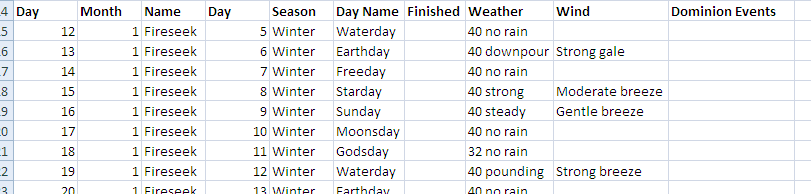
For each campaign world year, I build a calendar for the entire year in a spreadsheet - a row for each day.   Next step is to calculate weather for each day of the year; I use the probable home base or general sandbox location for the locus.  There's an excellent article in Dragon 137 (Weathering the Storms) that provides simple formulae and weather patterns for a range of climates based on terrain and latitude.  I find they're detailed enough for fantasy gaming and the formulas are easy to plug into Excel for calculating daily weather month by month - they provide temperature, precipitation, and wind.

Next up, I bust out the D&D Rules Cyclopedia to generate the chance for various annual Domain events (and then randomize the month and day for the occurrence).  The domain tables provide a mix of natural events and intrigue; they were originally printed in the D&D Companion book.

You end up with a schedule of weather and events for the sandbox area for the next calendar year, and a handy tool for marking the passage of time.  Will it take 3 weeks to copy that scroll back in town?  Then you know it will be day X and month Y when adventuring resumes; you'll be able to quickly describe the weather and set the tone.  The calendar is a handy tool for marking key notes right on the print out - here is the day so-and-so died, this is when we started the new delve, etc.  The ongoing benefits are excellent.

The standard Greyhawk calendar has some built-in holidays and feast weeks; I add some local holidays to the mix as well; for instance, the King of Keoland requires that all the vassal states like Sterich celebrate the founding of Keoland.

The last thing I do as we roll into a new calendar year is have the players advance their character ages one year.  I'm not interested in tracking individual birthdays for disposable PCs, so advancing everyone's character age at the same time is simple.  Since Gothic Greyhawk is using LL and the Advanced Edition Companion these days, we're using the AD&D 1E age tables via the AEC.

Here's a quick snapshot from the current spreadsheet; the campaign recently crossed into year cy577 in Greyhawk terms, so it's basically January.  Sterich is around the 35° latitutde area, giving it a warm climate with dry winters; January (Fireseek) is the wettest winter month.  A good rule of thumb is to drop the temperature 5° every 1,000 feet for altitude, so Barovia (at 8,000 feet - similar to Nederland in my old home area of Boulder, Co) is closer to 10° and snowing when the calendar indicates 40° and rain for the lowlands.


Once you've got the spreadsheet formulas built, it's simple to generate a new year's worth of weather and events.  My calendars see heavy use in the ongoing campaign; like a good map, I get significantly more out of it than what I put in.

Sunday, August 28, 2011

The Secret Door Tell


I don’t like blocked text.
I prefer really sparse descriptions for room text.
Just let me improvise.

These seem to be common refrains out here on the interwebs.  I don't mind improvising adventures, characters, plots, but I struggle with improvising dungeons well.  For instance, take the ubiquitous secret door:

The room is mostly empty, except for a door directly across from the way you entered.  Unlike the last empty room you entered, this one has a torch sconce on the right hand wall.

The map indicates there's a secret door in the room - I see that, and need to decide whether there's a tricky way to get it to open.  How often do you quickly improvise a unique way to open the secret door, and then introduce that element into your room description at the table?  Or do you just describe it as an empty room, and if the players happen to search the right-hand wall and find the secret door, their roll to find it includes finding the way to open it?  Or do they have to mess with the sconce?

If you add a clever way to open each secret door (like the moose head on the wall, or the sconce) you just telegraphed to the players to fiddle with the moose head.  If you just rely on a secret door roll... yawn.  Might as well play 3x or 4E and use spot checks.  Ostensibly, the paradigm of old school play shifts these types of problems to player skill, but that requires detailed DM descriptions to allow the players to push knobs and levers in the environment.

I'm finding that detailed room descriptions with lots of things to interact are the exact opposite of ultra sparse descriptors- and 33% of the dungeon are empty rooms.  There's an appeal to sparse dungeon keys and stripped down maps that requires a lot of DM improvisation.  My favorite old school experiences have been when the rooms are detailed enough that even empty rooms have something interesting to do in them, and this avoids telegraphing hidden treasures and secret doors.  I'm using secret doors as an easy example, but is really just the start of a larger conversation about improvisation versus pre-scripted content, and the level of detail (or lack thereof) in the two styles.

At this point, I'm just looking for recommendations from fellow DMs - how do you handle empty rooms, dungeon dressing, secret doors and sparse details in your own games?  I'll consider rephrasing this as a poll, later, but am interested in hearing how folks handle improvising the minutia.  I've seen some random tables on dungeon dressing and secret doors but would love to get shout outs to your favorites.  And empty rooms and empty hexes might as well be interchangeable.

If this were a poll, these are the types of answers I might foresee:

a. I develop some notes for empty rooms, traps and secret doors ahead of time (random tables or not).
b. I generate details during the game with tables.
c. I Improvise details for empty rooms and secret doors on the spot .
d. Empty rooms are empty rooms and secret doors are found with a die roll.

Wednesday, August 24, 2011

Your Villain is Suck - Part 2

A continuation of yesterday's piece on presenting better villains in your game sessions.

A recap of the problem:  When the DM is preparing an adventure site, they probably spend the most time developing the boss villain (if there is one) and laying out a bit of back story and motivation.  The DM would like the villain to be memorable; role playing games build shared stories.  But the typical boss villain only shows up at the end of an adventure, a nanosecond before the party unloads on him with everything they've got.

Familiarity breeds contempt.  We still want the party to unload on the villain, but the goal is to give the party enough familiarity with the villain that they cheer about it after they grease him.  It sounds really simple, but the party needs to know about the villain before they can feel contempt.  The goal of these techniques around presenting better villains is targeted at getting the players information.

Yesterday focused on some 1st person techniques to building out a villain's profile:
  • Finding evidence of villainous acts
  • Encounters with henchmen and name droppers
  • Rumors and stories told by bystanders
  • Targeting the characters personally by the villain
  • Direct confrontations between the party and the big-bad
Today we'll dig into the writer's bag of tricks and pull out some techniques that work well in film and literature, where there's a bit more creativity in terms of the narrative.  A DM is a storyteller, performer, and a bit of a writer, too.  Here we go.

Third-Person Techniques
In movies and books, the protagonist may not encounter the villain until late in the story, but the audience is already very familiar with them.  Through 3rd person story telling, we get to see all the horrible things the villain is doing along the way.  In Silence of the Lambs, we watch transfixed as Buffalo Bill kidnaps his victims, and then later when he lowers the basket into the pit - "It will rub the lotion into it's skin…"  The audience usually knows more about the villain's activities than the protagonist, and the audience feels the most satisfaction when the villain finally gets crushed.  As game masters, we can use similar techniques when running our D&D games by using 3rd person "cut scenes" to tease, foreshadow, and flashback in a way similar to movies and books.  Here is an example, picking up with the 'Bargle the Infamous' storyline from yesterday.

Early in the game, the players learn that a nearby farmstead is a smoking ruin, the latest target in the nightly attacks… they investigate.  After exploring the charred homestead, they conclude that orcs attacked the farm in the night; there are clear tracks leading into the foothills.  The DM decides this is a good time for a cut scene to reveal a little more background about what's going on, and to introduce the villain.  Here's how he might present it as a flashback:

Here is some extra information for you as players.  Remember that your characters in the game world didn't actually see it.  The night before, you see orcs come pouring out of the nearby woods, spears in hand, jumping the fences and overrunning the farm.  The entire family of Yeoman Aiden is quickly seized, gagged, and dragged off into the night.  As the last orcs retreat from the farm, you can see a shape floating in the air nearby, silhouetted against the night sky.  The figure looks like a wizard riding on a square of cloth - a magic carpet.  The wizard casually flicks a slender wand at the farm house, and it explodes into flame.  "If only those pathetic humans knew what I have in store for them in my dungeons, they would have pleaded for a merciful death.  Muhaha."  And the scene ends with the magic user banking sharply on the carpet, and catching up to his retreating war band.

What did this accomplish?  The players now know the villain behind the farmhouse raids is a magic user that leads the orcs; he has a vicious wand of fire balls; whatever the wizard is doing with the captured farmers, it’s a face worse than death.

In this case, this scene isn't necessary, it's just dramatic.  A sharp group might ask questions about the nature of the fire at the farm, and discover through player skill that it appears blasted by magical fire.  Inquiries in town would turn up rumors about the town's black sheep, Bargle, who swore to return some day and have his revenge on the peasants that exiled him years earlier.  The players may even learn how Bargle killed the village's favorite daughter, Aleena.

I would recommend keeping cut scenes short and to the point and choose carefully what to reveal.  They're good at heightening the drama or foreshadowing.  Here's another example - Bargle is taking townspeople back to his dungeon, dipping them in alchemical vats, and pulling them out transformed into orcs.  That sequence would be an excellent cut scene to portray later.  It demonstrates Bargle's depravity.  It increases the player's anxiety and creates a sense of urgency - especially if someone they know from the village is in a dungeon cell waiting to be dipped.  On the other hand, if you're an Evil DM, that might be the kind of "reveal" you want to save until later, after they've killed most of the orcs and realized they just slew a bunch of innocent transformed townspeople.  Muhaha.

It's been interesting to see people get out there and declare elements of their DM styles the past few days.  I run a player-driven sandbox, but I'm not above including cut scenes from time to time for drama.  3rd party scenes blur the line between player-driven and "telling the DM's story", so it's worth a warning - they're best used to present additional information after players have already made a choice of direction.  When you pull these types of techniques out of the toolbox, do so with care.

Examples from Recent Play
I've used techniques from yesterday's post and today's post recently in my current campaign, so here are some illustrative examples on developing a villain's relationship with the player to maximize the hostility.  My group has been exploring Castle Ravenloft and had numerous encounters with the big boss vampire, Strahd Von Zarovitch; they really started to dislike him.  In fact, I would say they earnestly sought his destruction; they looked forward to terminating him with the extreme prejudice.

The evidence of Strahd's depredations were everywhere in the village, and they learned more about his atrocities from those few villagers that were still alive.  In their first encounter, Strahd mocked them from a safe distance while commanding dire wolves to attack.  At another point, they had formed an alliance with the mayor's daughter Ireena, and Strahd reanimated the corpse of the dead mayor to attack them with her own dead father.  Later, he was unhappy they were staying at the mayor's mansion, so he fireballed it.  He summoned an earth elemental to smash the burning mansion to splinters and then stomp on the characters.  If the characters had any cornflakes, Strahd would have tried to pee in them.  They had lots and lots of direct and indirect face time with the vampire lord.

I also introduced a 3rd person cut scene.  In an encounter, Strahd polymorphed one of the clerics into a field mouse while the party was out in a large field, changed himself into an owl, caught the mouse running around out in the field, and carried the transformed cleric off to a high tower of the castle for some quality time - Reservoir Dogs style.  The cut scene involved Strahd interrogating the hapless cleric regarding the location of the item Strahd was seeking.  The scene ended with Strahd coldly draining all the guy's life and discarding the empty husk.  It was awesome!  The cut scene didn't tell them anything they didn't know already except that he just wasted their cleric and laughed about it.  "That's it, we've got to go kill this mother-frackin vampire tomorrow."  Mission accomplished.

Ravenloft is an easy adventure for applying this treatment because Strahd is such a multi-dimensional threat, but I use the same techniques with most adventures where there's an underdeveloped villain that needs a little help to cross over into being truly hated and despised.

Would love to hear some comments and reactions, especially if other folks use literary techniques like cut scenes or foreshadowing in their games (or, you know, maybe I'm too much of a hippy LARPer thespian type and should add the drama club badge to my DM profile).

Tuesday, August 23, 2011

Your Villain is Suck


The blogosphere's "Better DM challenge" got me thinking of other things I do at the table that I don’t see mentioned very often; the next few days I'll have some more posts on game mastering advice, starting with a two part piece on improving your villains.

First - has the following situation happened to you?  All of the minions and lesser challenges you built into your dungeon were placed there by the mastermind of the dungeon - we'll call him Bargle the Infamous.  Your group finally busts in on Bargle's lab, and he begins with his annoying monologue.  "So, you are the purile peons that killed my clever kobolds, ostracized my onslaught of orcs, and bumbled through my brace of brazen bugbears, and blah blah blah…"  About halfway through this ridiculous speech, the group decides to unload magic missiles on poor Bargle, quickly loot his corpse, and move on to the next room.  Done and done.

You were thinking this was the big climactic showdown with your favorite villain; you needed him to blabber on about his plots and plans so this final battle would seem meaningful, but the group wasted him without a second thought.  I'm here to help!  Today and tomorrow, I'll highlight some techniques for presenting better villains at the table, followed by some example at how they've worked in my own campaigns.  These techniques are battle-tested, Beedo-approved.

The Problem:  Lack of Relationship
The issue with the Bargle encounter described above is that the group has no pre-existing relationship with Bargle before they bust in on his laboratory.  He's just another meat-bag full of XP waiting to be scored.  There are some villains that are so overpowering and intimidating (like running into a Lich!) that they need no foreshadowing or build up - their very appearance will make the fight epic.  For everyone else, you need to lay the groundwork.

Published adventures are littered with weak villains - if you run them straight up.  Let's look at a classic: T1, The Village of Hommlet.  The main villain is supposedly Lareth the Beautiful, the dark hope of Chaotic Evil.  More like the dark hope of Chaotic Suck.  The first time he shows up is in the last room of the dungeon, about 3 seconds before the players kick his ass, steal his magic armor, and loot his sanctuary - "Drinks at the Welcome Wench are on me fellas!".  The Slave Lords, Drelzna of Tsojcanth, the priest of the Shrine of Evil Chaos, Eclavdra the drow - the classics are full of intricate villains that show up just in time to die.   You may wonder why they even bothered with back stories for these chumps.

If the players don't have any prior exposure to the villain, there's very little emotional triumph when the villain is defeated, and all those notes on the villain's back story are wasted ink.  There needs to be a degree of knowledge, familiarity, and relationship between the players and the villain.  Understand - they'll still kick his ass and loot the corpse and roll the body in a ditch, but at least they'll cheer about it, first.

First-Person Techniques
It sounds really simple, and it is: the players need to know who the villain is before the final confrontation.  If you're a first person purist - meaning the only information the players know about the game world is what they see and hear directly - then you need to have opportunities for the characters to encounter the villain's handiwork along the way.

Let's go back and use Bargle the Infamous again.  Bargle's humanoids are raiding the countryside, attacking farms.  The PCs get involved.  What are different 1st person ways to introduce knowledge about Bargle to the players, long before their characters meet him?

Perhaps the humanoids all wear uniforms or symbols that reference their new master, Bargle.  "You can kill us, but wait until Bargle hears about it - you'll be dead!", gloats the dying orc.  Escaped prisoners back in town tell stories about Bargle, the terrible wizard of the dungeon.  "He was going to cook me for his gnolls, it's a wonder I was able to escape".  The escaped towns person can describe Bargle's appearance and maniacal laughter.  Bargle's legend begins to grow.

To avenge Aleena, Bargle must die
Let us not forget, a dear friend of everyone who played the Mentzer tutorial, Aleena the cute NPC Cleric, was cut down by Bargle; an entire generation of Mentzer red box players grew up looking forward to the day they took down Bargle*.  Aleena's father, head of the local church, meets the PC's and shares his story.

As the player characters clear the levels, Bargle learns about them with his crystal ball and takes a personal interest in seeing them die.  Special ambushes are set, and the group recovers written instructions from Bargle to one of his humanoid commanders - it's clear to the PC's Bargle can describe their appearances perfectly.  Now that he's gunning for them, they have even more reason to go stomp him.

Ideally, you can maneuver Bargle to confront the players personally, at least once, before they confront him in his hiding place.  Perhaps he sneaks into town, attacks them from afar, and escapes invisibly.  A well-prepared magic user like Bargle should be able to show up, give the party a bloody nose (or worse), laugh and gloat at a little, and have plenty of tricks to escape.

The risk with a direct confrontation is that players are crafty and unpredictable, and you need to be prepared for them to think outside the box and kill your villain on the spot.  Don't get sucked into the trap of fudging the dice or changing the results if the players get lucky.  If they killed him, he's dead.  Don't have some preconceived notion of a final confrontation; you're not writing a novel.  You stuck the villain out there, DM, live with the consequences - time to move on.

But here's the overarching message - writing a dungeon or prepping a published adventure is only the first step towards running it.  Spend some time thinking about how the forces in the dungeon will interact with the outside world, and if there's a villain or guiding force behind the dungeon, how that villain will react to adventurers invading the dungeon.  Active resistance will make it harder on the players, and it will also give you these opportunities to directly foreshadow the final villain and let the players get a firsthand experience of the villain.  Ignore the fact that the dungeon key places the big bad guy in room 61 or whatever.  The moment the game starts, it's your world, so run the villain like an active opponent following through on his own goals and making his own moves.  You'll have more fun running the game, and your game will be better for it.

Ok - that wraps for today; tomorrow I'll look at using some indirect, 3rd person techniques to develop an interesting villain.  See you then.

*Bargle's Story - Bargle was a lowly 3rd level magic-user in the Mentzer D&D boxed set, but by the time the Grand Duchy of Karameikos rolled around, he was promoted to being a15th level wizard, and the court magician of the vile Black Eagle Baron.  He was a major villain in any Karameikos campaign, and led an organization of criminals and slavers called The Iron Ring.

While Aleena died in the tutorial adventure, it helps to have connections.  Her father uncle was the Patriarch of Threshold, a 9th level cleric, and she must have been raised from the dead, seeing as she too resurfaced in The Grand Duchy Gazetteer.

There have been 'Kill Bargle' adventures in Dungeon, and Aleena has a cult following to this day...

Monday, August 22, 2011

Badges!


Stuart over at Strange Magic had a pretty cool idea regarding game master styles - having a set of easy to reference badges that lets you know, at a glance, some notes about someone's game mastering style.  Do you make up rulings on the fly and improvise most of your encounters, or run scripted adventures?  Do you fudge dice when the whole party is going to die, or let the chips fall, even if it derails the adventure and wrecks your campaign?  Interesting stuff.  Quick caveat though - let's hold off on the value judgments - there are many ways to run a game, they're just not all the right styles for me.


Beedo's Badges
I picked Scary Stories, Death Happens, Don't Fudge Dice, By the Book, Exploration, Pre-made Content

I don't believe in fudging dice to guide the story, and death happens; for instance, we lost three player characters last night because they failed their saving throws against a banshee scream.

I don't believe in making up madcap rules on the fly, and try to be By The Book - I require resource management, encumbrance, light, all that stuff; however, we do have a set of pre-agreed House Rules that are considered part of The Book.

I try to give all of the adventures I run a horror twist, and heavily favor exploration themes.  I prefer to run pre-made content and use a small amount of improvisation to enhance it.

Saturday, August 20, 2011

Organizing the Tools and Techniques of the DM


DMing is more art than science, and the DM is the one role that can make or break the quality of the game.  A bad player can hurt a session, but there are techniques for managing bad players; the campaign doesn't stand a chance with a poor DM.

It's interesting seeing the "Build a Better DM" challenge get rolling, to see how many comments have focused exclusively on writing.  I could argue writing is the least important skill the DM needs to have; at best it covers a quarter of the skill set.

The DM is a storyteller, a performer, a writer, and an information architect.  You can have shortcomings in one area and still be a good DM, but a great DM needs to operate on 4 cylinders.  As I see folks respond to the Hill Canton's challenge, I mentally slide their techniques into one of these buckets.  To facilitate the dialogue, here is what I mean by them:

Storyteller
The most fundamental DM job is telling a story.  I don't mean guiding players through a plotted novel; I mean the constant task of description and Socratic back-and-forth of asking and answering questions, by and for the players, reveals the DM's world, and this flow of information is storytelling.

I mentioned yesterday the technique of not front-loading your descriptions too much.  Sparse initial descriptions are a lead-in to the DM's Socratic method; they build tension, require the players to ask questions to elicit more details, and quickly engages players in the environment,  As opposed to putting them to sleep with a wall of text (or speech).  You're not a f___ing writer.

(Seeing what I'm doing there?  Because you are a f___ing writer, you're just not a f___ing writer when you're actually at the table, presenting the game world.  Ha ha - just cracking me up at 3am).

Performer
The DM is portraying characters using the spoken word; it's impossible not to compare the act of portraying NPCs to theater on some level.  Whether it's memorizing a villain's key lines or delivering an outline, using a funny voice or accent, incarnating the physicality of a character at the table, or a similar technique, the DM is a performer.  Basic techniques of performance can help the DM.

I mentioned "NPC backstories are irrelevant" - focus on NPC behavior that would be relevant in a single-serving scene.  Uncle Dark rightly pointed out that a backstory might be necessary to get to the point that you know how that characters would behave "on stage", and that's a fair point; just remember that your psych profile you write that would make Stephen King proud isn't useful for portraying that character unless you can make it immediately demonstrable at the table.

I also put in a technique yesterday about 'never fudging the dice', and specifically called out the technique of using random results, no matter how gonzo, and working them into the story - as a technique.  I've done some improv theater, and my wife continues to perform and direct it; if you're not familar with the discipline, most improv involves getting an audience suggestion, and then the acting troupe quickly assembles scenes around the theme of the suggestion, sans script.  Random tables are the DM's "audience suggestion".  What's interesting about the use of random tables is that it crosses disciplines; if you use random tables ahead of the session, perhaps it challenges you as a writer, as a kind of brainstorming technique; using them during the session they are assuredly tools of performance and storytelling.

Writer
The DM is a writer, and ultimately needs to develop all the characters and situations that populate the game world; techniques of the writer apply.  My sense is this area will see the most development on the blogs - techniques like heightening the tension, Chekhov's gun, filing off the serial numbers, and foreshadowing; if not I'll get some blurbs out (eventually).

Information Architect
It seems to me it gets overlooked that the DM also needs to be an information architect.  It's great to generate ideas about the game world and write a dissertation length essay on a given adventure, but can it be ran effectively at the table?  Many published modules are an unwieldy mess because of boxed text or wordy descriptions that bury key information about a given story element, and they fail the test of usability at the table.

I gave advice yesterday about using a game calendar to track the passage of time, weather, and campaign events; it's a technique for structuring information for use and accessibility.

When we talk about site-based adventures, hex crawls, sandboxes, keyed maps, writing key elements right on the map, using sparse descriptions and improvising the rest, eliminating boxed text, using highlights or crib notes, random tables, NPC index cards, and so on, it's all about structuring the information needed to perform the game world; it falls into this DMing discipline of information architecture.

At the bottom of yesterday's post, I put a few placeholders on techniques to discuss, that I'll come back to in the next day or so.  In the meantime, if you come across techniques that other DM's are posting as part of the Hill Canton's challenge, consider which of these four disciplines are influenced by that technique; it's a valuable exercise.

Friday, August 19, 2011

Building the Better GM


The game is afoot.  Hill Cantons has started the "Building a Better GM Challenge", and bloggers are answering the call.  It’s going to be hard to stop at just 3 techniques.

Of course, I'd really love to hear what techniques work from some of the old time great Dungeon Masters in the hobby, so it would be awesome if folks that have rememberances of gaming with Gary or Dave Arneson, or really any of the folks from the game's storied past, could share some observances.

Thats not to say there aren't going to be newer techniques from more recent games that have a place - I have a whole list of "new school techniques that I like to use, but I'll start with some basics.

Make a Calendar
A calendar implies that you're marking the passage of time - turns, hours, days, weeks, months.  You're tracking climate, the weather.  On the macro level, have future events happening in the larger world that are tied to the calendar.  During July, the border skirmish between Kingdom A and Kingdom B will erupt in war.  Nothing adds some basic verisimilitude to the world like a calendar and a list of potential upcoming events and weather; the list is very easy to generate in advance.  It's huge when sandboxing.

Use a Progressive Descriptive Technique
"In the room is a book case, with a number of shelves and volumes, and a large desk in the corner."  Keep initial descriptions brief so the players can direct their own attention, instead of front-loading the exposition.  Hold back the fact that the desk is a large roll-top Victorian style, locked, with initials "AS" carved in the front of the drawer - that's second level stuff that's important when they go and investigate it closer.

Never Fudge the Dice
Use lots of random tables and accept the results specifically to spur creativity.  Instead of making the wandering encounter in the Orc Woods have to be orcs, isn't it more interesting to use a random result (Halflings!) and then have to quickly improvise why the group is encountering Halflings in the Orc Woods?

NPC Back Stories are Irrelevant
Instead of writing about NPC back stories, jot down or two quick things about their appearance, manner of speech, physicality at the table, or favorite sayings.  NPCs need to "tell their story" in single servings.  Example:  you could write up a long boring back story about the abused tavern wench that's 99% likely never going to come up, or you could just write in her NPC description - 'look down at the table when this character speaks, don't make eye contact with any of the players' and suddenly you have a much more interesting NPC.  Everyone's wondering what's wrong with her?

Edit:
Just a few I want to track, perhaps put in a part 2 in case another blogger doesn't pick them up:

  • Zak's 'Show don't Tell Rule'
  • When the action slows down, men with guns burst in the door
  • Advice on how to run someone else's published work at your table
    • Despite what some folks might imply, you can be a good DM without creating everything from scratch
  • Valuable stuff from the old school primer
    • The ming vase, the donner party, the moose head, abstract combat fu
  • And some controversial new schoolisms:
    • Better villains with cut scenes
    • Giving players some 'narrative control' from time to time


 -

Sunday, May 29, 2011

Running a Better Sandbox Game


As a bit of a PSA, and because most folks probably scan my blog through a reader and don't bother to read comments, I'm going to repost something Matt Finch said the other day in response to the "megadungeon monotony" post.

There are tons of house rules, class variants, new monsters, etc, littering OSR blogs (two thumbs pointing to this guy - just as guilty).  Tons of resources on building a sandbox, too. But keeping a sandbox game going, keeping it interesting?  Yep, not so much - that's why I thought a note with solid practical advice on *running* the game is worth a special shout.


It is absolutely key that a megadungeon has distinct areas -- and I mean distinct enough that the players can make the distinction based on play, not that the DM happens to know that there's a greater chance of giant rats there. Not only that, but the distinctions need to be meaningful. This allows players the ability to make a decision about where to go in the dungeon. Without that, it is a fungible, undifferentiated, who-cares landscape.


It's incumbent on the DM to either create a dungeon where future missions can be perceived and planned, or to provide some missions the players might choose. Blind exploration gets old if not leavened with some purposeful expeditions that have planning behind them.


Upshot of both those points is that players have to be given meaningful choices and the ability to pre-plan at least some of their activity. 


The major potential failing of a megadungeon is not to realize that pre-planning and preparation are fun and integral to the player experience, and a megadungeon risks removing this aspect of the game if it doesn't provide information. Information flow and discoveries are critical components of a megadungeon campaign, or else there is no meaning behind player choices. Might as well flip a coin about our equipment, spell, and direction choices? Not fun.
--Matt


Saturday, May 28, 2011

Megadungeon Monotony


What are we going to do tonight, Brain?
The same thing we do every night, Pinky...

The same thing we do every night...
I've run a couple of megadungeon campaigns and a few sandboxes.  One thing I've noticed with a pure player-driven exploration game, is that it can become repetitive if you're not careful.  Making clever themes and stories for the levels and sub-levels in the megadungeon only takes you so far; there are more elements to the campaign than exploration and it can require some special effort by the DM when running a megadungeon.

Show of hands, how many folks have run a 6-month megadungeon (or longer) - and how did *you* keep it fresh and interesting?

Here are some of my techniques, would love to hear other observations, so see you in the comments.

Quests
Vary up the exploration by providing goals within the megadungeon.  Examples could include seeking a set piece location the group has heard about through rumors (like finding the famous fountain of snakes), or it could be a quest from a patron - the princess was captured by bandits and carried off to level 3, find her for a reward.

NPC Rivals
I like having multiple NPC groups involved and returning to the same town as the PC's.  It creates situations with bragging rights, spying, trying to steal each other's maps, and possibly a team-up.

Campaign Events
Just because the game is focused on a single (extensive) location, there are still things going on in the rest of the world that could draw attention, or give the players a reason to leave and come back.  (I've been putting together a list of campaign events for the Black City that will go up some time soon).

Active Resistance & Restocking
As the group clears areas, make the survivors change their tactics and get ready for fresh incursions.  New traps are set, areas are fortified or vacated, other monsters might start hearing about the PC's and know them by reputation.

Conversely, there should be a good campaign reason why the place is full of monsters in the first place.  Because of that, more should be arriving all the time, and cleared areas will get new inhabitants.

Tuesday, February 1, 2011

Winter is Coming… and so is Gamer A.D.D.

HBO's Eddard Stark - coming to a game near you?
A few months ago Mrs Beedo decided to switch back to Comcast to save some $$$, and part of the deal was a couple free years of HBO.  :yawn:  And then I see that "A Game of Thrones" will be on HBO in a few short months, and suddenly I am wide awake and paying all sorts of attention.  Winter is Coming, as the tagline says.

And then the dread sets in… you see, I suffer from the G.A.D.D.  - Gamer Attention Deficit Disorder.

Maybe you have the symptoms yourself; you see the "Lord of the Rings" movies, and use your old campaign world to start the fireplace and begin sketching out a faux-Middle Earth for D&D.   You read the "Dark Tower / Gunslinger" comics, and you're thinking what a great mash-up it would be for D&D and Mutant Future or Gamma World.  If only my players suffered a TPK...  Maybe "Spartacus: Blood and Sand" had you thinking about getting that ancient world setting rolling along - or maybe a Hollow World setting.

And now this… "A Game of Thrones".  I'm hoping I've built in enough realpolitik murderous yet killable rulers into Gothic Greyhawk so that when I (inevitably) get caught up in the wonderful carnage and violence of Westeros, I'll be able to scratch the power politics itch without getting all loopy and working on yet another setting (The Black City will be keeping me plenty busy).

I'm calling it the mitigation theory of Gamer ADD - you can' t stop it, so try to contain the damage by lessening the impact when the new shiny idea pops into the brain.  "Squirrel!"  What was I saying?

Following classic risk management strategy, here are some other ideas for controlling your own G.A.D.D. problems:

Mitigation:  You can't stop reading things or watching movies, so new themes *will* pop into your head;  try to incorporate them into your existing campaign and compartmentalize the damage.

Acceptance:  Face it, you can't stick with a campaign, and when a strong new idea comes along, BLAMMO - back to the drawing board.  How many blogs do we see where projects are blown up by newer, better ideas?  Oh the humanity.

Avoidance:  Is it possible to prevent gamer ADD by only reading, watching, and seeing things that reinforce the themes of the game your running or developing?  Hmmm.

Transference:  Let someone else do the work.  Do yourself a favor and get the Green Ronin version of "A Game of Thrones" and run a one-shot or mini-adventure; when "The Hobbit" movie eventually comes out, play in your buddy's Mirkwood game and leave your Sword & Sorcery setting out of it.

How do you deal with your Gamer ADD issues?

Sunday, January 23, 2011

X is for Killing

Musings on freedom in the sandbox

I have a bit of a confession to make - I used to be a story-focused Game Master.  (We used to play 4E, too, but that's another confession.)  I spent most of the 90's and early 2000's running games for systems like Vampire The Masquerade, super hero systems like Mutants & Masterminds, and horror games like Call of Cthulhu.

What does a story DM do?  He makes up lots of interesting characters, develops an over-arching plot, and lets the players take on the role of characters in the DM's story.  At its best, everyone comes together and tells an epic and memorable story; at its worst, the players feel like their choices don't matter too much - a fixed ending is never in doubt.

The players in the current campaign are still talking about last week's game, and the zombie apocalypse they unleashed on southwest Sterich.  "How could the DM let that happen?", they wonder.  "All those NPCs we've met and befriended in places like Mittleberg, Poignard, and Beggar's Tomb Mine are all dead…"*

This is how I've come to love the sandbox and let go of the story.  No one knows how it's going to turn out.  Various NPCs in the world still have their own goals and agendas, and if left alone, they'll do what they can to move their agendas forward.  For instance, Lord Lennox of Mittleberg was preparing for war in the spring, to punish the pagan mountain folk for beheading a church missionary.  One of the characters, Phat Kobra, was knighted, and expected to be in the vanguard of Lord Lennox's expeditionary force.  Everyone was planning for the war.

Funny how 13,000 hungry undead swarming down the mountain can generate a change of plans.

Which brings me to my new sandbox mantra, X is for Killing.  I saw this list over on Il Male's blog; it made me laugh, and reinforced the direction my campaign is taking: 
  • Gods are for killing;
  • Clerics worship gods, therefore are for killing;
  • If it's not human is for killing;
  • If it's human but a little weird, it's probably for killing;
  • Magic-users are for killing 99.9% of times;
  • Dinosaurs are either to ride or for killing;
  • ...and so on.
What a wonderful set of principles.  No one is safe.  There are no Mary Sue's.  No one has plot immunity.   If the players don't stop the Shadow Demon attacks (Blood Moon Rising) in time, the entire village could be wiped out.  Half of Poignard *was* wiped out, in fact.  If the players awaken the dreaming dead (Death Frost Doom), the world will never be the same.

Nothing is written, no outcome is foreordained.  No one knows how it's going to end, least of all the DM.  Whatever story is there, will emerge or change from the choice and intervention of the players.

I loved the moment in our game last night, where the players gazed over the hex map with all its potential freedom and wondered… "We've just destroyed our world.  Where do we go from here?"


Anywhere you want, fellas, anywhere you want.


*Note:  It's not clear that all the settlements in the valley were destroyed, since the players went the opposite direction into the mountains.  I'll need to wait until they return to that part of the world to reveal what happened.