Showing posts with label Monsters. Show all posts

Sunday, September 24, 2023

The Strigoi - Vampire Alternative for LOTFP

Zombies?  Nope - vampires!  The Strain.

To quote my teenage daughter, I've become "low-key obsessed" with Guillermo Del Toro's The Strain.  I binge watched the four season TV series on Hulu, and am working my way through the source novels (I'm on Book 2).  The novels were written with the help of Chuck Hogan, a spy novel author, and so they read like page turner thrillers with a horror twist.  The TV series presents a squirmy, gruesome re-envisioning of the vampire myth with plenty of visceral body horror.  It's a perfect take on vampires for your LOTFP game, and in time for Halloween if you're looking for some horror reading or viewing.

The books have been out since 2009 and the series came to TV in 2014, so I'm not spoiling any ground-breaking new show as I discus the general plot.  Be warned, some discussion of the plot will follow.  The series starts with the arrival of a dead airplane landing in JFK Airport, a 21st century re-imagination of The Demeter crashing into Whitby along the English coast.  In The Strain, the 200+ dead passengers on the airplane are infected with vampirism, going through a biological transformation while their bodies are sent to various morgues around the city.  They awaken at night and wander off to infect their loved ones and passersby, and suddenly a vampire plague begins to quickly spread across the Five Boroughs.

New York is honeycombed with subways and transit tunnels that give the vampires places to hide during the day, and the plot features wealthy opportunistic "human familiars" teaming up with the vampire lord, The Master, by spreading misinformation and slowing down the response of government agencies.  Instead of an apocalyptic zombie plague, New York faces a vampire plague, which spreads beyond the city, and the series eventually goes full-on apocalyptic, with nuclear winter providing safety from UV radiation for a dystopian future ruled by the vampires.  It's bonkers.

The Strain upends the glamor that has claimed hold of the vampire myth - there are no sparkling, handsome or beautiful sexy vampires here.  They are victims of a fast-acting, incurable, mutagenic virus, spread by worms, that rewrites their biology to turn them into giant leeches or ticks - they eventually lose their hair, sex organs, and even their nose and ears will wither away.  Instead of fangs, The Strain vampires (called the Strigoi in the series) have a six foot mouth stinger that lashes out and attaches itself to a victim, followed by a slow glug glug glug as it siphons out all of the victim's blood.  Anyone bit by the stinger is infected with the vampire worms, and anyone engaging in combat with the Strigoi risks getting infected if splashed by the vampire's white blood.  There are many moments of body horror in the series as wriggling worms burrow into open wounds or eyeballs to infect a new host.

From the cover of Book 1 The Strain.  It's gruesome.

Classic D&D vampires had that weird problem where they've got the blood-drinking fang equipment, but really what they want to do is touch you in melee and drain life energy levels.  The Strigoi represent a terrifying way to put blood draining vampires back into your game in an action-oriented style that plays well with classic fantasy and D&D style combat.

Strigoi (Munchers - the newly formed)

Unarmored, Move 120'. Hit Dice 1-4. Attack range 6' doing 1-4 damage + specials, Morale 8.  Chaotic.

Newly formed Strigoi start with 1 HD and gain a HD each week they're able to feed.  There are powerful free-willed strigoi (Lieutenants and Ancients) that are significantly more capable than "munchers" - we'll tackle them another time.  Munchers have animal instincts, with an innate desire to return home and feed on their loved ones.  However, they are connected through a hive-mind back to the Master, who can force groups of Munchers to apply tactics or carry out more complicated actions as the situation dictates.  Strigoi have 60' infravision and heightened senses, including hearing - sensitive enough to hear nearby heart-beats.

In melee, the Muncher uses it's 6' stinger attack.  A hit target must save vs paralysis or be helpless while the muncher drains constitution at the rate of 1d6 per round until the target dies.    The stinger is unarmored and can be severed in combat by an ally with an edged weapon attack doing 2 or more points of damage.  Anyone hit by a stinger in combat is infected with capillary worms (see below).

Glug-glug-glug.  This should terrify any D&D character.

Strigoi are vulnerable to silver weapons, and must make a morale check at -2 when confronted with silver weapons and each time they are hit by silver.  They will likewise shun silver mirrors, as such mirrors reveal their true nature (undead and riddled with parasitic worms).  They are destroyed in sunlight.  

Strigoi take half damage from normal weapons due to their mutated biology.  (Alternatively, I suppose you could say any damage roll in the lower half of the damage range is ignored, while a roll in the upper half represents a hit to a vulnerable area like the neck or head - whatever is less fiddly and more fun for your table.  I like the latter.)

Capillary Worms

Each time a Strigoi is killed in melee combat, roll a d6 - on a 1 result, the victor is splashed by Strigoi blood (including the parasitic capillary worms) which seek to burrow into the victim's flesh and cause infection.  Like rot grubs, the victim must immediately apply flame to the worms (1-6 hit points of damage) or a worm burrows into their flesh.  At that point, only a cure disease spell can end the transformation into a Strigoi.  (In the series, modern UV lights can also destroy capillary worms).  Anyone hit by a Strigoi stinger is automatically infected by worms.

The disease weakens the host over a 24 hour period as the capillary worms multiply and overwhelm the victim's system, colonizing the victim's organs and growing the vampiric hinged mouth and throat stringer.  Strigoi have heightened metabolisms and "burn hot" for purposes of infravision, a possible way of detecting them at a distance if your game uses infravision.  The newly formed Strigoi will arise the following evening and return home, seeking to infect their loved ones.

Note:

Although the TV series focuses on a biological, viral explanation for the Strigoi, there are mystical and alchemical elements in both the show and  novels that involve a Judeo-Christian mythological view of the vampires and their origin.  Their history is recounted in a book of esoteric lore called the Occido Lumen.  While the Strigoi disease appears to be a purely biological phenomenon, they are actually a supernatural plague and count as true undead, meaning they can be turned by clerics with a Turn Undead spell or ability.  Munchers are turned as Wights.

Potion of Longevity Ingredient

In the series, 3rd century alchemists created a formula to leverage the capillary worms as a component in a potion of longevity - more to come as I get deeper in the books.

I don't think I'm done with The Strain or the Strigoi yet, as I read further I'll likely provide some stats for the powerful free-willed "Lieutenants" and the terrifying "Master".  It's the Halloween season, after all.

Note:  All the images are from The Strain TV series, subject to copyright, and used here only under fair use as part of a review and discussion of the work.

Sunday, September 3, 2023

Spotlight on ACKS: Where Orcs are Evil

I'm overdue to say something about Alexander Macris's video channel.  Alex is the writer of Adventurer Conqueror King and he's been doing a YouTube channel for several months now where he tackles game theory and being a better referee.  He's got a collegial style and well-articulated positions.  Last week he tackled the question of whether your RPG should have "inherently evil races" (video is posted below).

This question has been around.  It's been a lightning rod in D&D style games since the Keep on the Borderlands introduced tribes of humanoids just up the road from the Keep (and it's usually accompanied by a debate on colonization in gaming).  Over 40 years, designers and authors have granted more sympathetic attributes to the humanoids in their game worlds, prompting Wizards of the Coast to declare there were no longer evil humanoids in modern incarnations of D&D, but rather they would have all alignments like humans - a sort of "Fantasy Star Trek", where through cooperation, inclusivity, diplomacy, and cultural exchange, everyone can find common ground and have a place in the Federatio… er, Forgotten Realms.

At that point, might as well admit James Raggi was right 15 years ago when he dumped fantasy settings for the early modern and said, let's just place adventures in the real world and have complex conflicts with human antagonists without the furry costumes… but that's another game, another post.  Alex is clinging to heroic fantasy with its panoply of sentient races.

Alex offers a workable solution to the question of innately evil races.  An "innately evil race" would be one where coexistence is not possible at all - the evil race represents an existential threat to human civilization.  The example he uses in the video is the xenomorph from the Alien series.  You're either on the side of civilization or you’re siding with the enemy and betraying it.  The scientific term for this unresolvable clash of species is "competitive exclusion theory".

The problem is that humanoid depictions became relatable and too human.  Orcs are a misunderstood culture, like a fantasy version of  Star Trek's violent yet honorable Klingons.  They're no longer Tolkien's implacable forces of destruction and death.  In the movie Return of the King, there's a visceral experience of orc hatred of humanity when the orc commander proclaims, "The age of men is over, the time of the orc has come."  The battle of Minas Tirith is an extinction event - the stakes are victory or the fall of civilization.  In Middle Earth, Fantasy Star Trek is reserved for the humans, elves, dwarves, and hobbits to become kissy-kissy allies and cohabitants.  The spawn of Morgoth (and the orcs) have no place in Eriador.  (And yes, I'm side-stepping any broader discussion of the orcs based on Tolkien's letters or life experiences - here I'm just reacting to the representation in the fiction).

Tapping back into the Trek universe, maybe the Borg are the best example of that existential threat.  Or the Gorn.  In fantasy, something like GRR Martin's White Walkers are a foe with whom there can be no compromise.  But for mainstream fantasy games, 40 years of treating orcs, goblins, and hobgoblins as variant people, has gone too far to reclaim them as an irredeemable enemy.  Were the seeds sown as early as the 1E Monster Manual, with it's complex and naturalistic depiction of humanoid tribal life?

But we will do as we will, in our home games.  Here is the video:


One parting thought - I'm intrigued by the idea that depictions of orc-like monsters and boogeymen in fairy tales and literature may hearken back to some "species-memory" of conflict between homo sapiens and the Neanderthals during the Ice Age.  Instinctual memory sounds like goofy pseudoscience, but it's fun to think about.  It brings to my mind the horrible "Wendol" from the movie The 13th Warrior (Michael Crichton's Eaters of the Dead novel), where the Wendol are a nigh-supernatural force of Neanderthal-like primitives that emerge from remote caves to terrorize Viking villages.  There are no universal translators, parleys, or requests to negotiate anywhere in sight - just battle axes, swords, and a doughty crew of Northmen to hold the line and stand for the survival of mankind.  Along with Antionio Banderas.

Friday, March 20, 2015

Attack on Titan on Taenarum


I just finished binge-watching the Attack on Titan anime series.  I know it's on one of the big streaming services - Hulu or Netflix.  It's a post-apocalyptic series where humanity huddles behind a giant series of concentric walled areas because the outside world has been overrun by "titans".  Titans are gigantic smiling idiots that shamble around the countryside and eat people.  It's a clever variant of the zombie apocalypse genre.  The main characters are a bunch of cadets who join the armed forces to fight the titans, and the extreme violence and presentation reminded me a bit of Starship Troopers.  It's both horrifying and comical watching titans eat people with those idiot smiles on their faces.


I don't think I'll ever look at D&D giants the same way.  Fe Fi Fo Fum, I smell the blood of an englishman!  But D&D giants are only 8 - 12 feet tall (or thereabouts) - not big enough to hold people dangling by their feet and swallow them whole like sardines.  We must go bigger!


In Greek Myth, there are all sorts of primordial beings.  There are the personified great forces of the universe, like Erebos, Nyx, Gaia, Chaos, and Uranus.  There are gods and titans, monsters, and giants.  Gods and titans are pretty much indistinguishable to me.  The Greek gods act like a bunch of petty teenagers with super powers with the titans as their super rivals.  Half the gods and heroes have titans for parents, so there's no dearth of cross-breeding.  I see them a bit like Zelazny's Courts of Amber and Chaos in The Chronicles of Amber - they're reflections of each other, and alignment is all relative.  The one thing the gods are good at is beating up on primordial monsters.

The Giants of Greek myth could be made scary.  They're born of Gaia, one of the primordial beings, and clamber up out of the earth.  They're dangerous enough to fight the gods.  They could be super giant!  In pursuit of that goal, the giants of D&D are herby demoted to "lesser giants", the descendants of those 60' tall primordial giants from the dawn of time.  There's even precedent in Greek myth, since there are the 3 primordial Cyclopes that serve as armorers for the gods, and then a lesser race of degenerate cyclops that live on islands and eat people, like Polyphemus in "The Odyssey".  Giants are now the same way.

One of the themes I'm striving towards in the Taenarum campaign is that all those origin stories in the Greek universe are true and relevant (to a point) in the current age.  The primordial beings are still out there, sleeping and sessile.  All of the titans and monsters trounced by the gods in Hesiod's Theogony, and imprisoned in Tartarus, are all there, guarded in small part by Hades, who acts a bit like hell's jailer.  The road to the underworld is a direct path to the realm of Hades, but it's also a path to Tartarus - and all sorts of malefactors that would like to see the Titans returned to power, or legendary monsters freed from Tartarus, scheme in the depths of the dungeon on how accomplish these ends.

That also means there are ways to awaken the Primordial Giants.  With Attack on Titan firmly in mind, how can I not unleash some 50-60' tall horrors that stride across the countryside like dumb smiling Kaiju and lift the roofs of buildings, scooping out the inhabitants like a child pulling dolls out of a doll house?  This is a thing that must happen in this campaign:


Anyway, back to Attack on Titan.  The anime was great, but there was only one season (25 episodes) so we're off to figure out the best way to keep up with the manga.  My wife would exile me to the couch if I dropped a few hundred dollars on manga back issues, so I'm hoping the library has them, or there's a streaming service to read them online.  Wikipedia mentions a potential live-action movie and the idea that maybe there's a second anime season in the works, so we'll see.


Thursday, January 16, 2014

Harrow Home Bestiary

Here's the start of the Harrow Home bestiary file.  I expect to update this post as I add monsters.  It's starting with coverage for some of the random encounters in the surface ruins.

Acolytes
AC as Leather, MV 12, HD 1, Atk 1, Damage 1-6, ML 7, AL C.  1-8 appearing.  These unholy pilgrims from the far countryside have donned black robes and cowls as they approach Harrow Home, seeking the diabolic shrines in the dungeon depths.  If there's more than four of them, roll a D10 to determine the level of the leader ( 1-4 = 2nd level leader, 5-7 = 3rd level leader, 8-9 = 4th level leader, 10 = fifth level leader).  Any treasure they carry is incidental.

Angry Villagers
AC as Unarmored, MV 12, HD 0, Atk 1, Damage 1-6, ML 5, AL N.  1-20 appearing.  A mob of angry townsfolk here to find a missing villager.   -2 to reaction rolls as they assume anyone near Harrow Home is "with them".

Bandits
AC as Leather, MV 12, HD 1, Atk 1, Damage 1-6, ML 8, AL C.  1-8 appearing.  Bandits near Harrow Home are filling the role of robbers, kidnappers, or grave robbers.  They're happy to rob, kidnap, or kill anyone they run into (if they think they can take them).  They'll have a mix of clubs, crossbows, pistols, and rapiers.

Bandits, Reavers
AC as Leather, MV 12, HD 1 + 1, Atk 1, Damage 1-8, ML 12, AL C.  1-8 appearing.  Reavers are bandits who have joined the Thurman Gang and taken on The Mark of the Beast (a claw-like scar on the chest).  They never check morale and get +2 to hit in combat.  Thurman's Reavers prefer heavy melee weapons - axes, mauls, and archaic swords.

Living Dead
AC as No Armor, MV 6, HD 2, Atk 1, Damage 1-8, ML 12, AL C.  1-8 appearing.  Living dead always attack last in the round.  They are human "zombies" created by subjugating their will through a magical substance, Zombie Powder.  They can't be Turned by clerics and don't have standard undead immunities.

Traders
AC as Leather, MV 12, HD 1, Atk 1, Damage 1-6, ML 7, AL N.  1-8 appearing.  A trader is a merchant guiding a pack mule or horse and wagon; all other members of the group are bodyguards.  Traders represent smugglers and unscrupulous merchants dealing goods to the inhabitants of Harrow Home.  [ I'll need to come up with a typical trade goods table to identify what they might be carrying… ]

Samples Encounters
Encounters with low level humans tend to appear the same on paper - there's not much to differentiate them from a stats perspective.  The trick is to (attempt) to cobble together interesting characters.  Here are some sample encounters from the bestiary list.  (Reavers will be detailed with the first dungeon level).

Sample Acolyte - William Barrett (leader)
Charismatic and striking, "Bloody Bill" was a sea dog decades ago in the time of Drake and the Spanish Armada.  He trades on old war stories.  He wears an eye patch and has a limp.  He uses his personal magnetism to lead groups of naïve followers to Harrow Home to pay homage to Old Scratch with him.  They usually don't leave when he leaves.

Sample Bandits
Ludlowe and Potts, Esquires
Ludlowe is a bully and Potts his sycophantic side kick.  Anyone else with them is rabble looking to get paid for their gruesome labors.  They rob graves and drive a wagon of corpses to sell to the mountebank in the dungeon cellars.  They have improvised weapons and shovels, but Ludlowe owns a pistol.

The Watkins Gang
John Watkins is young and illiterate, but makes up for it in ruthlessness.  He takes commissions from the Thurmans to perform kidnappings around the countryside.  Luckily, other people in the gang can read the descriptions of the marks!  No guns here  - clubs and knives only.

Tim Bodger's Boys
Bodger is a freeloader and prefers easy jobs, ambushes, and shortcuts.  He and his gang tend to drink their earnings away at the first opportunity.  Knives, bows, and Bodger owns a sword.

Sample Traders
Samuel Parsons
Parsons owns the Four Bells Trader, a London shop specializing in strange ingredients and rare imports from the continent.  He enjoys the high premium paid by Harrow Home's masters, and stays in the nicer inns when he travels north.  His bodyguards will be well armed with pistols and muskets, riding horses while Parsons rides on the wagon alongside a driver.

Richard Childs
Slick Dick climbs into the moors from the northern coast, his wagons laden with goods smuggled through places like Whitby or Robin Hood's Bay.  He has the personality of a snake oil salesman and tries to trick or con during encounters.  His merchant sign hanging off his wagon is the Two Black Dogs.

Monday, December 16, 2013

Living Statues are not Golems

It always seemed curious to me that AD&D had the classic Golems - Clay, Flesh, Stone and Iron - whereas the Basic D&D book had lower level creatures called "Living Statues" - Crystal, Iron, and Rock.  I always viewed it as  part of an "AD&D just gets better stuff" syndrome.  However, in the Expert rule book, classic D&D would add variants of the Golem, such as the Wood, Bronze, Bone, and Amber Golems.  Strange that the archetypal Clay Golem or Frankenstein-like Flesh Golem never made it to classic D&D!

However, there are a few key differences between the Living Statues and Golems that make the oversight more nuanced and more interesting - the overlap between the monster types is incomplete.  Regarding Golems:  they have a morale 12, meaning they never check morale, and are unaffected by Sleep, Charm, and Hold spells.  They're also immune to non-magic weapons.  They're firmly in the realm of powerful magic constructs, true automatons - mindless and dedicated to relentlessly following the creator's orders, heedless of personal danger.

The Living Statues have a morale rating of 11.  There's a slim chance that a statue chooses to disengage from combat or retreat - the self preservation instinct implies awareness and a degree of consciousness.  Living Statues are unaffected by Sleep, but they are affected by mind control - Charm and Hold spells work against them - more evidence that a guiding consciousness is present within the construct, differentiating them from their more powerful cousins.

For my campaigns, Living Statues are constructs like Golems, but achievable at lower cost - represented by the weaker combat statistics and fewer magical immunities.  The short cut to creating a Living Statue is imbuing the creation with a degree of will.  Independent thought makes the Living Statues less reliable as guards and servants -they're capable of interpreting commands loosely or abandoning their posts in the interests of self preservation.  The idea of a powerful wizard with a bunch of unreliable stone flunkies is kind of funny.  I suppose that's why Living Statues end up collecting dust in the odd corners of low level dungeons - they have a tendency to forget their mandates or get abandoned for more effective servitors by the high level wizards.  For a pulp fantasy setting, the Living Statue is imbued with the soul of a sentient being or a summoned outsider during creation, allowing some unusual story possibilities.

It does make me wonder if such a theme appeared somewhere in the classic pulps of the early 20th century.  Living Statues seem to be a Tom Moldvay creation; I don’t remember seeing them in Holmes (and please chime in if they went back to OD&D).  Moldvay's bestiary is rife with pulp action monsters, and his power trio of classic D&D adventures - The Isle of Dread, The Lost City, and Castle Amber - borrow ideas heavily from 1930's era weird tales.  They are practically homages to Robert E Howard and Clark Ashton Smith.  (If you're new to the hobby and enjoy weird tales, I highly recommend those adventures).  I have to wonder if the Living Statues are a throwback to the weird tales era that I'm overlooking.

Friday, July 19, 2013

Orcs, Goblins, and Gnolls, Oh My

I've mostly been running some Call of Cthulhu games lately, so the itch to get back to running fantasy is growing.  Plus, it's summer, and the kiddos are out of school - it's high time for another family game!  The two littles are old enough to follow along with a game, and my daughter can read a character sheet now, so they'll be off to THE KEEP ON THE BORDERLANDS* shortly - mom and the three kids.

Here's the thing - kids and Gygaxian Naturalism don't mix.  There will be no orc babies or crying goblin moms in the game, mewling that the adventurers just killed their husbands.  I could have the whole table reduced to tears in short order.  (In fact, there is no crying in Dungeons & Dragons).  Ergo, it's time to whip up some alternate origins for the humanoid races, ones that put them firmly in the realm of monsters, and not as misunderstood, hairy pseudo-people.

Kobolds
The jealous Lord of the Underworld (Hades, Nix, or a similar character) works hard to keep the ways and passages to his gloomy realm hidden from mortals, and the kobolds were created to lure and confuse miners (ie, tommyknockers).  They delight in creating devious traps and laying ambushes, watching from the shadows with their ghostly, dead eyes.  As a Lord of the Dead, Hades is unable to create natural life, and thus the kobolds aren't truly alive - they're golem-like constructs made from children's bones,  rat's blood, and other scavenged materials, stewed in Hade's giant cauldrons.

Orcs
The souls of wicked humans become wriggling larva, squirming in the pit of Hell, but powerful witches (Satanic witches) are able to call them back to the mortal world through their dark pacts.  They grow them in breeding pits into disciplined servants, the orcs.  There is no hope for redemption for any orc; there's only the belief that if they serve well and inflict sufficient pain and suffering on their maker's victims, they'll climb a rung on the ladder when they're cast back down to the pit.

Goblins
Beneath the moldering eaves of the Goblin King's vast forest, putrid gardens spew forth the goblins and their larger cousins, the hobgoblins.  The goblins claw their way up out of the ground, chalk-colored and earthy, with a tuft of leaves on top of their heads to attest to their gestation as a root vegetable.  They're drawn to the woods and forests near human settlements to carry out their favorite diversion, kidnapping human children and carrying them off to wander the Goblin King's gigantic labyrinth beyond the mortal world.

Hobgoblins
Hobgoblins are grown from massive gourds, like pumpkins, and frequently use serrated shields and edged weapons that allude to sharpened leaves, or bulbous armor that calls to mind the contours of a large gourd.  Unlike their smaller brethren, the hobgoblins delight in robbery and banditry, frequently forming armed bands that terrorize lonely sections of roads and trails.  They eventually carry their loot to the Goblin King's vast treasuries, making the crossing each Halloween and vying to be crowned the new hobgoblin king for the next year.

Bugbears
Bugbears are the boogeymen of faerie lore, gangly fairy creepers covered in short, bristlelike fur, peering out of the shadows with their multifaceted eyes and clacking mandibles.  They can climb walls like a spider and contort to fit into near impossible spaces, such as the nook beneath the stairs, the hall closet, or perhaps squeeze down a narrow chimney.  Their insides are filled with bugs and worms and all manner of crawling things that spill out if they're killed.  Their mistress is a cruel and mad faerie lady, covered in spider webs that suggest a veiled wedding dress; she's known to sages only as "the Bride".

Gnolls
When the demonic witch Baba Yaga needed footsoldiers capable of running tirelessly across the steppes, she transformed a mongrel pack of wild dogs into the first gnolls, and taught the first gnoll shamans the dark rituals necessary to consecrate future mongrel litters to Yeenoghu and warp more canines into two-legged gnolls.  Roaming bands of these marauders leave behind death, destruction, and a noticeable lack of dogs.

Ogres
The oldest crime, the oldest prohibition, is against cannibalism, and there is a spirit that sometimes takes root when a man eats the flesh of another man, transforming the forbidden diet into an addiction while changing the transgressor - body, mind, and soul - into a hulking man-eater that lumbers off into the wilderness to indulge its dark passions far from torches, pitchforks, and angry villagers.  Possession by the ogre spirit leads to an immortality, of sorts.

There we have it - my quick set of alternate humanoid descriptions.  I suppose if I'm doing THE KEEP ON THE BORDERLANDS, I should tackle Lizard Men, too.  Hmm, upon rereading, I notice they're not quite as "kid friendly" or whimsical as I would have hoped.  Perhaps I watch too many horror movies to run a kid's D&D game.  But kids are tough, and real fairy tales are pretty scary, right?  They'll be fine, right?


*Gygaxian syntax requires all of his published works to be capitalized.

Tuesday, March 5, 2013

Towards More Interesting Random Encounters


Encounter tables are a fantastic way to define an RPG setting; they're experiential instead of narrative, and serve useful campaign defining purposes both in their creation and use.  They're extremely economical in terms of presenting useful setting information in a compact space.  But they're not without problems.  The traditional wandering monster table requires the DM to improvise an entire encounter right on the spot and there's not much with which to work.  As Brendan pointed out in a previous comment, a result of 8 orcs, range 70', reaction roll: 9, is fairly bland as a starting point.

What can we do to make those encounters more interesting?

My first thought was to have a simple "monster motivational chart".  Imagine you're a simple Ogre named Pigswallow, just trying to make your way in the world.  What motivates Pigswallow to abandon the comforts of lair and den, joining the ranks of wandering monsters everywhere in search of better things, and risking a dangerous encounter with adventurers?

Monster Motivations (roll 2d6)
2 Seeking spiritual or intellectual fulfillment
3 Searching for mates
4 On guard patrol
5 Seeking a shelter
6 Looking for water
7 Looking for food
8 Looking for warmth, comfort
9 Looking for treasure
10 Looking for lost companions
11 Out to prove their worth
12 On a quest for knowledge

It's pretty basic, but you can see that rolling a motivation for Pigswallow (and interpreting through monster psychology) could help with the encounter embellishment.  I rolled a friendly reaction (12) and motivation food (7), and suddenly Pigswallow is magnanimous, since clearly the player characters have brought their rations as offerings to avoid his lordly wrath; a similar roll of 9,9 leads to a somewhat friendly Pigswallow, as long as the characters are willing to pay him to go away, and so forth.  I'm not sure what "spiritual fulfillment" looks like for an Ogre, but it would be fun to improvise.  The table is only there to help with intelligent encounters, although maybe something similar could be built for animal behaviors.

The second problem involves what is the party doing.  There's this false assumption that just because the player's announced a marching order, they spend their entire time in the dungeon in perfect formation, with perfect spacing, never deviating from rank and file, ever ready for anything.  No one ever relieves him or herself, there's no breaks for water, no one drops a piece of equipment, and the lights never go out.  You have carte blanche to roll on a table like the one below any time there's an encounter to see what's really going on with the party at the moment the encounter is detected.  (I posted  a larger version of this table, for wilderness encounters, here:  Too Busy Looking at the Map to Notice the Monster).

What is the Party Doing? (roll 2d6)
2 Changing over a light source
3 Drinking water
4 Mapping
5 Listening
6 Scouting ahead
7 Exploring and alert
8 Talking and walking
9 Walking too close together
10 Someone just tripped and made a loud noise
11 Equipment problem
12 Taking a break

Of course, I think the ideal situation to the wandering monsters is to come up with a few pre-planned encounters for each entry, in advance.  For the Black City, where many of the encounters in the early game were competing explorers, I have 10-12 encounters pre-made to cover bandits, veterans, traders, NPC parties, etc.  It was a fair amount of time invested, but really paid off in play.  Another approach for monsters, particularly ones that wouldn't have motivations represented by the monster table above, would be to come up with a few specific dispositions so each encounter is a little different.

For instance, gjengangers (Norse zombies) are pretty common in the Black City; here's a sample table I could see myself using to determine what the gjengangers are doing whenever their number comes up on the wandering monster table:

Gjenganger activity (roll d6)
1  Shambling toward the player characters. Brains!
2  Lying still like dead bodies on the floor
3  Crawlers, pulling themselves forward by their arms
4  Milling around senselessly until aroused
5  Busy messily eating something else
6  Lurking in a niche or around the nearest corner to lunge out

I'm sure someone out there has done a bang-up job of creating ultimate wandering monster encounter tables, but it's so easy to lose track of the tribal knowledge out there in the wilds - between the blogs, message boards, zines, and other publications.  I'd love to hear about some of your favorite expressions of good encounter tables that you've seen in use.  I'll think about it as well and reply in the comments.

Monday, February 4, 2013

White Dragonology


For a game based on "Dungeons & Dragons", I don't get the chance to throw too many dragons at my players.  Since the players fought and defeated a white dragon statted like one from the Moldvay Basic book last week, I was able to make some observations.

Encounters with dragons are dangerous and random.  The dragon will open the fight with a breath weapon, and there's a 50% chance it will breath each round thereafter (max of 3 times per day).  A healthy 40hp dragon, breathing 3 times in a row, would wipe out almost any mid-level party (120 damage!)  Alternatively, if the DM doesn't roll the 50% chance, the dragon might not get the chance to breath again all fight.  As I said - the randomness of the breath weapon make it dangerous, and random.

Another factor is that the dragon's breath damage is tied to its current hit points.  If a party hits it hard, with a lot of early damage, they can greatly reduce the threat of the breath weapon.  In our game, the players ditched in a side passage, letting an automaton they were controlling engage the dragon, until they could launch an effective bum rush, knocking the dragon out of its high hit points with some solid swings (which allowed them to survive the remaining two breath attacks when they finally came).

As the DM, I wasn't happy with the 50% chance of breathing; my dice were cold and it didn't breath until late in the fight, when its hit point total was greatly reduced.  But I do understand the need to reign in the overwhelming breath attack with the variability so a party isn't overwhelmed in 3 rounds of breath attacks.

The BX white dragon attacks with two claws and a bite (damage 1-4/1-4/2-16) and has only 6 HD.  That makes it a glass cannon - the opening breath is really threatening, the physical attacks aren't fantastic, and the remaining breaths are the mercy of the dice.

Since I wasn't terribly impressed with the BX version, I checked out how the white dragon fared in some of the other rules that frequent my table.

AD&D 1E
The white dragon in the 1E AD&D monster manual is exactly the same statistically as the BX version, with one important difference:  dragon fear.  In AD&D, dragons generate terror which forces lower level characters to flee or take attack penalties.  The Black City group wouldn't have struggled against the AD&D version - they had too many 1st or 2nd level retainers or replacement characters that would have fled.

BECMI / Rules Cyclopedia
The Mentzer set, and the Rules Cyclopedia, had a major problem because they stretched play over 36 levels - how do you scale dragons to threaten characters over such a long career?  The BX dragons were re-branded as "small dragons", and large and huge variants were added (9 and 12 HD respectively, for the white dragon, with rules to bump the HD even further).  The requirement of rolling a 50% chance for breathing was removed for the large and huge dragons, tacitly allowing the DM to use the breath to do the most harm each round.  The larger dragons are also given some additional combat options (swooping dives, crushes, kicks, tail sweeps, and so forth).

Adventurer Conqueror King (ACKS)
The dragon hierarchy is flattened in ACKS, so that any adult dragon will have 10 HD regardless of color.  The breath weapon is 1d6 per hit die,  decoupling it from the dragon's hit points but keeping a variable factor - which means that even an injured dragon can uncork a ferocious breath attack of 10d6 damage.  ACKS does keep the 50% chance of breathing each round that you see in BX or AD&D (max of 3 per day).  One of the real interesting things is giving each dragon a special offensive or defensive ability, like invulnerability, gem-encrusted hide, decapitating bite, and so forth, making each dragon encounter memorable and more dangerous.

I'm really happy with the uptick in danger represented by the ACKS dragons - any adult dragon is a house, the late-fight breath weapon is still devastating, the ancient dragons are as dangerous as the BECMI huge dragons, and the new special abilities are flavorful and interesting.

Monday, October 29, 2012

Monstrous Monday: The Headless Horseman


Sleepy Hollow is a real place, not that far from where I grew up - it's just a short way up the Hudson River, across from Nyack.  I spent plenty of time camping and hiking up in Harriman, a state forest just a bit further up the river on the west side, or visiting Bear Mountain, a popular destination.  Like so much of the north east, it's steeped in history, and many of these places have significance dating back to the revolution.

I imagine the name "Sleepy Hollow" is today synonymous with the movie of the same name, but here's an excerpt from the original story by Washington Irving that relates the tale of the headless horseman:

The dominant spirit, however, that haunts this enchanted region, and seems to be commander-in-chief of all the powers of the air, is the apparition of a figure on horseback without a head. It is said by some to be the ghost of a Hessian trooper, whose head had been carried away by a cannon-ball, in some nameless battle during the revolutionary war; and who is ever and anon seen by the country folk hurrying along in the gloom of night, as if on the wings of the wind. His haunts are not confined to the valley, but extend at times to the adjacent roads, and especially to the vicinity of a church at no great distance. Indeed, certain of the most authentic historians of those parts, who have been careful in collecting and collating the floating facts concerning this spectre, allege that the body of the trooper, having been buried in the church-yard, the ghost rides forth to the scene of battle in nightly quest of his head; and that the rushing speed with which he sometimes passes along the Hollow, like a midnight blast, is owing to his being belated, and in a hurry to get back to the church-yard before daybreak.
--The Legend of Sleepy Hollow

The Hessian trooper is a type of spectre, an undead monster that rides each night upon a ghostly horse to harrow the countryside, always seeking his missing head.  The movie embellishes the story further, providing a 'tree of the dead' which includes a doorway to Hell, and includes a witch that uses the Hessian's skull to control the spectre and direct its attacks  In game terms, we can treat the Hessian as a modified spectre:

The Hession, from Sleepy Hollow
The Hessian
AC as plate and shield, HD 6, ATK two weapons or thrown pumpkin, D by weapon type or special, MV 24, AL C, ML 11

The headless horseman attempts to slay anyone it encounters along its nightly course, collecting their heads.  It will only cease its nightly rides when its own head is returned to its grave.  It can only be damaged by magic weapons, and it has standard undead immunities.  It frequently carries a pumpkin or similar gourd carved with a leering face, which it can throw at a victim (once per night) to a range of 30'; anyone struck by the pumpkin must save vs death or die (at least, that’s how Ichabod supposedly dies in the story!)

The headless horseman cannot cross running water, even using a bridge.

A magic user that possesses the horseman's skull can use it to control the horseman, similar to a potion of Control Undead, and the horseman is barred from attacking the possessor.

In your campaign, any particularly wicked and powerful evil warrior, decapitated in a gruesome manner and buried without his head, could form the basis of your own headless horseman legend.

However, the headless horseman motif has its roots in an earlier headless monster, the dullahan from Irish folklore.  Like many of the dark fairies (unseelie or sluagh), the dullahan blurs the lines between fey and undead.  The dullahan acts like an angel of death, a figure that rides the countryside seeking out a specific victim; when it confronts them and speaks their name, they die.  Furthermore, it will dump a bucket of blood on anyone that crosses its path, marking them for a future visit from the dullahan; it can open gates and doors at will; it wields a whip made of human spines, and its decapitated head can breath fire.  You can easily adjust the Hessian to represent a dullahan, giving it a hellhound-style breath weapon and replacing the death-pumpkin with something more like finger of death.

The monster from "Chopper"
There was a cool version of the headless horseman on TV - well, I thought it was cool back in the 70's - in one of those old Kolchak: The Night Stalker episodes, a headless motorcycle rider taking revenge on its killers when its grave is disturbed.  It tracks down its killers and chops their heads off with a sword.  Kolchak finds the missing skull and hurls it at the rider as it's bearing down on him.  I'm sure somebody has made stats for Kolchak as a Call of Cthulhu or Chill character - he's the man.

Below are the other blogs taking part in this 'Monday before Halloween' blog hop - let's see what else is out there!


Monday, October 22, 2012

Monstrous Monday: Gaki, the Hungry Ghost


Image from the scroll of the hungry ghost
His belly is huge, his mouth is small, and his hunger is endless.

The Gaki is a kind of ghoul, a spirit returned to the world with unnatural hungers that can never be satisfied.  A quick image search online will turn up "the scroll of the hungry ghost", which shows images of various Gaki in lamentable poses of suffering.  The scenes are reminiscent of the accursed in Dante's inferno; the endless hunger of the Gaki echose the mythological torment of Tantalus.

Gaki are formed from the souls of greedy or selfish individuals who are not able to pass on to a proper reward in the afterlife; there's a Buddhist belief their poor karma has cursed them to return and feed on corpses.

The Gaki
AC as Leather, HD 3, Attacks 2 claws, 1 bite, Damage 1-4/1-4/1-8, MV 6, AL Chaotic.

A Gaki uses a form of polymorph self to live on the outskirts of a human settlement, assuming it's true form to dig up and feed on fresh corpses.  The folklore implies the Gaki can enter enclosed spaces, perhaps using its polymorph ability to change into something small enough to infiltrate a locked room.  A Gaki can be laid to rest by a powerful priest or an upright member of the Gaki's family performing proper ancestor services and offerings.

Dreamblade's Hungry Ghost
The Gaki is an interesting campaign creature; not so much a dungeon encounter as a type of non-combat challenge afflicting towns in the countryside.  The Gaki makes for a lamentable creature that can't control it's urges, a nuisance monster for characters to either drive off or lay to rest.

Monday, October 15, 2012

Monstrous Monday: Nukekubi


If you're like me, you first saw these freaky creatures of Japanese folklore in the pages of Mike Mignola's Hellboy - they're featured in the short story "Heads", and also in the animated piece, Hellboy: Storm of Swords (pictured).  Mignola loves classic folklore and the pages of Hellboy are full of unusual creatures.

Like many supernatural creatures in Japanese folklore, it's ambiguous whether Nukekubi are demons, cursed humans, a kind of undead, or spirits.  They appear almost entirely like normal humans during the day, and often live in a family group of 2-5 members, somewhere remote.  When night falls, their heads separate cleanly from their bodies and fly off in search of human prey.  In human form, a Nukekubi can be identified by a thin red line along the seam where the head cleanly separates from the body each night.

In the Hellboy story, the Nukekubi offer Hellboy hospitality at their remote villa; when he wakes in the night, he sees all the headless bodies sitting in the parlor, grumbles in the usual fashion, and then the heads start hunting him.

Nukekubi
AC as leather, HD 4, attack 1 bite,  damage 1-6, MV 12, ML 10, AL Chaotic.

Nukekubi emit a frightening scream when they fly into combat, causing Fear (as the spell), to panic their victims and break a group apart.  They'll track a target into the night, biting, rending, and tearing the flesh.

A Nukekubi head takes damage from normal weapons, but isn't destroyed when it reaches zero hit points; instead, the head is forced to flee and return to it's body.   The only way to destroy a Nukekubi is to prevent the head from rejoining the body by dawn, by hiding the body or locking it someplace secure.

Nukekubi are another cool monster for the future Spirit Island campaign, and also a contribution to Tim's weekly Monstrous Monday in honor of Halloween:


Monday, October 8, 2012

Monstrous Monday: Children of Mukade


Mukade was a gigantic centipede monster living under the bridge Tschitta, in Totomi.  It was said to have glowing eyes that could boil a man's blood, and venomous breath.  Mukade was dangerous enough to hunt dragons, and was eventually killed by the hero Hidesato with an arrow through an eye.

Children of Mukade are monstrous centipedes descended from the legendary demon.  They don’t fear man and frequently attack on sight.  Provincial lords pay a bounty to any hunters that return with dead Mukade, as nests of the beasts disrupt travel and can make remote bridges unusable.  This is a monster I'll eventually use in the Spirit Island campaign - and probably create a gigantic demon centipede for use in the Night Lands.

Children of Mukade
AC as chain, HD 4, Attacks 1 bite, Damage 1-8 plus poison, MV 18, ML 9, AL N

The children are 12' long monstrous centipedes, with red legs, a green body, and red head and mandibles.  They are extremely swift, quickly attacking from beneath a bridge or ruined habitation.  Their virulent poison is strong enough to kill a man.


The image is from an interpretation of Mukade by Arta01 over on deviant art.

Monday, October 1, 2012

Monstrous Monday: The Faceless


I had to decided to pitch in for Tim's Monstrous Monday event for the month of October.  October really is one of the best months, isn't it?  I need to start getting out some monsters that will work well in the Spirit Island campaign.  Plus, I need to carry through on my threat to make some monsters that would use Dreamblade figures!

First up is a creature based on a monster from folklore, the Mujina (or more properly, Noppera-bō).  I'm not a fan of the previous incarnations of the Mujina, so I'll refer to them as The Faceless, an alternate type of doppleganger.  Commoners often refer to them as 'Faceless Ghosts', but this is a misunderstanding of their true nature.

The Faceless delight in terrifying a victim unto death; they are skilled shape changers and often work as a pack, replacing people close to the intended target for building up to a final, horrible reveal.  A common scenario involves a victim encountering a stranger on the road, frequently a woman combing her hair, discovering in horror that she has no face, fleeing to a well-known person (like a wife), and then experiencing the ultimate horror as the wife too, wipes away her visage to reveal that she is also one of The Faceless.

The Faceless
AC as chain, HD 5, Attacks 1 weapon or monstrous claw, Damage by weapon or 1d12, Mv 9, Morale 8, AL Chaotic.

The Faceless can assume the identity of any human, drawing forth memories and thoughts in order to perfect the duplication.  They are unaffected by Sleep or Charm.  They save as 8th level fighters.  When The Faceless reveals its blank visage, anyone viewing it must Save vs Death or flee in fear.  If one of The Faceless has taken the role of a key loved one, or other person well known to the victim, the victim must Save vs Death or die.


Friday, September 7, 2012

Dreamblade Monsters


The latest campaign idea I've started throwing some energy behind is to develop a setting inspired by feudal Japan, the warring states period, but put a lot of the action on a nearby mist-shrouded island I'm calling "Spirit Island".  Spirit Island is a place where the walls between the mortal world and the spirit otherworld are thin; beings can slip sideways between the worlds on Spirit Island - especially near the shrines and dungeons the players will be seeking out.

One of the things I'd like to do is build out a bestiary of strange and unusual creatures… and then it hit me, I have this gigantic collection of Dreamblade figures just hanging out in the garage.

Anyone out there also play Dreamblade back when it was in print?  I was all in on that game - tournaments, qualifiers, the whole thing.  Game play featured a strong analytical component like chess, requiring constant calculations of future moves and probabilities.  It ended up being a bit too intense for the casual crowd, the random boosters were pricey, and I'm sure the design costs for the minis were high; Dreamblade was killed after 5-6 sets were released.

There are nearly 400 sculpts across the various Dreamblade sets, drawing inspiration from a wide range of cultures and themes.  The figures are usually a bit weird and unusual, and many of them are horror-themed.  I should be able to find some excellent inspiration for the bizarre and otherworldly inhabitants of the spirit realm by browsing the Dreamblade figure pool.

Listed in the picture is the dreadmorph ogre, the windborne blademaster, the thunder sultan, the inspired samurai, the boneblade serpent, and the fleshless reaper.

Thursday, July 12, 2012

Lamentations of the Polar Bear


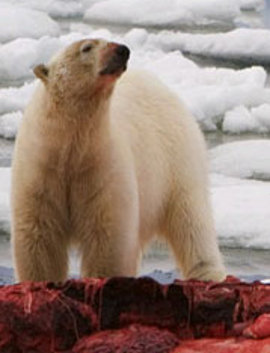
There are polar bears all over the island of Thule, for the Black City campaign, so I was adding stats for the bears to the bestiary.  While looking at how some of the games have handled them, I saw quite a bit of variation by edition.  Check it out.

BX Version:  The Moldvay edition puts the polar bear at 6HD, with claw/claw/bite attacks doing 1-6/1-6/1-10.  If both paws hit, it does a "bear hug" for an additional 2-12 automatic damage.  6 HD makes the polar a serious threat for 0-level men and low level characters; bears are the terrors of the island.


I couldn't find any evidence that real bears "hug" anyone or anything, so I wonder where the expression originated.  The most I saw was that a bear will rear up and rend repeatedly with a flurry of claws.  Going forward, I'm going to treat the "bear hug" as such a rending attack, but keep it otherwise the same mechanically.  If someone knows more about real bears doing bear hugs, I'd love to hear or see it!

AD&D didn't have a polar bear in the monster manual, but it does eventually show up in MM2.  At that point it's given HD 8+8, doing damage of 1-10/1-10/2-12 and a hug for 3-18 if one of the paws scores an 18 or better.  This version is significantly tougher than the BX version, as well as the brown bear from the first monster manual.

The king of 'over-the-top' polar bears is the version in LOTFP's Weird New World:  this guy is given 12 HD!  Damage is 1-8/1-8/1-10 with a hug of 2-16 - above BX, below AD&D, but the sheer toughness of 12 HD (and the attack roll bonuses it gets) means this guy would challenge even a high level party.  I'm not sure why James beefed the polar bear up so much; he had a weight guideline for predator HD and a 1500 lb bear is right in the 6-8 HD range.  Regardless, all those Speak with Animals type spells suddenly become a lot more important when 12 HD man-killers are walking around.  They don't see people, they just see 'Big Mac', 'Quarter Pounder', 'McNuggets' - that's the party halfling...  (McNuggets would be a great name for a halfling character, by-the-by...)

Speaking of LOTFP, I need to get a post up about the 'grand campaign'.  There are a few of the proposed adventures that are pretty dang interesting.  Seems like a good Friday post for tomorrow.

ACKS usually follows BX pretty closely, but the Polar Bear and Cave Bear are switched around in order, so I think that's just a typo or mistake.

The BX version will be fine for my assumed demographics; a 6 HD polar bear is plenty threatening to a group of 1st or 2nd level characters, easily capable of killing a character per round.   I might save a bigger HD version for a 'demon bear' or similar monster.  It does raise an interesting question, which is how do you size your 'real world' monsters against fantasy monsters and people?  That 12 HD polar bear could probably kill a white dragon.  Should a bear be able to kill a Hill Giant, assuming your campaign has such monsters? What level of hero should be able to go out alone with spear and helm and be able to best a bear in single combat?

The island of Thule is modeled after Spitsbergen island, and polar bears are a serious threat, even today.  I remember reading at one point that all new citizens have to take mandatory rifle training and always carry a rifle with them; while there are strict protocols governing when a bear can actually be shot, it seems that every year someone is killed by a bear while walking outside of the towns without a gun.

Black City Update
I've been second-guessing the decision to create a description for every hex of the ruined city.  You may recall a few weeks ago I was struggling with the use of random tables during game play, versus using them in advance to facilitate creation, and wondered if I shouldn't just generate everything in advance.  320 hexes later, and I now have something like 60 pages of brief notes.  What's done is done, and it will certainly 'play fast' at the table.

Here's a point on the importance of good NPC's:  many of the serious enemies in the ruins are other adventuring parties, and NPC party stats take up a large footprint of page space.  Once you're in the ruins, law and civilization melt away, and these armed bands of Norse explorers behave like a mix of outlaw bikers, vicious pirates, and bandits from the American west.  Trust no one, and keep your axe ready.

Monday, May 28, 2012

Mythic Monday: The Tarrasque


Wow - it’s been a while since I've posted a monster for Mythic Monday - my well of inspiration has taken me to other places these many months.  This past weekend, churches everywhere celebrated the feast of Pentecost, and my readings last week referenced dragon floats used in religious celebrations and feasts in Spain and southern France.  In following the lead back to its source, I was brought to the legendary Tarasque (or Tarrasque, in D&D).

Take a moment if you like, go hit Wikipedia and read up on the Tarasque.  Otherwise I'll paraphrase briefly:  Born of a middle eastern fire monster and the biblical Leviathan, the Tarasque was a 6-legged dragon that terrorized 1st century southern France before it was subdued by St Martha, a holy woman that pacified the creature while approaching it bare foot, in a white dress, and wielding a flask of holy water and a cross.  Then the villagers chopped it up (and renamed their place Tarascon).  Prior to its subdual, the beast was nigh invulnerable due to its armored shell.

The version of the dragon that shows up in Corpus Christi celebrations and the religious festivals is called a Tarasca, and a quick google search will show a handful of nifty Tarasca floats and wood carvings - here's a collage so you can see what I mean.  I like how they all have the signature turtle shell back and those big freaky mouths.  Some of the old woodcuts display the Tarasque with legs sticking out of its mouth, mid-meal.  We don't have too many festivals here in the States where people roll around man-eating turtle-backed dragons.  :sigh:

Images of various Tarascas
There are some bits of the story that are intriguing.  What is it about the theme of innocent maidens assuaging the most terrible of beasts?  I've read psychological theories of predatory monsters, how they call to mind primordial fears of being hunted by animals, or Freudian taboos of cannibalism, but I don't recall coming across an explanation of the 'beauty taming the savage beast' motif.  I just know if a gamer wrote the story, an unarmed cleric facing down such a monster with a vial of holy water wouldn't even count as an appetizer.  Bye bye village.

The tarrasque is a fascinating monster to put in a campaign; it lies dormant for years at a time, wakes up, depopulates an area, then stumbles off to find a good sleeping spot until it's time for the next eating binge.  How cool would it be to put a depopulated area into your low level sandbox… "Oh yeah, there used to be people here, but then the Tarrasque came through a few years ago, and folk are slow to move back… who knows if it's going to wake up near here again sometime soon?"  Sages would try to chart and predict that kind of thing on the calendar; kingdoms would plan evacuations around the imminent waking of the sleeping Tarrasque.  Plus, the Tarrasque is one of those awesome creatures to put on your monster kill 'bucket list'.  "Some day, I'm going to slay that stupid Tarrasque.  It ate my village."

Check it out, though, there's one amazing power of the legendary Tarrasque that didn't get copied over into D&D lore.  I try to keep the blog somewhat on topic and clean, but this is too funny to ignore:

And when he is pursued he casts out of his belly behind, his ordure, the space of an acre of land on them that follow him, and it is bright as glass, and what it toucheth it burneth as fire.
--The Golden Legend

When the Tarrasque "has a movement", so to speak, it burns down acres at a time.  And it uses this as a defense mechanism.  Unholy flaming shit.  You can't make this stuff up.

To my fellow Americans, enjoy your Memorial Day holiday, be sure to thank a veteran for their service, and I'll see you guys again shortly with more ideas on the Harrow Home Manor.

I almost forgot - the Tarrasque shows up in Monster Manual 2 for AD&D... I know many of those monsters are reprints of modules, does someone know if there is an earlier source for the Tarrasque in AD&D?  Thanks for any insight!

Wednesday, April 25, 2012

The Spreaders - a Menace for the Colonial Hexcrawl


I've had a busy couple of weeks at work, so blogging is taking a bit of a back seat.  However, we got the Trail of Cthulhu game started last weekend (a report is forthcoming); I've managed to get in some reading for the Colonial Hex Crawl idea; I'm still plugging away on the Black City, currently mapping and detailing The Black City's Tower of Pain.  All fun stuff.

This creature, the Spreaders, gives me great hope in the potential of the Colonial Hex Crawl.  They're dismissed as a rumor, a child's tale to scare hunters and trappers into avoiding pristine campgrounds while plying the waterways in the rich forests of western New York.  There are stretches of river and shorelines that have an evil reputation, and woe to the foreigner who ignores the warnings of a native guide or dismisses Indian tales out of hand.

The Spreaders are small faeries that emerge from their subterranean burrows at night to drag off unwary trespassers.  In concert, a number of these diminutive sprites can cast a powerful sleep spell, ensuring that no sentry or guards disturbs them as they trundle off a victim into the night.  When the victim finally awakens from their enchanted sleep, they'll discover they've been spread eagled on the ground, their arms and legs firmly bound with vines.  Sticks are wedged to keep each finger splayed, the legs spread apart, eyes propped open with twigs, and mouth wedged apart with wood.  It's quite likely a search party would walk right past a victim, covered in dirt and leaves (but for the eyes), or hidden in a bramble, unable to make a sound or move.

Victims that stumble into the spreader's domain usually do so at the end of a long day of river travel, making camp at a tempting spot just as dusk settles over the river.  Had they performed a more detailed search before dark, they might have discovered a nearby hollow filled with the cast off belongings of previous victims; the rotting remains of canoes and boats stretching back years and decades molder into rot where the Spreaders carried and hid them.  Here and there in the nearby woods are skulls and bones of past victims that unwisely camped near these dark faeries.  And below ground, deep in their diminutive tunnels and warrens, the Spreaders wait for the next evening.

The Spreaders - Malicious Forest Sprites
AC as chain, MV 6, HD 1/2, Atk 1 spell, see below, ML 7, AL C, No appearing (3-18)

Every 5 Spreaders acting together can cast a sleep spell once per day that induces a deep, magical slumber.  10 Spreaders can carry a sleeping victim off into the nearby forest and "spread" them in a secluded spot to die alone.  Abandoned victims lose a point of temporary wisdom per hour due to horror (minimum score 3) and die in 2-3 days from exposure and thirst.

The spreaders don't collect treasure, but the nearby woods usually have a spot where the belongings and canoes of previous victims are dragged and hidden, so there might be incidental treasure in the canoe graveyard.

*The art is from the Fiend Folio (the Forlarren, by Russ Nicholson). The spreaders are from an Abenaki ghost story retold in When the Chenoo Howls, a collection of eastern Native American monster tales.  For children.

Thursday, April 12, 2012

Angry Mutant Apes of the Black City


I was working on the ape men colony in the Black City's ruined arena, and had some fun with worm madness and the ape men.  Here's the simple version so you don't have to go back and read stuff from a year ago:

The ape men were slaves of the aliens in the city, white haired hominids like the Australopithecus, created for labor and servitude.  The aliens bred them by devolving early humans down along the genetic tree to a more primitive state.  The other factor to consider is worm infection.  The Greys bioengineered a parasitic worm that mutates and enrages its host (roid worms)- if you want a blast from the past, here's a whole article about worm infection: Worm infection and berserkers.  So what happens when a white ape gets infected with worm madness?

Angry Mutant Apes.

When the ape men see first signs of infection in a member of the band, they dump them in the pits, a series of warren-like passages beneath the tunnels where they lair.  There's a ramp leading into the arena from the pits, with a grate barring the way, and the ape men lift the grate to release the hungry mutants whenever the area is invaded.  I figure it's like Barsoom with snow and ice.

Angry Mutant Ape
AC as leather armor and shield, MV 12, HD 4, Atk 2 claws, 1d4/1d4, and see below, ML 7, AL N.

The ape men have learned to avoid infected water sources like the well in the Transit Tunnels, but there are still pools on the level 2 Warrens that have worm infection.  When a white ape is infected with worm madness, the unstable DNA of the ape men combines with the worm infection to transform the white ape into an actual 4HD carnivorous gorilla monster; 50% of them mutate further and gain one of the attributes from below.

1  Extra Arms - the mutant ape can make 4 claw attacks instead of two
2  Horn - a huge horn grows out of the mutant apes skull, granting a gore attack (1d6)
3  Vicious Bite - the mutant can bite for 1d8 damage
4  Oversized (extra HD) - the mutant is 5HD instead of 4HD
5  Sharp Claws - each claw attack is 3-6 damage (1d4+2)
6  Fast Healing - the mutant regenerates 2hp per round
7  Purple!  - 8HD and fist pounds that do 2-12 damage per fist
8  Gore slathered:  AC as unarmored, +2 attack/damage, morale 12, roll again
9  Super Intelligent:  has used low level telepathy or empathy to turn the other mutants into its followers
10.. ?

This table can easily be expanded.  What's your favorite ape mutation that belongs on the mutant white ape table?


* The picture is a mash-up of Trek, Congo, and the four-armed white apes from the Jon Carter Movie.

Tuesday, April 3, 2012

The Headless Jotun


One of the areas I was revising for the Black City campaign last week is the Great Glacier.  The city is cut in half by a glacier that's pushed through the ruins, calving off ice chunks into the fjord along which the ruins sit.

A curious item to be found in the dungeons is the severed head of a jotun - the never-ending ichor that oozes from the neck has formed a pool which spawns nasty frost mites and other pests in the dungeon.  The headless body, on the other hand, is still frozen in the glacier…

The Headless Jotun
The jotuns are mythological ancestors of the races of giants, semi-divine beings dwelling beyond the world in their realm of Jotunheimr.  The passage beyond Midgard was once near the icy north of Thule.  This jotun's head was sliced off by an energy beam from the city's defense system, the Face in the Ground, and the ichor-covered head quickly melted into the glacier.  The headless body dropped onto the glacier - it radiates extreme cold and has long been covered by ice and snow.

Characters searching in the hex [I'm redoing the map, so I'll add the hex number later] have a chance, equal to finding a secret door, of noticing the 20' tall, blue, headless body, buried under 5-10' of ice.

If the Jotun Head is dug out of the dungeon and reunited to the body, the jotun's power is restored and the being will come back to life.  Roll a standard reaction to determine if the jotun immediately starts eating characters; if the reaction roll is positive, perhaps it offers a divine boon before stalking off to the north.

One other thing - the Face in the Ground may have been reactivated during excursions into the ruins; if so, it's entirely likely the Jotun is attacked all over again.

Fornjot the Jotun
AC as plate and shield, MV 18, HD 20, Atk By weapon or smash, damage 7d6, ML 11, AL C.

The jotun radiates extreme cold when angry, causing 1-3 damage per round to characters in melee with it.  The Jotun can cast magic user spells as a 13th level magic user, preferring spells of illusion, wind, or cold.

Note:
I always loved the part of Princess Mononoke where the mercenaries are running around with the head of the forest god of the wood, so I'm amused to have a bit with Vikings carrying around the head of an immortal giant.  I'm sure players will wonder what a jotun's head is worth, and it could lead to interesting problems if brought back to camp.

Thursday, March 29, 2012

Psionic Alien Ghosts


One of the locations I recently put together for the Black City is haunted by a psionic ghost.

The Black City is an alien ruin because the race of Greys was slaughtered in a psychic cataclysm before the ice retreated.  Their most powerful controllers, the hive minds, were advanced telepaths, linking the entire colony telepathically.  When tragedy struck, the torment of the hive minds left behind psychic ghosts, malevolent shadows of pain and hatred that linger even now.

Thus, there's a class of psionic monsters in the Black City that can be encountered in locations where a hive mind died during the cataclysm.  While the more powerful versions will be like the Monster of the ID (drawing inspiration from that classic, Forbidden Planet) the one inhabiting the ruined "central command" is more like a vicious poltergeist.  Another one to add to the Black City Bestiary.

The calcified corpse of the hive mind still sits in the large amplifier chair that once allowed it to broadcast commands throughout the city.  A dull mauve alert has been flashing for a millennium or more, casting the large room into intermittent darkness.  The psionic ghost fettered to that crystal corpse attacks with telekinetic pushes, or seizing weapons to smack characters with their own armaments.  The push attack isn't damaging, but anyone that climbs the tall shaft from dungeon level 1 into central command from below is in for a rude surprise.

Psionic Ghost of the Hive Mind
AC as Unarmored*, MV 12, HD 5*, Atk By weapon or push, ML 12, AL C.

*The AC and HD stats are for the corpse fetter.  The actual psionic entity is immaterial.  Destroying the fetter by reducing it's hit points to zero releases the psychic residue and destroys the ghost.

Unlimited by the physical constraints of a body, the psionic ghost can make 2-4 attacks per round.

Invisible:  the psionic ghost is invisible, but any seized weapons will dance around in front of the character it's attacking.  Detect Invisible reveals the psionic ghost, which appears like a malevolent leering alien with oversized head, and the tendril fetters tying it to the crystalline corpse like a silver cord are plainly seen.  Detect Evil also reveals the ghost's presence and the fetter.

Telekinetic Push:  A character saves vs paralysis or is knocked down by the telekinetic push.  This can be used to knock characters back down the shaft, or keep them from charging the crystal corpse.

Weapon Grab:  treat each weapon as AC Chain for purpose of the grab attack; a character can make an open doors check to retain a weapon already in hand, but a sheathed weapon is yanked away for use by the ghost.

Weapon Attack:  Any seized weapons can be used on future rounds to make a 5HD attack.