Thursday, January 23, 2025

Shadowdark: The Good, The Bad, the Ugly

I've been enthusiastic about Shadowdark since I first picked it up.  Now that I've been playing it for several months across a couple of campaigns, I can write a critique that's not just an academic exercise or armchair quarterbacking.  I also updated several home brew adventures to Shadowdark recently and ran them as dungeon crawls at last week's Philly area gaming expo, so I've had experience running Shadowdark for a dozen people new to the system as well as seasoned veterans.  My players are loving the system and I see no signs of us putting it aside as long as we're doing old school dungeon crawls.  

Shadowdark is an "OSR-adjacent" game that features concise, simple rules using modern mechanics to deliver a 1970's or 1980's gaming experience.  That's basically the "elevator pitch" for the game - a 1980's BX vibe with modern mechanics.  If you're happy with your AD&D, BX, BECMI, or anything in the first wave of clones, there's potentially not as much here for you unless you want to try out a modern experience.  The retro clones and their friends started with old rule sets and streamlined them to improve the presentation and editing.  Shadowdark goes in the opposite direction - it starts with 5E mechanics and ideas from other modern games, simplifies them, and adds back in the elements that drive a classic dungeon crawler experience.

For self-amusement I'm grouping these perspectives into Good, Bad, and Ugly, but here's a large caveat about the "ugly" category; beauty is in the eye of the beholder.  One person's ugly mechanic will be sublime beauty in the mind of the next referee or game master.  I'd hazard that one's perception of these mechanics will depend on how much "fantasy world simulation" you expect in your game.  There are a lot of elements in 1970's AD&D, for instance, that are targeted at creating a living, breathing, world-in-motion where the rules of the game are the laws of the simulated fantasy world.  I've found that modern games (including 4E and 5E D&D) eschew these "simulationist" elements by giving players more meta-game abilities (like inspiration points in 5E D&D) or elevating the power and abilities of player characters far beyond the other inhabitants of the game world.  In modern games, player characters are special and cut from a different cloth from the NPCs and monsters.

Here's an example where Shadowdark parts ways with it's forebears - creating a magic item.  AD&D, BECMI, and BX have defined magic research steps involving high level magic users, rare spells, and scads of money, time, and exotic ingredients to create a magic item.  NPC wizards can make magic items with enough time, capital, and skill, and high-level player-character wizards can pursue the same if they want to put in the work.

Enter Shadowdark, and modern design.  Wouldn't it be cool if leveling up just included a random chance of creating a signature magic item?  Thus on the advancement tables for the Shadowdark wizard, any time the wizard is rolling for a new class ability (and yes, class abilities in the game are random - more on that later) there's a 1 in 36 chance (snake eyes) of "Oops, I created a magic wand?"  Now both of my wizard players stare in glee when it's time to roll that talent - to them, getting an item this way would be amazing.  It's a huge check mark in the column labeled "fun mechanic" for them.  But it's a far cry from having to grind out 9+ levels of wizard, hoarding gold pieces like Elon Musk, building a remote tower or redoubt for seclusion, and navigating the arduous magic item creation rules just to be able to say, "I finally created... a humble dagger +1.  Woot."

I think it comes down to old and new games are trying to do different things.  Shadowdark is laser focused on running great adventures (both dungeons and hex crawls) and less concerned with the fantasy world-building outside of the adventure, which can be so engrossing in AD&D.  As I go through the list of "ugly or sublime" design choices below, whether you find them baleful or beneficent probably depends on trade-offs like game experience vs verisimilitude.  Maybe it's a traditional vs modern axis as well.  I've certainly found myself favoring one viewpoint or another through my referee career.

The Ugly... or Sublime

Random Class Talents

We already covered the "oops I made a magic item" example when leveling up.  In fact, the entire character advancement scheme involves random improvements to abilities, including the ability to raise character stats like strength, dexterity, intelligence, etc.

Imagine two fighters with similar modest stats at the start of the game.  One of the characters repeatedly rolls stat increases upon advancing, and in a few levels they look like Gregor Clegane the Mountain from Game of Thrones, while his compatriot retained kept his modest physique, while instead becoming deadly with bows, swords, and axes.  Perhaps a third fighter ends up as a defensive specialist, with extra hit points and improved skill with armor.  There's elegance to the way random advancement can drive diversity among characters of the same class.  The more I see the random talents in action, the more I like them.

It's a big difference from older games, where all classes receive the same class abilities at the same levels.  Additionally, the core attributes of old school characters like strength and intelligence are mostly set in stone after character creation, barring the odd Manual of Bodily Health, Tome of Leadership and Influence, and similar rarities found in dungeons.  Modern designs since 4E allow player characters to significantly improve their character attributes through leveling.

Luck Tokens

Shadowdark includes a mechanic called "luck tokens" which affords the player a re-roll.  In older games, I can't think of any common player-controlled instrument of fate that let a player reach into the setting from beyond the world and change their destiny, barring the rare Wish spell.  But effectively that's what luck tokens do; a game event has occurred (the player misses a key roll), the player has the power to press the pause and rewind buttons on the game, and the player announces "I'd like to re-roll that with my luck token".

Luck tokens make Shadowdark eminently survivable.  Don't believe the hype that Shadowdark is super deadly - luck is a strong mechanic, and those sentiments are likely coming from the 5E crowd.  Luck tokens are (and should be) a scarce resource, so they drive interesting discussions as players debate the best use of them.  Resource management is an important part of the dungeon crawl experience and luck is a powerful resource that mitigates randomness.  There are also new class designs like the Bard and Seer that include the creation or manipulation of luck tokens in their core abilities, so luck tokens are clearly a signature mechanic.

My verdict:  they're powerful, but they drive healthy player discussions around resources and mitigate some randomness; I like them in a game like Shadowdark.

The Torch Timer

People online fixate on the torch timer.  Here's how it works: the duration of light sources in Shadowdark are not tied to in-game time, they last 1 hour using table time.  When a new torch is lit, the referee turns on an egg-timer, flips an hourglass, sets a countdown on their phone, whatever.  An hour later, the torch goes out.  As a referee, I still track old school turns to know how much "in-game" time is elapsing for purposes of spell durations, wandering monster checks, that kind of stuff.  The torch runs on a completely different track.

So what does the real-world torch timer accomplish?  First, darkness is scary in the game - no player characters have darkvision or infravision.  The game advises the referee to make darkness a constant threat, almost like a survival horror thing.  Invariably, players lose track of the real-world timer at some point and the torch goes out in the middle of a combat, plunging an orderly scene into horror and chaos and screams.  When they're paying attention to the torch, it incentivizes the players to self-correct (ie, stop talking about football or politics) and get back to advancing the game.  I find it minimizes "analysis paralysis" or too much equivocation since the torch counts down whether they're exploring or yapping about their day in the office.  Plus, the player characters have limited gear slots so they have a limited supply of light sources with them.  Shadowdark is very much an "encumbrance matters" system.

Conclusion:  the real-time torch timer is a gimmick, but it puts in some work creating tension.  It's great fun for the referee when the players lose track and the light goes out.  Muhahahaha.

THE GOOD

Game Mechanics

Shadowdark bring modern mechanics and themes like ascending armor class, bounded accuracy, advantage/disadvantage, limited action economy, simple skill checks, no saving throws, flat hit points, and a focus on theater of the mind (non-tactical movement and ranges) so the game plays very quickly at the table, which I prioritize highly.  I'm usually running groups of 5-6 players.  Fast moving rounds with simple rules keeps the gaming moving quickly and everyone engaged.

OSR Experience

I love horror games, but for classic dungeon crawls, my heart is with the Tom Moldvay vibe of 1980's modules like Castle Amber or The Lost City.  Shadowdark is quite possibly my favorite dungeon crawler / OSR type game to channel that spirit of 1980's D&D and classic adventure modules like The Lost City, Horror on the Hill, In Search of the Unknown, and similar.    It uses XP for treasure, no darkvision for player character races, reaction rolls, morale checks, and a fantastic encumbrance system (even simpler in implementation than the LOTFP encumbrance, which is already quite good) that all make this a fine exploration system.  It's not the first "encumbrance matters" modern creation, but it does it really well.  I've run a lot of OSR and related rules, between the previous section on mechanics and this section on the experience, these are the things that have me regarding the game so well.

Presentation

The rulebook is concise and easy to read, including A5 pages with large text - something I appreciate as my eyes are getting older.  Wordy books are just hard to use at the table.  There is a free set of quick start rules for both players and the referee that include everything needed to try the game, including a full-size dungeon adventure - if you have any Shadowdark interest, go check out the free rules:  Free Quickstart Rules.

Cursed Scrolls

Shadowdark official expansions have been coming through zines called "Cursed Scrolls" - there are 3 now with 3 more coming in early 2025.  Each Cursed Scroll includes new classes, spells, and character options; a hex-crawl sandbox setting, and a fully populated dungeon and new monsters.  I've made good use of Cursed Scroll 3 (Midnight Sun) as it included Norse themed classes, gear, monsters, and adventures.

Spell Casting

Shadowdark uses a "roll to cast" mechanism which means characters can keep using spells until they fail a check.  Once they fail, they can't use that spell again until the following day (and critical failures will lead to a mishap and consequences).  A cleric could fail their first cure wounds spell or get to use it multiple times during an adventure, and the complexion of the game changes dramatically between those two poles.  In my experience, other players frequently prioritize saving luck tokens to help the casters avoid critical spell failures too early in the adventuring day.  Overall it's a novel change from Vancian spell casting - casters aren't as powerful as 5E but significantly more powerful than old school games.  This might also be the largest departure from classic OSR games and the biggest swing towards 4E and 5E powered casters.

Character Funnels (Gauntlets)

I'm a convert to using a character funnel to kick off a campaign after using the Shadowdark "gauntlet" rules for both of my campaigns.  It's an idea that originated with Dungeon Crawl Classics, and is renamed a gauntlet here (and the implementation is marginally different). If this is new to you - the gauntlet or funnel involves bringing 4 zero-level peasants to a short but dangerous adventure; many of the peasants will die along the way, but survivors will matriculate to being level 1 characters after the gauntlet.  It's like a non-boring "session zero" for the campaign, and every group for which I've run a gauntlet has really enjoyed it and came away with memorable survivors.

Magic Items

Shadowdark philosophy assumes magic is unreliable, so there are random tables of drawbacks for magic items.  It's a small thing but does differentiate it apart from BX style games.

XP and Carousing

The game uses XP for treasure but abstracts away from the actual gold piece count to use coarse grain numbers - a typical treasure find is 1 XP, a major hoard or magic item is 3XP, and a character may need 10 XP x Level to level up (10 XP required at Level 1, 20 XP at Level 2, etc).  It's simple to adjudicate at the table (and the ref needs to record the XP finds in real-time).  Shadowdark characters get about 1/10th the treasure of an OSR game.  Furthermore, the game has a carousing mechanic for XP during downtime in between adventures, which will act to 'drain the party's coffers' and keep them motivated to go back to the dungeon.

Community

The Shadowdark spaces (reddit, discord, Facebook) are all shockingly drama-free and populated with folks just there to talk about the games.  It's remarkable - they seem to be free of politics and controversy while the detractors are on the outside.  There's a ton of DIY energy and activity that reminds me of the early OSR some 15 years ago.  I don't know if anyone's done a population poll, but I imagine the majority of Shadowdark players are coming home from 5E as opposed to OSR veterans and grognards.

BAD

Your mileage may vary; these are the (relatively minor) quibbles I have with the rules.

Deadliness

Shadowdark combat is fairly forgiving compared to old school games.  Characters reduced to zero hit points have a death timer that usually gives the party several rounds to stabilize them, and with the power of casters and the presence of luck tokens, there's a good chance the cleric will have a cure wounds spell.  All hit points and ability damage are restored via a long rest, like 5E.

Equipment Abstractions

Because of the limited gear slots, there are some abstractions implicit in the adventuring gear.  For instance, a ration represents both food and water in the same encumbrance slot; characters don't carry stand-alone waterskins.  You can buy 10 iron spikes but the hammer is 'virtual' and doesn't take up a slot.

Time Definitions

Shadowdark flipped the meaning of rounds and turns.  Exploring is done in rounds, combat is done in rounds, and players take turns during a round.  Combat rounds and exploring rounds take different amounts of time.  The designer changed the exploring rounds (crawling rounds) from 1 turn = 10 minutes (BX D&D style) to 1 exploring round = 6 minutes; 10 rounds in an hour.  Spells are measured in rounds, and they don't differentiate between combat or crawling rounds.  So a 5 round spell will last 30 minutes if cast during exploration rounds, but will last only 30 seconds if cast during combat.  It's curious.

Monster Stats

Monsters are very sparse, focusing on minimalist abilities.  Many of them have lost campaign depth.  A good example is the Night Hag, which traditionally has ethereal travel and a wide range of spell casting abilities in older games; the SD version can only cast a blindness spell and Change Shape.  Boo.  Likewise, all NPC's are statted like monsters and don't use equivalent spells as player characters; they're more simplistic befitting their limited time on the stage.  It's a much different mindset from older games where monsters populate dungeons but also have campaign roles.  I find myself consulting Labyrinth Lord or the Rules Cyclopedia for additional BX-themed monster abilities.

Character Options

There's no "race-as-class" like a BX game, and the races have been retitled "Ancestries" and kept simple and flavorful.  I like the change - ancestry is a fine term for me, and doesn't carry weird Sci-Fi baggage like "species".  As mentioned, no one has darkvision, which is for the best.  Sadly there's no Elven fighter/magic-user style character just yet (so this could appear under the bad, too).

Publishing Aesthetic (3rd parties)

I'm a little tired of all the samey-looking 3rd party supplements with the all black covers and limited B&W art.  It's not even a grim-dark game!

*****

So there we go.  Obviously I'm in a place with my players where the good and the sublime outweigh the quibbles, but hopefully this gives my readers (who I imagine are mostly grognards) a good sense of what they can expect.  The biggest thing I'd recommend is getting the free player's quickstart and referee's quick start: Free Quickstart Rules.; Kelsey Dionne is generous with the free rules, including a  good-sized sample dungeon, to be able to give Shadowdark a whirl at your table.

Sunday, January 19, 2025

Shadowdark at Philly Area Gaming Expo

 I ran 3 games of Shadowdark at Philly Area Games Expo (PAGE), a convention that seems to be gaining some traction in the area here in it's second year.  There were plenty of YouTubers and ex-TSR era and WOTC designers at it.  I sat in on some seminars, including OSR tavern keeper Tenkar talking about the jump from blogging to video.  Interesting stuff.

I ran 3 home dungeons 3 home dungeons adapted to Shadowdark (the players were Vikings and Northmen exploring alien ruins in the frozen north, some horror vibes too).  If that sounds familiar to old-time readers... I'm resurrecting The Black City for Shadowdark.  I've got about 60 pages of it done.  I figure if I keep signing up to run set pieces of it as convention dungeons, it'll force me to keep deadlines.  My home games are going to be in Curse of Strahd and Karameikos for a while, so I've got a few months before the whole thing needs to be ready for the home crew.

It was interesting seeing what was being run... about 50 5E games, 30 session of AD&D 1E (respect!!), 20 Shadowdark, 20 Castles & Crusades, then 5 or so for OSE, OD&D, and B/X/BECMI.

As for my games, they went really well.  Two of the tables were all new to Shadowdark and OSR style play, and they came away thoroughly entertained.  The 3rd dungeon were all Shadowdark veterans.  I had a couple of professional designers each sit in on a game, Richard Baker and Ed Stark.  Turns out 1) professional designers are interested in trying new games; 2) they're also really really good players.  Fun to have them in the sessions.

One of the Shadowdark zines (Cursed Scroll 3 - The Midnight Sun) features Viking-themed classes, equipment, monsters, and dungeons, so two of the classes from there (the Sea Wolf and Seer) were popular choices for pregens in the Black City dungeons.  The Sea Wolf was average; it's a slightly worse fighter at fighting, with the ability to pick a daily boon from a Norse god, which was flavorful.  However, one of the Sea Wolf players took great advantage of the "shield wall" ability to ward his group while relentlessly pushing forward against a crystalline entity hurling barbs at the players.

The Seer, on the other hand, was an MVP.  Shadowdark can be swingy (especially spell casting) and the Seer (which is part diviner and Norse runecaster) can generate many luck tokens (manipulating fate), smoothing out the play experience for level 1 characters.

A couple of pics from two of the dungeon crawls: 


Sunday, January 5, 2025

Progress Report - Horror on the Hill

I love the Jim Holloway art from this era of Basic D&D

We missed a lot of time with this campaign!  Several of the players are die-hard Eagles fans (go birds), and there was a run of late afternoon games on Sundays or Sunday nights which displaced RPG game nights, so I think we've only played 2-3 times since October when I last checked in on this campaign.  Our cast of characters has reached level 2 and has explored most of the surface ruins of Horror on the Hill and about half of level 1 of the dungeon.

Here are the characters:

  • Skargold (half-orc fighter)
  • Glo (dwarf fighter)
  • Barlow (halfling cleric of Ord)
  • Ithior (elf wizard)
  • Malad (elf thief)

In Shadowdark, ogres are level 6 monsters, so one of the most dangerous surface encounters was with an ogre (rolled as a wandering encounter) which forced the players to retreat, put down caltrops as cover, put doors between them and the ogre, basically use good tactics to create distance and let them injure it at range before closing to melee when it was weaker.  There are some old school goodies in the module like a hidden sanctuary in the monastery with a magic fountain, and several characters got stat boosts drinking the enchanted water (2 ended up paralyzed for half a day).  Sleep took care of a barracks of humanoids, and then they were down some stairs to the dungeon.

Sleep is proving to be highly effective in a scenario featuring humanoids under the Shadowdark magic system.  Shadowdark is "roll to cast" instead of using spell slots, so if a spell is successful, the caster can try it again in a future encounter.  A few lucky spellcasting rolls and even a 1st level wizard can deploy multiple sleep spells, although it doesn't scale to affect higher level creatures like the classic sleep spell.  The players have rescued a dwarf prisoner, Gareth Ironhand, who was being forced by the hobgoblin king to make weapons for an army the hobgoblins are trying to raise (pictured above - I love the Jim Holloway art of this period in TSR).  The players have promised Gareth they're going to put an end to the threat.  They've also learned the hobgoblins revere a "fire boss" deep in the hill called "Rhazgar", an allusion to the dragon on the third level of the dungeon.

Magic items are fairly bland in old school adventures - lots of shield +1 and sword +1, for instance.  A simple hack I'll do is generate some possible cultures that could have generated the magic item in question, just to give it a modicum of flavor - it's not a well-made shield, it's an archaic shield with a double eagle crest that dates back to the Thyatian Empire, and appears good as new.

I'm running this B5 Horror on the Hill in Karameikos, part of the Mystaran "Known World" setting from the BX and Mentzer sets, so here's a simple table of nationalities for use as above:

Magic Item Flavor:

  1. Ancient (Blackmoor)
  2. Rockhome
  3. Alfheim
  4. Old Traladara
  5. The Empire (Thyatis)
  6. Glantri
  7. Karameikan (elvish made or royal court/military)
  8. Monster-Crafted
  9. The Church
  10.  Independent Wizard (Bargle et al)
  11. Alphatia
  12.  Distant land (Vestland, Ylarum, Darokin, etc)

In this way, they haven't found just a shield +1 or mace +1, but the aforementioned Shield of the Empire or a holy weapon that belonged to the Great Church of Karameikos.  It's low-effort but goes a long way to adding simple flavor to otherwise uninteresting treasures.

At this point I've probably refereed 10 games of Shadowdark between the two campaigns - enough to have a feel for it.  There are a few things I don't like about the system (not fatal flaws, but irritants).  I'll have to put together a gripe post, grognard means complainer after all.  Nevertheless, the system plays really fast at the table - very simple to adjudicate and run combats.  Obviously all OSR systems have this attribute; Shadowdark leverages unified mechanics based on 5E that make it even simpler to operate than the beloved Moldvay.  One of the biggest departures is what I alluded to above with sleep - by dropping Vancian magic, casters can sometimes go on a heater and punch hard.  A cleric (er, priest) can heal the whole group with a series of successful cure wounds spells, or the wizard can put the party on "easy mode" when facing off against goblins and hobgoblins by spamming sleep.  Maybe I'll do a "the good, the bad, the ugly" kind of post on Shadowdark in the near future, because there's a lot more to say.  I'll finish by saying both groups of players have given it an enthusiastic two thumbs up; I know they're enjoying the games and appreciate the system.

Tuesday, December 24, 2024

Enabling Curse of Strahd as a Sandbox

One of the most important things I needed to do for myself to simplify Curse of Strahd (COS) is related to the book's presentation.  It's presented as a sandbox campaign, with a full-sized hex-crawl wilderness map (the Valley of Barovia), a full-sized dungeon (Castle Ravenloft), and then 12 other adventure sites comprising villages, smaller dungeons, or wilderness sites.  The issue I've found is there's a lot of text in the book, making it too easy to overlook critical information that acts as connective tissue between locales - ie, the plot hooks.  I see that as the #1 job of a sandbox referee - making sure the players have opportunities to learn things about the game world so they can make meaningful decisions about what to do.

I broke COS down two ways - the first was by settlement, what are the most important nuggets of information they'll learn at each location that could lead to further adventures.  I also organized the plot hooks by adventure site, to identify what are the ways characters can get pointed at a particular locale.

Here's an example: one of the locations is a werewolf den far to the west.  Players could stumble upon it if they crawl hex by hex.  The werewolves kidnap children in the valley, make them fight each other, and adopt the survivors into their werewolf clan to become werewolves.  There's been a recent power struggle between leaders in the clan (with the former leader now imprisoned beneath Castle Ravenloft).  Unless the players stumble upon the werewolf den, there are scant plot hooks that point to it.  They could meet Emil, the deposed leader, while exploring the prisons beneath Castle Ravenloft... although by the time they're exploring the castle, they're probably out to kill Strahd and not interested in a werewolf side quest.  The only other clue pointing to the den is if they have a random encounter with a werewolf in the wilds and are able to interrogate it.

The werewolf den shows up in the "tarroka readings" the referee can use to scatter various helpful items around Barovia and randomize the campaign.  In the original I6, everything is contained within the castle, but in Curse of Strahd, helpful items (including a potential ally) are split between the wilds and the castle.  One of the werewolves appears as a potential ally against Strahd (the enemy of my enemy...) and the werewolf den appears as a location where a quest item can be placed.

It wasn't obvious on first read-through that the touchpoints leading out to the remote werewolf den are so tenuous, or dependent on random chance.  If the referee wants to ensure the players learn about its existence, they may need to add an explicit plot hook to a location.  Perhaps the wolf hunters in the tavern of one of the towns (Vallaki) could be a good option for rumors about a vicious werewolf clan in the western wilds.

Anyway, I'm sure you get the point, dear reader - until I went through the book and organized the plot hooks, I wouldn't have noticed how prevalent or scarce are some of them.  The information pattern creates a likely "flow" through the campaign.  Here are my notes organized by site on plot hooks that are over and above the ones from Madame Eva's tarroka reading.

BAROVIA

  • Death House
    • Learn about the Durst Windmill (now Old Bonegrinder)
  • Tavern
    • Madame Eva's camp
    • Vallaki is a safe city (Ismark and Ireena)
    • Wizard of Wines (wine is scarce - added by me)
  • Church
    • Krezk Abbey is safe and holy
  • Mad Mary
    • Daughter is in Castle Ravenloft
  • Night Hag Peddler (Morgantha)
    • Strahd has a secret at Amber Temple
    • He has an enemy at Argynvostholt
    • Madame Eva has a Vistani camp
    • She and her sisters are at the Durst Windmill (Old Bonegrinder)
  • Strahd
    • Invitation to Castle Ravenloft

VALLAKI

  • Tavern
    • Wine is scarce - visit Wizard of Wines
    • Possibly cross paths with Rictavio (Van Richten's tower)
    • Wolf Hunters may be aware of the werewolf den (added by me)
  • Kasimir
    • Quest to visit Amber Temple
  • Luvash
    • Needs wine - visit Wizard of Wines
  • Town Rumor
    • The ruins of Argynvostholt

KREZK

  • Needs wine from Wizard of Wines Winery

WIZARD OF WINES

  • Can learn two additional quests, Yester Hill and the ruined village of Berez

ARGYNVOSTHOLT

  • Learn about the Amber Temple
  • Quest to Castle Ravenloft to retrieve the dragon skull

WANDERERS

  • A revenant can reveal Argynvostholt
  • A werewolf can reveal the werewolf den

There is a lot more information in the book and additional side quests and smaller incidental sites to investigate, but the items above represent the major ones.  If you want to make sure your players hear about the Amber Temple, for instance, as it's one of the more important dungeons, the people who know about it are the night hag in Barovia (or at Old Bonegrinder), Kasimir the elf outside Vallaki, or talking to the ghost of the dead dragon at Argynvostholt.  I find this kind of "cheat sheet" helpful to ensure I don't overlook critical information about the sandbox.

The general flow of the adventure I've perceived is characters get many future plot hooks during their start in the village of Barovia, with one the most accessible and reasonable things being to get out of town and go to Vallaki; the next most likely destination after Vallaki is the besieged Wizard of Wines winery, where they can learn about two additional quests involving Yester Hill or the ruins of Berez.  There are plenty of side quests between Barovia and Vallaki, including visiting Madame Eva, Old Bonegrinder, getting caught up with the mayor of Vallaki's madness, fighting off vampire attacks in Vallaki, traveling with Ireena in tow and keeping her safe from Strahd,etc.  Some of these are best represented as events -  having a list of events off to the side to "keep the world in motion" is the next cheat sheet to build.

One thing my players do to stay organized is they use a shared Google sheet for posting marching orders, party treasure, game notes, screen captures of handouts, and plot hooks.  I like their approach and it should work well keeping track of all the things they can do during their "Holiday in Barovia".

All of this advice is system neutral; Curse of Strahd was published for 5E, I'm converting it to Shadowdark, and it seems like you could do the same for any OSR game.  Shadowdark and 5E have similar wealth expectations, making that piece of the conversion easier.  We did our pre-Christmas game last night so next post I'll log our adventures in Barovia to date.

Sunday, November 17, 2024

Curse of Strahd - for Shadowdark


I started running a game with my neighborhood gang for Horror on the Hill, a classic module from the 1980's.  Meanwhile, my high school group voted to do Curse of Strahd.  The high school gang was formerly "The Pillories", the party that played Lamentations of the Flame Princess over the past year and recently wrapped their campaign.  Originally we were going to do a Call of Cthulhu next, but I wanted to get some more "drive time" with the Shadowdark rules set, and we talked about several different campaign ideas.  They ultimately picked Curse of Strahd.  Curse of Strahd (COS) was originally written for 5E, but don't hold that against it, and it seems like it will work fine using Shadowdark rules.  We're 3-4 sessions into the campaign, but this post is about the conversion process and getting the campaign set up.

There are a  few good 5E campaigns that lend themselves to a retro style of play and sandbox gaming - Dungeon of the Mad Mage, Tomb of Annihilation, and Rime of the Frostmaiden, for instance.  Curse of Strahd occupies a nearby place - it’s a little verbose and almost wants to be a plotted or scripted scene-based campaign, but it's also set up as a hex crawl in the valley of Barovia, with Castle Ravenloft and several dungeon sites.  There's a small cottage industry in the 5E crowd of converting Curse of Strahd into a full-blown scene-by-scene adventure path, but it seems easy enough to go in the other direction too, and bring to the foreground the sandbox elements and player agency.

As written, the campaign suggests gifting experience levels to the players as the players wander Barovia and do stuff - it's more exploration focused than the scene-based milestones that show up in adventure paths, but doesn't go all the way towards an "XP for Treasure" mode like I'd want in a retro sandbox.  The first thing I wanted to figure out was how much experience the campaign gives out naturally if you tried to run it as an XP for Treasure campaign.  It was a little tedious, but I tallied the treasure finds from the hex-crawl locations and dungeons.  I also assumed characters will get to go carousing several times, as XP for carousing seems to be a default assumption of Shadowdark, and fits one of the themes in Curse of Strahd - Barovia is dreary, and wines and spirits are one of the few things that bring joy to the dismal landscape.  The total XP in COS a little light - there's enough XP for a party to get to level 6 if they "collected most of it" which we don't necessarily want to encourage.  So the XP will need a little juicing - either adding treasure to locations where it's sparse or nonexistent, increasing the reward amounts, and/or adding some boon or quest rewards for major accomplishments.  Shadowdark doesn't use a 1gp = 1xp basis; the game uses an abstract system where treasure hordes are worth either 1xp or 3xp, and legendary items are worth 10xp. I've seen where referees use a 5xp category for major hordes and I think that change could be effective at increasing the campaign's overall XP.  One thing I'll mention - the actual gold piece counts found in a 5E adventure are right in line with Shadowdark's recommendations - which is somewhere around 1/10th the amount of treasure you'd see in an old school game.

Sly Flourish has been running Ravenloft as a Halloween one-shot the past couple years and uses 5th level PC's for Ravenloft (the original I6 was for characters levels 4-6) so I imagine 5th-7th level characters would be fine for the finale of COS.  It won't take much adjustment to the campaign's XP to ensure player characters can get into that range before they head to Castle Ravenloft for the final confrontation with Strahd and the brides.

If you're familiar with Curse of Strahd, you'll know there are several meaningful accomplishments the characters can do along the way that could represent XP moments:  lighting the holy beacon of Argynvostholt, discovering Strahd's secret at the Amber Temple, finding the lost Arabelle (Madame Eva's heir), restoring the Wizard of Wines Winery, and so on.  Shutting down Old Bonegrinder or rescuing children from the werewolf fighting pits in the western caves could fit as well.

Regarding monsters:  there are online guides on converting 5E monsters to Shadowdark, so that wasn't hard to do.  I think I ended up with about 40 converted monsters in the monster document I made.

The last piece to prepare for sandbox play was to have clear notes on plot hooks and connections between non-player characters, locations, and what the players can learn.  There are 14-15 places to explore in the valley, and varying amounts of NPCs to meet in each location.  In an adventure path, the author will dictate patrons or events that push the players from scene to scene; for the sandbox, the players have the agency, they're the ones doing the pushing, and the referee's job shifts to making sure they have the opportunity to get enough information to make meaningful plans.  The hardcover of Curse of Strahd is text-heavy and verbose; I found it helpful to make an outline for each location of which nuggets of information can picked up at each locale or NPC.  There's a natural flow to the campaign, with the opportunity to engage in side quests and detours depending on player preference.

And voila - that's how I've turned Curse of Strahd into a retro style sandbox.  I'd be glad to post the quest outlines or monster conversions if there's interest.  Otherwise I'll get some game reports rolling on how we've done so far.


Friday, October 18, 2024

The Pillories Have Been Death Frost Doomed

Herein lies the tale of our abrupt and terrifying end to Death Frost Doom.  As if it could end any other way.

When we last met with The Pillories, their halfling, Remi Knotwise, had crawled through an air vent and landed in a hidden part of the dungeon, the tomb of an undead horror (the Exalted Inquisitor).  After realizing he was trapped in the tomb, and taking some horrendous internal and psychic damage from the Interrogator's questions-from-beyond-the-grave, he quaffed his potion of gaseous form and flew out of there (leaving all of his stuff in the room).

Over the course of a few game sessions, the players scrounged for clothing for Remi amongst the crypts.  Allister tried to use ESP on the jelly monster guarding the "well of souls" to find out its secrets, and went temporarily insane when he was assaulted by the anguished thoughts of all the souls trapped within the creature.  Instead of whacking the creature and continuing past it, they decided (once Allister recovered) they would follow Remi's path through the ceiling tunnel and go whack the Exalted Inquisitor instead.  The undead Inquisitor was whacked.  Remi collected his gear, the magic user "knocked" the door, and the players found themselves in a new part of the dungeon, the tombs of the "Greater Repugnances".  They made the fateful decision to go left.

Left brought them to the Tomb of the Blessed Afflictor, the undead commander of the legions buried within the mountain.  He appeared as a long-robed skeleton lord sitting on his throne, leering at them.  He showed off his freaky undead mind-powers by telekinetically slamming the door behind them so they were stuck in the room with them, horror-movie style.

Maximus, the name of the undead general, wanted them to swear an oath, first requesting him to raise his undead army, and then a promise from them to guide him to a large mortal city.  in return, he would swear not to harm any of them, directly or indirectly.  These oaths would break the powerful magic keeping him trapped within the mountain.

The priest, Father Blackburn, was first to speak - "We will never serve you, monster!"  His henchman, Geoff, drew his sword.  The undead lord hoisted Geoff into the air with a lift of his hand after Geoff failed a saving throw, and with a flick of the wrist, sent Geoff telekinetically smashing into the far wall with a sickening thud.  Geoff died instantly (he was only level 1, after all).

Initiative was formally rolled, and the monster went first - sucking Blackburn into his grasp via the telekinetic force pull, and telling the others it was not too late to stand down before he killed their priest.  The rest of the players froze!  Intimidated by the undead lord, they watched as Blackburn continued to squirm and resist, denying all the monster's overtures towards capitulation, until the thing grew tired of dialogue with the rebellious cleric and drained the life energy out of him!  It may not have been a glorious death but it was well-respected by the others, as Blackburn's player perished while staying strong for his ideals (knowing this was the campaign finale).  What a dramatic moment - this is why we play these games.  Remi, Yuri, and Allister each took a knee and agreed to help the undead lord escape the mountain.

Time seemed to distort as a nightmarish delirium descended on them... the monster escorted them to the Crypt of the Testifier, where supernatural oaths were spoken and sealed.  The jelly monster at the well of souls was ordered to dissolve, releasing the anguished souls of the dead.  Maximus's undead army was reformed.  The players reeled as if in a living nightmare when they beheld the legions vomiting out of the crypts.  The hungry dead from the frozen earth above them clawed their way out of the soil and rampaged down the mountain and into the high vales and valleys, overwhelming clan holds and besieging the village of Langholm.  These were the anguished victims of the cult, now turned into free-willed ghouls and hungry dead, desperate to eat the living.  There would be rumors for weeks to come, spread across Scotland and Northern England, of a strange plague across the northlands, causing its victims to waste away while infecting them with a horrible form of cannibalism.

Maximus ordered his army to fortify the mountain and close the passes, awaiting his return.  He needed to learn about this new world in the year 1630.  He collected the skin and clothing from Geoff back in the dungeon, consuming Geoff's likeness so he could pass as human once more.  The monster was pleased the characters would be taking him to York, a place he knew from Roman times when it was still called Eboracum.  He didn't mind that the characters claimed the campaign's "MacGuffin", a book of esoteric lore and knowledge that was on an altar by the Well of Souls.  Maximus had larger goals now.

The campaign ended when the group once again passed under the medieval gates of York.  The players felt the supernatural bonds of their oaths dissolve as they crossed the threshold to the city.  Maximus made to disappear amongst the busy streets, pausing briefly to look back at them over his shoulder and smiling from behind Geoff's stolen face and skin.  "Be seeing you."  He winked before flipping Geoff's hood over his head, and melted away into the crowd.

I'm not sure this is truly the end of The Pillories, but what a glorious and horrible way to part ways with our erstwhile heroes.  This group is going to undertake a gothic-themed Curse of Strahd campaign next (converted to Shadowdark), and that will keep us busy for some time.  Maybe I'll have The Great Virginia Disastrum read by then, and that could be our next LOTFP foray, a fun-filled trip to colonial Virginia.  But first, a nice vacation to Barovia.

 Be seeing you.

Monday, October 7, 2024

Horror on the Hill - New Maps and a Report

My youngest son's football team had a "bye" this weekend so I had some extra time Saturday and put together a few maps for our Horror on the Hill Shadowdark game.  ("Horror on the Hill" refers to the old TSR-era adventure module B5 The Horror on the Hill).

First up is Guido's Fort - a frontier stockade sitting across the river from the ominous "Horror on the Hill".  I put a small frontier settlement outside the fort, some fisherman, hunters, and loggers, along with a trading post, the Lion's Den Inn, and a stable master who supports also supports the fort.  I have some character sketches for them; since the stable master is a retired sailor (pirate), he could be a source for the rumor that leads a party to hunt for the Isle of Dread.  I'm thinking if this campaign sticks a little while, a classic Karameikan adventure like The Isle of Dread or Night's Dark Terror could be a nice follow-up to Horror on the Hill.

Guido's Fort for B5 Horror on the Hill

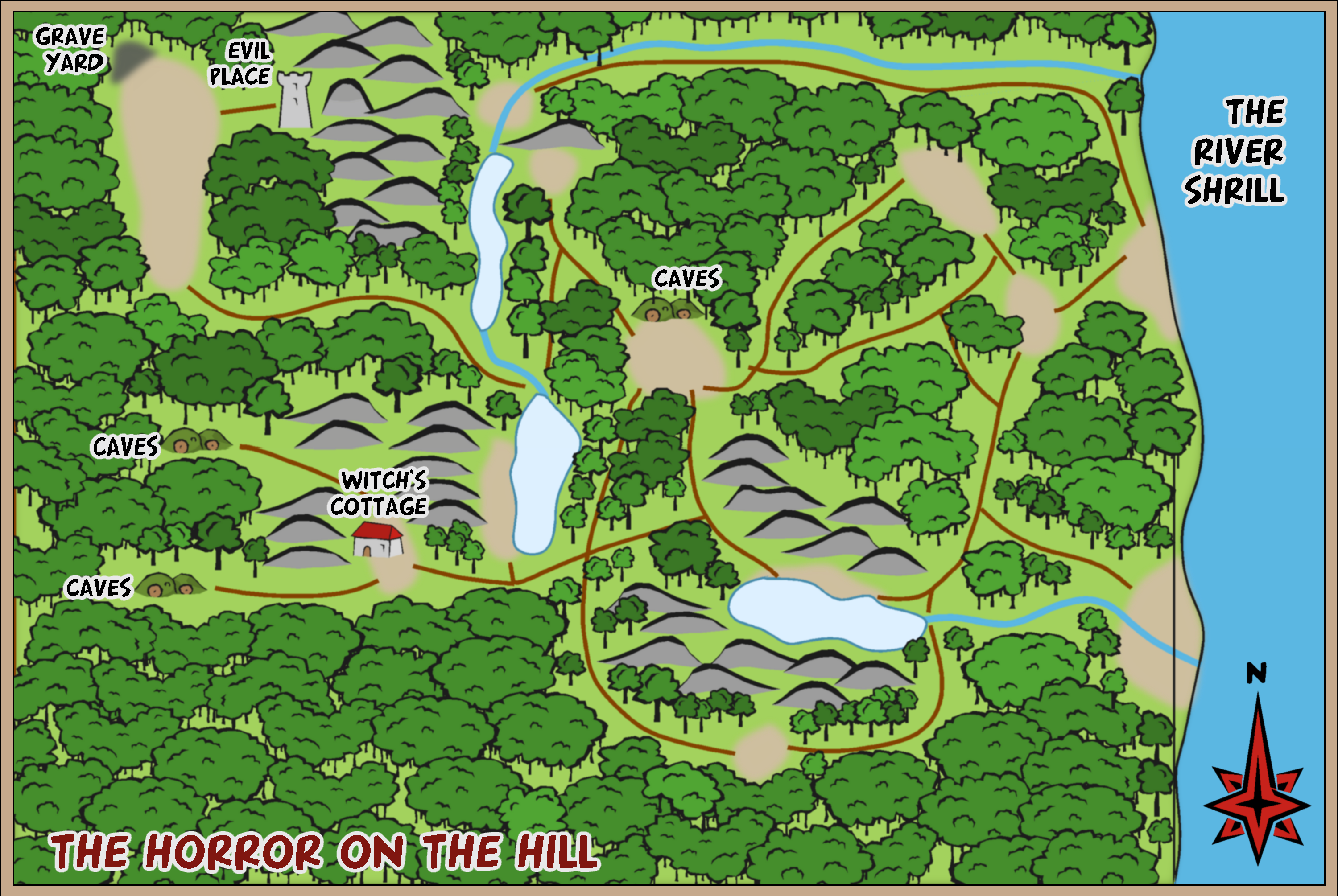
Here's the original wilderness map for Horror on the Hill - it might be one of my least favorite maps in the early B-series canon.  It needed something different.

Blech

At least for now, I've gone with a fun style reminiscent of a theme park map.  Maybe I'll do a Keep on the Borderlands map in this style at some point too.  I've lost some of the cliffs and elevation, so I may take another go but this made me chuckle and I had fun with it.

Horror on the Hill - theme-park style!

Here's the path the players have taken the first couple of games.  They cleared out a nest of killer bees (1), avoided a steamy geothermal cave (2), scouted an encampment of hobgoblins and avoided them (3), fought some ghouls in the graveyard (4), and then began exploring the ruined evil monastery on the top of the hill (5).

The trip to the top

We're enjoying Shadowdark so far - it feels like an OSR system, with a heavy focus on exploration, XP for treasure, and survival horror.  Player characters are very soft at level 1 and damage is flat, so the risk of TPK is ever-present.  Fighters are good, magic is powerful but unpredictable, and people drop to zero hit points a lot.  The "downed rules" do give the party a round or so to revive a dying character, which is both a little forgiving but creates a logistical challenge for the other players, so I'm enjoying the effects.

More to come on Shadowdark, but first I'll show how we wrapped our Death Frost Doom campaign.  Salut!