Saturday, April 18, 2020

People are the Real Monsters

NPC Stat Blocks in the Fifth Edition

"Monsters are real... and they look like people".  Humans are the most compelling opponents in a roleplaying game.  Players may attack a band of orcs as a knee-jerk reaction (grrr, monsters, kill them) but when they run into a rival band of adventurers, most groups stop and think.  Fight, parlay, intimidate, team-up, betray.  If Game of Thrones taught us anything, betrayal at the hands of supposed friends and allies spawns bitter tears, and revenge is a dish best served cold.  Our most memorable villains have been NPCs that the players can't immediately kill - either because of the political situation, or because they're not powerful enough.  I firmly believe games need powerful NPC characters that can challenge the players both inside and outside the dungeon.  In fact, using my my last post as a guide, the Gygaxian demographics of classic locales such as Hommlet or the Keep on the Borderlands indicated that 15-20% of the people living in settlements have character levels, capable of helping or hindering the player characters.

When 5E came out, there weren't too many pre-made NPC stat blocks in the base game - the Monster Manual included 20 or so out of 450+ monsters.  The referee was mostly on their own to use the Dungeon Master's Guide to build additional NPCs as monsters.  Now that there's well over a dozen adventures and soucebooks, the game has accumulated quite a few more pre-made stat blocks for NPCs (90+ in fact).  To make it easier on myself populating the world with people-monsters, I aggregated them in one place - you can check out a copy here ( 5E NPCs by CR *).

As a simple experiment, I took a look at two classic adventuring parties - how easy would it be to quickly assemble them using the 5E NPC stat blocks?  Without further ado here is the gang of Aggro the Ax, who faced off against Gutboy Barrelhouse and company.  (Bonus points if you remember where these guys showed up!)


A few points to call out.  There are not exact matches - Arkayn is listed as a Cleric 4, the Priest NPC statblock is for a level 5 Cleric.  There is no Level 5 Wizard stat block, the Illusionist from Volo's Guide to Monsters is level 7 (but only CR 3).  It'd be easy enough to swap out some spells if you think Abner should be a blasty wizard.  For Blastum, the 'Evil Mage' stat block from Lost Mine of Phandelver is a level 4 caster, so that's a good match.  I didn't see any Fighter/Wizard spell blocks on the list, so I made Barjin a Bard (a 4th level caster stat block).  It took just a few minutes to pull these together, which is good.  I'm pretty confident I could quickly build out a handful of rival adventuring parties for game use from the volume of NPC stat blocks that now exist in the 5E accumulated bestiary.

Here's a watch out though.  The NPC stat blocks top out at CR 12!  Let's put that in perspective.  In 5E terms, a CR X monster is meant to be a hard fight for a 4-person party of X level.  A CR 12 NPC should be a challenging encounter for a 12th level party.  In reality, optimized and competent players punch way above their weight class.  Plus the action economy dictates that a 4 on 1 fight will not go well for the monster side.  A CR 12 NPC is something like an archmage or archdruid (18th level casters).  Your goal as referee is going to be to ensure any one these CR 12 NPCs never faces off solo against a group of powerful opponents - they need to have strongholds, retainers, henchmen, and allies to round out their defenses.  I've run some Tier 3 5th Edition (character levels 11-16) and it's fun trying to challenge over-powered characters.  Looking forward to thinking about high level NPCs hang onto their power in a world with player characters.


* I didn't include NPCs from specific settings like Ravnica or Eberron, but I'll update the doc if/when I add them in there.  Let me know if anyone has an issue accessing it; this is the first time I'm posting a file via Google Drive - if it works I'll do it more.

Saturday, April 11, 2020

Compost Heaps and Snowflakes - a Look at Hommlet, Phandalin, and the Keep

Last post I laid out a thesis - as the style of play in D&D has shifted towards "unique and special heroes", it's significantly altered how designers approach world-building - particularly around setting demographics.  I used the Fight Club/Tyler Durden movie quote as a launch point for a look at how styles have changed.  As an experiment I'm now reviewing the design choices in a few of the iconic starting locations for early D&D and then Fifth Edition - comparing the Village of Hommlet and Keep on the Borderlands with the Village of Phandalin (the starting locale in both of 5E's boxed sets).  The designer's approach to detailing the demographics and factions of the home base imply what the game is about and activities contemplated in the respective locales.

Home Bases in the Compost Heap
Two of the most well-known starting bases in D&D's history are The Village of Hommlet (from module T1 of the same name), and the Keep, from module B1 The Keep on the Borderlands.  Both were penned by Gary Gygax, co-creator of the game, and have a lot to say about his world-building philosophy and view of player characters.  Let's start with a look at Hommlet.

Hommlet's main track
I've started so many AD&D campaigns in Hommlet through the years I can practically close my eyes and imagine entering the village from the west on foot, passing Elmo's farmhouse, and turning up the tree-lined road towards the Inn of the Welcome Wench - with the sounds of the blacksmith's shop across the way ringing out in the morning air.  It's a D&D equivalent of the Prancing Pony and the Village of Bree, a launchpad for adventure.  What jumps out to you when reading the depictions of Hommlet is how every cottage and building has a description that goes beyond a superficial view of what the players see - it'll include the strongbox with 50sp under the loose floorboard, or how the farmer is a member of the "Old Faith" and trains with his strapping sons for the village militia.  Their spears and ringmail armor are polished and in the shed out back, in case you need to know.

In fact, many of the people in Hommlet have character levels as adventurers.  Elmo is a 4th level Ranger, who keeps a magic battle ax, chain armor, and shield, buried in a lead-lined chest to foil detect magic attempts.  The Druid of the Grove is 7th level.  Not only are the nearby rulers, Rufus and Burne, retired adventurers themselves (8th level fighter and magic user respectively), but the players can hear local tales about how the pair fought a green dragon and a large horde of bandits in their younger days.  Now they're spending their adventuring hoard on a sturdy tower and keep, and protecting the area with a troop of mercenaries, the Badgers.

What does this approach to setting design imply about the world?  First - the player characters are not particularly special.  The world is full of monsters and dangerous places, and the player characters will not be the first people to take up arms against the night creatures and return from their exploits with wealth and experience.  Hommlet has 15 non-player characters (out of about 75 or so) that have character levels.  In fact, the village boasts a 10th level thief, a 7th level assassin, 8th level fighter and magic user, 7th level druid, 6th level cleric, and then a handful of lower level NPCs.  Essentially 20% of the village has a level like an adventurer!  This is a place that could mount a defense against an assault on the village, or put a bunch of rogue player characters in their place if they turned into actual "murder hobos" and unleashed mayhem, as the haters would say.

This type of design anticipates a range of alignments and play styles at the table - not everyone is expected to be Dudley Do-Right.  Gary planned for scoundrels.  You don't hide Elmo's magic armor in a lead-lined chest under the floor unless you expect mischievous player characters to use their detect magic spell to try and find something to steal.  Hommlet envisions a game world where characters with magic and powers are known, and reasonable people train and prepare because the wilds have bandits and monsters.  People that come to town might have low morals.  Be ready for them.

Furthermore, it shows a career arc for player characters, right from the beginning, that grounds their journey in the world of the setting.  Adventurers accumulate wealth and fame, and then settle down as rulers or leaders in the community.  The clerics build chapels or temples or groves, wizards create towers and places for their libraries, fighters attract men-at-arms and settle the wilds.  They don't necessarily stop adventuring, but the types of challenges that cause them to take up arms are different, the threats must be greater.

Approaching the Keep on the Borderlands
Let's pivot to the Keep on the Borderlands.  The civilian section of the Keep is far more limited, with only about 30 or so non-military personnel in the "outer bailey".  Overall, the Keep has about 10 people with character levels, ranging up to a 6th level fighter and 5th level cleric.  However, because it's a military installation on the frontier, there's a much larger contingent of guards - 140 level 1 fighters as soldiers.  Much like Hommlet, the depictions of the Keep include details that would only be relevant if the players attempted some mischief, like stealing from the jeweler or looting the chapel.  Also like Hommlet, there's enough "beef" present to make short work of any clumsy attempts to rob the good citizens of the Keep.  The players can try, but they'd better be careful and lucky.

There are two other facets of Hommlet and The Keep to discuss - the idea of factions and quests.  Factions represent roleplaying opportunities for the characters to establish their identities and develop allies.  In Hommlet, the factions include the new faith (based around the church of St Cuthbert) and the old faith (represented by the druid of the grove).  Most citizens are identified as belonging to one or the other of the village's principal religions.  There is also a loose faction concerned with law and order - not far from Hommlet is the large ruined dungeon, the Temple of Elemental Evil, and various factions for good in the nearby kingdoms have agents in or near Hommlet keeping watch on the nearby evil temple.  Elmo reports back to the Viscount of Verbobonc, for instance.  These factions give the players opportunities to learn rumors and lore for adventures - an early form of quest-giving.

The Keep on the Borderlands is straightforward; basic D&D used a simple Law vs Chaos alignment structure, and the Keep is a bastion of law (civilization) out on the chaotic frontier.  Everyone in the Keep stands for a Law, other than one of the prominent NPCs in the outer bailey who is a secret agent of Chaos.  Like Hommlet, the players have the opportunity to collect rumors from citizens of the Keep, which can lead them towards various adventure sites in the nearby wilds.

Where Snowflakes Get their Jobs
Fifth Edition has two boxed sets - the 5E Starter Set and the 5E Essentials Kit.  Both sets came with a basic set of rules and a starting adventure, featuring the village of Phandalin.  If you're a newer player, you may have encountered Phandalin as your model for an introductory home base - either through Lost Mine of Phandelver or Dragon of Icespire Peak, the two starting adventure books.  Phandalin doesn't loom in my memory as a living, breathing place the same way as Hommlet, but Hommlet had 40 years and several beloved AD&D campaigns to establish itself.  I came to appreciate Winterfell and the Nentir Vale during 4E, so newer settings can resonate.  The Forgotten Realms have never excited me, so the bar for Phandalin is higher.  But let's assume I'm a newer player that started with a 5E boxed set, the way I started with the Moldvay Basic Set way back in 1981.  What lessons would I glean from Phandalin about world building and expectations of the game?

First off, Phandalin is sparsely described.  There are 30-35 buildings in the village, but only a handful have descriptions.  There are 14 named characters in the village across the two adventure books.  There are no game stats anywhere.  The text literally says "The characters have no reason to fight ordinary townsfolk, hence no game statistics are provided for them".  Nor are there guards, soldiers, or any type of law & order beyond a non-combatant "town master".  There's a saying - in the kingdom of the blind, the one-eyed man is king.  In a village where everyone is a mere commoner with 4 hit points, a couple of player characters with infinite magic cantrips (take your pick - fire bolt, ray of frost, or eldritch blast) could declare themselves emperors of the village.  I guess there's no point in sacking Phandalin, since none of the locations have anything of value.

You begin to understand what a 5E setting implies about the game.  Characters with adventuring levels are extremely rare - a typical village has no one like the player characters.  Settlements are vulnerable to bandits, ruffians, and any type of predatory humanoid unless adventurers come along to save them.  A town or village is only there to provide clues, hooks, and rumors that quickly route the players out of town to where the adventures happen.  Town is not  a place for action.  Obviously, this also requires everyone at the table to agree to play a "hero" - scoundrels and rogues need not apply.  I'm imagining one of those badly designed video games, where you try and use your attack button on the store clerk, and the game flashes a "you can't do that here" warning on the screen.

One thing Phandalin does well is quests.  Both starting adventures have ample rumors, clues, and quests scattered liberally across the NPCs in the village.  Icespire Peak is a little more heavy handed, with an actual "job board" posted at the town masters, but I don't disagree with the sentiment there.  The surrounding areas are presented like an open world, with many small adventuring sites.  I like the approach the writers (Perkins and Baker) made in building out the nearby wilds.  There are also a handful of the Forgotten Realms "factions" represented in Phandalin, such as the Harpers, Order of the Gauntlet, Zhentarim, etc.  These can be allies and sources of information for similarly aligned player characters.  None of the contacts are retired adventurers.

What a strange turn modern D&D has taken from the roots of the hobby!  The presentation of Phandalin characterizes how D&D has moved away from explicitly supporting Sword & Sorcery fantasy fiction, clever tricksters, or sullen anti-heroes; there's no longer any model for a career arc from adventurer to authority figure or ruler; even absolute novice adventurers are rare and powerful compared to ordinary people, and could quickly overwhelm a "rugged" frontier settlement like Phandalin.  I will say, in later adventures like the hardcover Waterdeep: Dragon Heist, more care and attention was placed on establishing a city that has institutions and authority figures experienced with dealing with powerful adventurers.  Waterdeep works as a more sensible 5E settlement that assumes adventurers are present in the world and society has adapted to their presence.  Unfortunately, new players get stuck with Phandalin as their model.

Next
Despite my criticisms, I'm currently playing 5E and my players love it.  My project has been to fold, spindle, and mutilate the Fifth so it behaves more like the older editions.  It's a work in progress.  And don't get me wrong - AD&D 1E is full of its own warts.  Weapon speed factors, weapon vs armor class, training costs, psionics, the whole of Unearthed Arcana, the monk class.  It's a rough game to try and play "by the book".  The only truly perfect edition is Moldvay basic (and yet there are detractors of race as class out there).  So don't take any of this too seriously, I'm just poking fun when I use descriptors like compost heaps and snowflakes for game styles.

However, since I am trying to get my 5E settings to behave more like Hommlet, and less like Phandalin, I need to take a harder look at NPCs in the Fifth and what we can do there.  How would we do a 5E version of Hommlet?  How do we create rival adventuring parties?  That's coming up next.

In the meantime, I've posted a new poll.  Some of our best games involved roguish scoundrels landing themselves in regular fiascoes when they tried to rob the bank at the Keep, or break into the evil trading post in Hommlet.  In your games, do you treat your towns and villages like adventuring sites (fair game for unscrupulous players) or more like the Phandalin "video game" approach - "you cannot take the attack action here in town"?

Update:  I needed to pull the poll down as I exceeded "monthly views" for the free gadget - will need to find an alternative.

Friday, April 3, 2020

Are Your PC's Snowflakes or Compost?

Why Tyler Durden Would Play AD&D

"You are not special. You're not a beautiful and unique snowflake. You're the same decaying organic matter as everything else. We're all part of the same compost heap."

I spent some time perusing a message board recently and encountered (gasp) many different opinions.  As I scanned several discussions, particularly about world building, a pattern became apparent to me- a loose correlation between how the referee views adventurers in the setting, and their approach to world building and running adventures.  I'm labeling these two approaches to player characters Snowflakes or Compost.

Snowflakes
Referees in this type of game are likely to come right out and tell the players their characters are special.  They're also expected to be heroes.  Adventurers are rare in the setting, and the player characters, who are all chosen, god-touched, destined, royal blood, or otherwise meant for greatness, will set out on a heroic journey to do something... very important.  This is the realm of Tolkien, Shannara, Earthsea, and much of fantasy literature.

In this type of world, NPCs are like monsters.  They strut and fret their hour across the stage, and then are heard no more.  The world is constructed like those old Wild West movie sets, props to give the illusion of a world.  The elements of the game world exist to support the referee's story and enable the characters to be heroes.  Detailed demographics don't add value; the referee is empowered to make up what is needed in terms of NPC's to fit the needs of the story.  Player characters rarely run into rival adventurers in dungeons, if ever.

Adventures involving the snowflake style are probably plotted adventure paths - the goal is to build a story of epic heroic fantasy and that needs planning and authorial guidance.  Referees feature milestone experience or a similar story-based award, to keep the player characters leveling up at a brisk pace so they can face the next set of challenges.  Encounters are somewhat balanced to the level of the characters, to provide sufficient challenges for an exciting game (Goldilocks style - not too easy, not too hard, but just right).

This style seems massively popular with the influx of gamers in the past decade, and what little of I've seen of popular Twitch games.  In the OSR, we trace this shift towards heroic fantasy and plotted (epic) stories back to Dragonlance, where the players take on the role of pre-made heroes of destiny (characters from the actual fantasy novels themselves.)

Compost
This style of world building assumes player characters are made of the same "compost heap" as the rest of the world.  While adventurers will eventually rise to levels of great power, at the beginning they're no better than a common soldier or town guard, true apprentices in their chosen fields.  Adventurers are common in the world; many of the rulers, archmages, and luminaries of the setting got their starts as adventurers themselves.  (Just look at characters like Mordenkainen, Bigby, Robilar, and more from classic worlds like Greyhawk).  Because player characters became rulers with armies, compost settings needed mass combat rules, too.

NPCs in a compost game are built with the same rules as player characters, with the same levels of power.  Rival adventurers are common in this type of setting and the random encounter charts will feature NPC parties regularly, both in the wilds and dungeons.  Compost games favor an open world format - some type of sandbox, with numerous ruins and site-based adventures, and adventurers earn experience predominantly by recovering treasure. The story is less about the referee preparing an epic storyline, and more about presenting a setting with interesting choices.  Compost games are intensely interested in demographics and worldbuilding because they rely heavily on random tables - random tables are defining characteristics of the setting, the secret code.  The world is not level-balanced, and it's possible for careless player characters to stumble into danger way beyond their power level.

Editions and Bias
The snowflake style started in D&D back with Dragonlance.  I don't remember how common it was during 2E (I mostly skipped that edition) but epic adventure paths highlighting heroic characters were a defining characteristic of 3E and Paizo.  Nonetheless, 3rd edition and 3.5 took the compost approach to demographics and worldbuilding to the extreme - every NPC in the setting had player character style rules and templates applied.  It was a path of madness.  I can't comment how it may have improved with Pathfinder or PF2E.  4E completely embraced snowflake style worldbuilding, but it forced the referee to level balance every encounter to the level range of the player characters.  The 4E world made no logical sense in the absence of PCs.  A 4E Troll, for instance, had an armor class somewhere in the 30's; no NPC in the setting could even hurt a troll, unless some level-appropriate player characters came along to fight it off.  A single troll, nigh invulnerable, would reign supreme in a small kingdom!  It was terrible.

5th edition leans more towards the snowflake approach, but the pendulum slowly shifts towards the center.  NPCs don't follow PC rules, and there's no easy way to build rival adventuring parties - the likeliest approach is to cobble something together from the limited NPC stat blocks that have been published here and there in monster books.  There's nothing stopping a referee from making NPCs using player character rules, though - it's just unwieldy.  Random tables for wandering monsters weren't in the base game, they came out later in a sourcebook, but they're there now - and a few of the published adventures have started incorporating them into the design.  A 5E conceit called "bounded accuracy" ensures your village full of commoners could defend themselves against a predatory monster, such as a troll.  There's no in-game path for player characters to move into domain ownership and become rulers or wage military campaigns - 5E campaigns are laser focused on adventuring.

I suppose I'll keep plugging away on my future 5E setting for sometime after Tomb of Annihilation - but now I have a nickname for it that works on several levels.  The compost heap!

Sunday, March 29, 2020

Tomb of the Nine Gods - Game Reports for Levels 1 and 2

It's been a couple of months since we checked in on my weekly home game, using the Tomb of Annihilation hardcover campaign.  Previous installments are here (Tomb of Annihilation).  This is WOTC's best published campaign, full stop, especially if you grew up playing 70's and 80's D&D.  This campaign is a giant sandbox, pure and simple.  There are some overarching objectives, but how the characters get there is up to the players.  My guys ended up as privateers at one point, sailing around Chult and hunting pirates!  Overall, WOTC has done a nice job of writing most of their hardcover campaigns to feature open world sandbox adventures - Princes of the Apocalypse, Curse of Strahd, Storm King's Thunder, Dungeon of the Mad Mage, and Tomb of Annihilation are all open structures, while Tales of the Yawning Portal and Ghosts of Saltmarsh feature reprints of classic dungeons (many from the AD&D catalog).  I'd just like to see a Greyhawk Sourcebook, please.

The Tomb of the Nine Gods is the capstone dungeon for the campaign.  It's a sprawling death trap dungeon filled with puzzles and traps (6 levels, covering 80 or so rooms).  There were 9 "trickster gods" slain by Acererak, each representing a different alignment, and their crypts are scattered throughout the dungeon.  Each crypt is basically a heist, with puzzles and traps.  When the characters succeed in opening a sarcophagus of a trickster god, they gain a useful magic item, and the character has a chance of being possessed by the trickster spirit, which then goads them to try and act in accordance with the spirit's alignment.  It's created interesting roleplaying, as some of the good aligned characters are hosting evil spirits, and frequently admonishing the spirits that "my mind is now your prison and I will never give in to your evil urges".  We've got at least one Lawful Good spirit in the mind of an evil character, "Ew, your mind is like a bathroom that's never been cleaned.  I can't unsee what you're thinking", and there are couple of character/spirits that are well-paired with each other.  From time to time, the spirits also pass useful information or lore on to their hosts.

We've played 7 sessions in the Tomb so far, covering dungeon levels 1 and 2 (sessions 28-34 of our overall campaign).  It's slow going, but not a slog.  Most rooms have the potential to be very deadly, and a few can be actual TPK's, so the players are being cautious and doing a lot of planning.  One thing I've noticed is that many of the Save or Die type effects have been replaced with "save, or take massive damage" - like 75-100 hit points types of damage.  Plus if you die, many of the traps have a secondary effect - the character is chopped in half, or disintegrated completely.  Because the over-arching campaign revolves around a "Death Curse" that has deactivated Raise Dead effects worldwide, dying in the Tomb is effectively perma-death anyway.  Not even Revivify, a common 3rd level spell to pull someone back from death's door, works in this campaign.  Death's stick.

It's no surprise the players trod slowly and carefully.  I'm expecting the campaign to take a few more months, ending somewhere between sessions 45-50, after a year of play.  Good value returned for a hard back book.

One thing the campaign has improved is my ability to drop innocuous verbal cues in descriptions to foreshadow traps, secret doors, and similar concealed structures.  There are many important rooms hidden on each level and it's easy for the players to devolve into "pixel bitching", the art of searching every 10' square for hidden stuff, at a snail's pace.  I'd much rather describe a scuff mark on the floor (where a secret door rotates out) or a discolored mark (where a hidden trap crushed a previous victim) as part of a broader description, and let the players sift through what's meaningful (if they're paying attention to cues).

Enough preamble, here's our cast of characters and then on to the highlights:

Cast of Characters

  • Stompy, a forge priest dwarf cleric (level 8).  His catch phrase is "Thems good eating!", such as after facing a dinosaur.
  • Woodson, an Aasimar sorceror (level 9).  He's good at one thing - burning stuff.
  • Reed, halfling rogue (level 9).  Their no-nonsense scout.
  • Osric, a hexblade warlock and their "tank" (level 9).  The party's megalomaniac conqueror.
  • Emporo the Mighty, fighter sidekick (level 9).  The super competent sidekick (if Osric is Dr Venture, Emporo is Brock Samson).
  • Prism, an evoker wizard (level 8). Was once a Wizard of Thay, now support Osric's schemes.


Level 1 - Rotten Halls
The entrance to the tomb is in the north of the ruined city.  There's a false entrance and a hidden real entrance.  The jungle surface has invaded the first level, draping the walls in vines and dappling the floor with sunlight; the traps include walls of darts and spiked pits that make it feel like an Indiana Jones excursion.  The crypts on this level were fairly easy for the group to navigate; the hazards were manageable, and there were several battles with the undead.  The most difficult death trap involved getting past an adamantine fan, into a room that required a character to enter a box in order to turn a key-nob that can only be turned when the box is closed; closing the box and turning the nob inflicted a terrible effect on the character.  Woodson went into the first and second box (wearing a Death Ward spell) which kept him from disintegrating after taking lethal damage in the black box.  Osric dealt with the final box by summoning a minor demon and compelling it close the lid and turn the nob for him.  Since that experience, the characters have been leaning hard on Death Ward.

Misty Step has helped the magical characters get out of harm's way several times, but apparently Dimension Door is prohibited.  The one time Reed activated his Cloak of the Mountebank to bypass a hazard with Dimension Door, he landed in a horrible oubliette piled 6' deep in corpses.  The real horror began when a tentacled monstrosity, an Otyugh, stalked him through the filth.  Reed had to evade the monster's groping tentacles by hiding beneath a corpse, using it as a shield, and scooting carefully towards one of the ubiquitous "green devil faces" on the wall using the corpse as moving cover (he called it his "Walking Dead" maneuver).  He pulled a lever in the green devil face, which created a vacuum, sucking all the contents of the room into the devil face's mouth (to be disintegrated by a sphere of annihilation).  This got rid of the Otyugh, but Reed had to succeed at 6 consecutive saving throws to avoid getting pulled into oblivion by clinging to the outside of the devil face.  After a minute or so, the suction ended and he was able to flip a second lever, which teleported him out of the room trap.  The players have learned through trial and error certain magical effects are denied by the power of the tomb.

The layout of the tomb is easily navigable, with a 50' wide spiral staircase surrounding an open vault that descends across the top four levels of the tomb.  In addition, there are hidden stairs up and down that can be found, there are pits that allow descent between levels, and even a waterfall down to level 5.  It's a well-designed layout with lots of interaction and mobility.  The players sent a flying familiar down the vault to begin scouting the other levels and the bottom of the shaft - t least until it was shot by an undead dwarf with a crossbow down on one of the lower levels.

In addition to running into "tomb dwarves", undead workers with green devil masks, they also ran into "tomb guardians", misshapen flesh golems in heavy plate armor and bucket helmets ("Gregor Cleganes").

Level 2 - Dungeon of Deception
An interesting features on level 2 is a gravity ring - a looping passage that makes a complete vertical circle.  As the players walk the circle, they inadvertently enter a demi-plane where a mirror copy of the tomb exists, used for testing new traps.  At first, the players didn't realize they were in a mirror tomb, but when they did figure it out they realized it could be used to "practice" defeating the puzzles and traps of the crypts before doing it for keeps in the real world.  Along the way, a few of the characters attuned to a magic item that cursed them with turning into man-goats.  Lots of bah-bah-bad jokes incoming.  Stompy and Prism are both furry goat-man hybrids now.

One of our entertaining bits was when the players stumbled into a workshop area where the tomb dwarves assembled new tomb guardians.  They ran into "Withers", an undead wizard tasked by Acererak with keeping the traps running.  Withers thought of himself as the "branch manager" in charge of guest services.  I love megadungeons, or in this case a large dungeon, that account for maintenance and expansion of the environs.  Withers viewed himself as responsible for presenting an entertaining experience for the "guests".  When the players stumbled into his office, he asked enthusiastically about their exploits - which traps and hazards were harrowing, which ones were too easy, if they ran into the owner would they be leaving a good review?  Of course he admonished them for straying into the "employee-only area", and that he'd be forced to notify the owner if they didn't comply with guest policy and return to the guest areas.  Alas poor Withers, he may be Acererak's employee of the year, but they ended up killing him anyway.

Next up, they'll be exploring level 3.  The past two weeks of gaming online (via Zoom) have worked out well for us.  Hopefully you've given it a try with your own gaming groups as we all stay indoors.


Monday, March 23, 2020

Gaming in the Time of Corona

How We Moved Our Game Online During the Virus

The world has changed a lot in a week.  We've jumped from a little over 1,000 cases in the US to 40,000 cases of the virus.  Competence is not a strength of the current government; it seems likely the reported numbers are significantly under-stated based on the poor testing and preparations.  Schools are closed, businesses are shut down, and people huddle in their homes.  Medical supplies are already dwindling and we're only in the opening weeks of the campaign agains the pandemic.  The local county hospital has already appealed to locals to donate extra masks - construction businesses and carpenters have been donating the masks they use for managing dust on work sites.  It's going to be a bumpy time for us.

There's a lot of stress and anxiety in our daily lives, much uncertainty about what's going to happen.  Will we be able to stay healthy?  If someone you know or love gets very sick, will the healthcare system be there to catch them?  These are frightening considerations.

I'm able to work from home, and my company manufactures stuff that's considered essential to the supply chain (not toilet paper, but other stuff that ends up in grocery stores).  Waking up, logging in, and follow a regular workday routine is surreal against the backdrop of the daily news, but the normalcy of it helps to breed a little calm.

It's important to stay connected during this period of "sheltering in place" and social distancing.  The kids are connecting with their friends on FaceTime and social media and video games.  It was important to me to figure out how to shift our table top game online and stay connected with "the boys".  I'll take a few hours of seeing friends, laughing, and getting to do our "elf games" as a slice of normalcy under these circumstances.

I did a survey of available technologies and approaches, and we landed on one that seemed to do well for us.  In the interest of sharing what we did and how it worked, here's how we brought our game online.

Technology
There are a handful of technological questions to answer:  Do you want to use a Virtual Table with digital maps and automation?  How will you solve for voice conversations (and/or video)?  Do you want online character sheets and an online dice roller?

The Virtual Table Tops are intriguing and they offer a lot of cool automation (but at a high price).  There are subscription costs, and the requirement of buying digital copies of books you already own.  Plus they seemed to have a high learning curve. Considering that this is only meant to be a stop gap for a few months, I wanted to try an approach that felt more like our regular game and didn't involve a huge learning curve.  (I'm tech savvy but that's not where I wanted to spend energy during the plague).

We looked at different options for voice and video, like Discord or Skype.  I use Zoom at work and it has some useful features during video calls that made gaming easier.  We coalesced on Zoom for the voice and video tool.

Zoom and no Virtual Table meant the players would have to be responsible for maintaining local character sheets and local dice rolling (the honor system).  I use a notebook to track hit points, spell slots, and all sorts of limited resources during our regular games, so it was easy to keep that up on my side during the switch to online gaming.

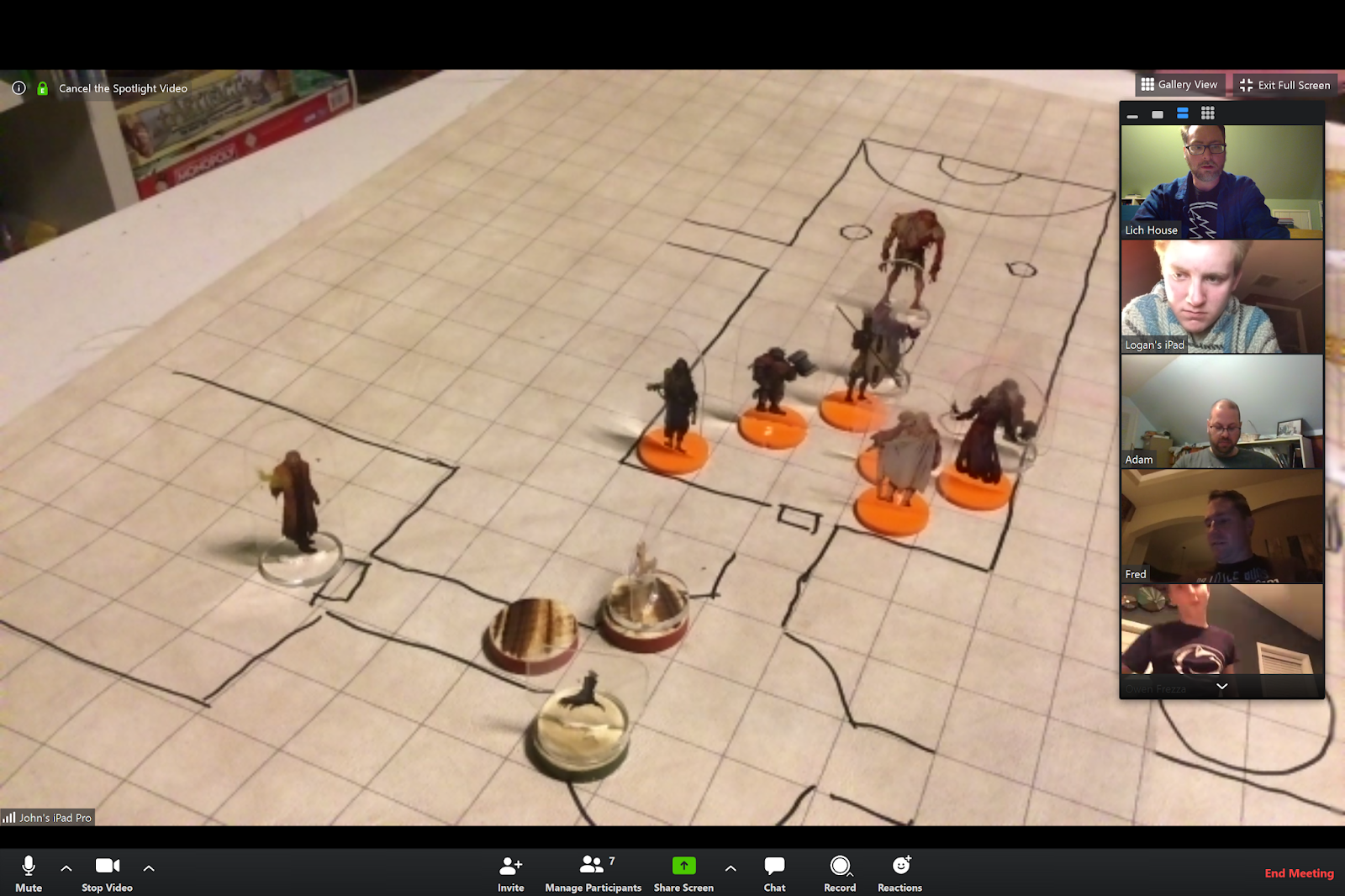
On Saturday, I did a technology test with each player, made sure their device of choice (either PC or iPad) had the Zoom client, good sound and microphone, and could see the map.  On my side, I used an iPad with a permanent view of the battle-map and a laptop camera to engage with the players.  We were ready for regular Sunday night gaming.

The players appoint a traditional caller and mapper each night; the mapper drew on regular graph paper and held their work up to the camera for the other players to see when they needed to make a decision.  During combat, I put the initiative order on my DM screen like always, and called on the players in turn; I was remote hands to move their miniatures on the battle mat as they took their turns and described where they wanted to move.

Here are some pictures.  The top one is the group in "gallery view".  Voice and video were very clear on Zoom, and the players can see gestures, body language, smiles, the whole thing.  One warning is you need a paid license for Zoom ($15 for the host for a month).


Zoom has a spotlight feature where you can make one of the videos persistent and large sized - this let the players make the camera on the battle mat larger size and zoom in to see more of the battle mat.


Stay safe everyone and cherish your loved ones through this mess.  If like me, getting together with your friends and playing some D&D games online offers solace and normalcy during the chaos, I hope our approach gives you some ideas on making it work.  Feel free to ask questions in the comments.  Be well.


Saturday, March 21, 2020

A Turning Point with 5th Edition

I've been dubious about 5E.  I do not see eye to eye with modern adventure design and the expectations of modern players (post TSR players).  The story of my blog has become a search for a middle ground - running the system my friends all prefer (the 5th) while running a game that satisfies my own expecations, too.  However, I finally think we're getting there.

If you've read my game reports on Tomb of Annihilation (TOA) you know TOA is one of 5E's adventures I praise liberally.  It's flaws are modest, it's virtues are many.  It thrusts the players into an old school style hex crawl, requiring that they plan and manage resources.  The story isn't about an author's scene-based plot to follow, it's an emergent story built over time based on player actions.  Tomb of Annihilation checks off some good boxes.

We are in the capstone dungeon of the campaign, a grim place called the Tomb of the Nine Gods (the erstwhile Tomb of Annihilation itself, the namesake).  It means what it says on the cover.  Death lurks around every corner.

I've noticed a big change in the players.  Everyone has been leaning in a little more at the table.  They take their time discussing spell choices and preparations for the adventuring day.  Planning matters.  There's a nervous energy as I describe the next room. It's palpable.  The threat of instant death has a way of sharpening the mind.

It brings to mind a Flannery O'Connor quote, from a "A Good Man is Hard to Find":  "She would of been a good woman," The Misfit said, "if it had been somebody there to shoot her every minute of her life."

5E feels the most like D&D when there are real consequences behind every player choice.  Many of the hardback books are too "balanced" and forgiving.  I'm starting to see what it takes to deliver a good game of 5E (my definition of a good game, at least).

The Tomb of the Nine Gods is not unfair, and I'm not an adversarial DM.  Sure there are save-or-die effects, and massive damage traps, and literal death rooms that can kill the whole party.  It's an homage to Tomb of Horrors!  But there are clues, and high level characters are not without resources.  Mostly though, the players are surviving because they are planning well, making smart choices, and sometimes getting a little lucky.  They've cheered each other and high-fived each other and relished their hard won successes.  It's been real fun on both sides of the screen.  It's been D&D.

I wasn't sure how this bare-knuckled style was going to play out in a Fifth Edition setting, and it's going quite well.  My 5E "training period" is coming to a close.

PS:
Mandatory Corona-vacation will shift us online for our next game session - I'll come back with a report on what tools we used and how it went.  And I'll get a game report posted with some details of these "player victories" in the Tomb.

Monday, March 16, 2020

Kickstarter Alert - Flat Plastic Miniatures Hardbound Support

I'm a big fan of Flat Plastic Miniatures (FPM) and have been using them for a couple of years now.  I love the fact that I can store a thousand miniatures in a few small binders.

The idea behind this particular kickstarter campaign is pretty cool - it'll provide every miniature you'd need to run a published 5E adventure.  This is the first campaign, and it's for "Last Mine of Phandelver", the first adventure that appeared in the D&D Basic Set.  The main tier ($60) gets you 84 miniatures, bases, and a carrying case.  It's got 4 days to go at $29,700 and I'd love to see it hit $30k and unlock the extras.  I'm expecting this will be the first of many "hardbound support" campaigns, they've hinted next up could be Storm King's Thunder.  The link to the kickstarter is here:  Hardbound Support

Here are some pics of FPM in use last night (they've been regulars in my Chult campaign).  These are from a crypt on level tomb of the Tomb of the Nine Gods in Tomb of Annihilation:


And here's a picture of one of the carrying cases (a mini "Flexxfolio" from Ultimate Guard).  They are super easy to haul around in little binders: