Showing posts with label Flat Plastic Miniatures. Show all posts

Sunday, May 17, 2020

Death in Chult


It's been a few weeks since we checked in on my Tomb of Annihilation game, and what the players have been doing.  The short answer - they've been dying!  The game is 5E, so character death is much rarer than OSR games, especially when the group is 9th and 10th level.  Despite us playing 5E, they managed to get two founding members killed last week.

The Tomb of the Nine Gods (the erstwhile Tomb of Annihilation) is a creation of the lich Acererak, with green devil faces and all the Acererak stuff you'd expect.  Hidden somewhere in the tomb is a corrupt relic that's causing a "death curse" in the Forgotten Realms.  The campaign has seen the players explore a massive jungle hex crawl, a ruined city deep in the jungle, and now a trap-filled dungeon, seeking the source of the death curse.  The 3rd level of the tomb, where our action occurred, also happens to be the lair of a Beholder, "Belchorzh the Unseen".

Many of the walls across level 3 are covered in purple mold, which can sprout small eyeballs to watch the adventurers... or zap them with an eye ray if they try and destroy the mold.  It's similar to a "lair effect" for the beholder.  As the players carefully made their way across level 3, defeating puzzles and traps, fighting the tomb's guardians, the beholder was there, watching from the purple mold eyeballs.  When they collected the 10 "eye gems" needed to unlock the vault door to the beholder's lair, it knew their personalities and capabilities well.

Belchorzh lairs in a 50' diameter vaulted room, with a 50' domed ceiling overhead.  The polished, reflective marble of the floor was treated to be like ice, causing unlucky characters to slip and fall.  The beholder had another unfair environmental factor, a floating metal sphere (6' across) with a powerful magnetic effect that sucked all metal-wearing characters to stick to the sphere.  The magnetic field also caused missiles to veer off-kilter, making ranged attacks against the beholder suffer disadvantage.

Besides it's eye rays and anti-magic cone, the beholder also had the gift of invisibility.  He is called Belchorzh the Unseen, after all.  Acererak had granted the beholder a permanent invisibility effect with a wish spell; dispelling the invisibility was not a guarantee unless the players got lucky.

Tracking an invisible flying monster, that can move 3 dimensional, is challenging, but managing the beholder's tactics is compounded by needing to consider the cone of anti-magic out of it's main eye, which nullifies it's own eye rays.  I developed a notation for the beholder's turns of tracking which clock setting the beholder was closest, where it was looking (for purposes of the anti-magic) and it's current elevation, in case of area attacks.  In this way I could leave the beholder off the field of battle while it was undetected and invisible, but still track it's location in case someone got lucky with an area attack, like a fireball.  As a rule, the beholder would suppress part of the group with it's anti-magic cone, leave some character's unaffected, and then assault the characters outside of the anti-magic zone with eye rays.

Two of the heavy hitters (the warlock Osric and the dwarf cleric, Stompy) both got stuck to the magnet ball, which the beholder levitated up the ceiling on a future turn with its telekinesis power, putting them out of the way.  Because it never looked up with the anti-magic cone, they were good targets for random eye rays, and the dwarf would have been killed by a death ray if not for wearing a "death ward" spell.  As the beholder used eye rays, the players could triangulate it's position for area fire and place it in a vicinity, even if they couldn't see it.

A beholder laying the smackdown


After a session and a half of battling the beholder, the group suffered crippling losses and eventually made a run for it.  Reed, their halfling rogue, was disintegrated to a pile of dust; Emporo the Mighty, their fighter, was petrified and abandoned to his fate.  The other characters had been experiencing a wide range of deleterious effects, such as paralysis, sleep, and the worst - being charmed.  Beholders are no joke.

Here's a question for fellow referees - how much do you consider it the dungeon master's role to coach and train your table of players to play well?  I don't mean "in the moment", they need to make their own choices during tactical play, otherwise you're just playing the game for them.  But I'll give you an example of coaching - before we started this final chapter of the campaign, now going back a few months ago, I suggested they make it a habit to talk (as a group) about spell preparation whenever they finish a long rest - it encourages group problem solving and awareness of each other's capabilities.  Plus our two spell casters, the cleric and wizard, are both casual players and could use the help with spell selection from the power gamers.  I insinuated that a trap-filled puzzle dungeon requires different planning considerations than a combat-heavy dungeon crawl; they should reconsider detection spells, locate object, dispel magic, and similar utility spells.  "What got you here won't get you there", as they say; the game is changing.  It's one of the truly great or terrible things about Tomb of Annihilation; the different campaign arcs require different stylistic approaches to succeed, providing distinct arcs and experiences. Hex crawling wilderness travel doesn't prepare you for Tomb of Horrors style misdirection and stakes.

Their first blunder in the beholder's lair was not having (enough) dispel magic on hand.  The warlock had it prepared, but he used his first spell slot to summon an elemental, and he failed his dispel magic roll on his one shot to dispel the invisibility.  The cleric, wizard, and sorceror could offer nothing, and were punished for it - they couldn't deactivate the magnet ball, save their friends from charm spells, or deal with the beholder's invisibility, which even limited the use of their spell repertoires.  You can't magic missile something you can't see.

There were other issues with their all around play, too.  Several characters had access to at-will magic abilities that could let them identify if they were in or out of the anti-magic field just by checking if their items were working - simple stuff, like making their magic weapon glow.  Some of the casters sacrificed spells trying to cast while standing in the anti-magic zone and watching their effect fizzle.  The fighter forgot he was an expert bowman for part of the night.  The metal-armored guys could have cut the straps on their armor to escape the metal magnet globe, or tried to destroy it (especially the dwarf cleric, who wields a non-metal staff of striking).

Despite bad tactics and a poor plan, they still escaped with only two deaths out of six players, and the beholder was down to less than 30 hit points when they finally fled; it had been offering them terms of surrender in the lead up to their departure.  You'd expect a beholder to "own" a party of unprepared characters, so if there's one silver lining, it reiterated that even mid=level 5E can be deadly if the player aren't on top of their game.

We arranged new level 9 characters for the fallen, and inserted them into the dungeon as survivors of an earlier excursion, lost in the mirror dimension (a copy of the tomb accessible on level 2).  Having had enough of invisible beholders, the party rested far away from the beholder's lair, and completely bypassed level 3 on their next trip down.  When we pick up with the next game report, it will be with their explorations on level 4.

Back to the topic of coaching, though, last week's session triggered me to reflect on the role of referee as "good gameplay teacher".  I believe we have an obligation, particularly early in a campaign and with new players, to make sure they understand the rules and their character options.  Friendly reminders of overlooked abilities are appropriate, at the start of a session, for instance.  The reminder that they collaborate on spell selection and planning is of that nature.  Beyond that, however, we have to be willing to let player choice and the dice dictate the outcomes, untroubled by DM interventions.  Our stories of Belchorzh the Unseen, the beholder that bested them and from whom they barely escaped, will be better for it.  Sadly I don't think Tomb of Annihilation is that popular with the typical 5E crowd, they seem to want the heavily plotted adventure path type scenarios.  They're perplexed by how to run a wide-open sandbox game.  It's a pity, because it'd be interesting to read more game reports on how players fared with Belchorzh.

Monday, March 23, 2020

Gaming in the Time of Corona

How We Moved Our Game Online During the Virus

The world has changed a lot in a week.  We've jumped from a little over 1,000 cases in the US to 40,000 cases of the virus.  Competence is not a strength of the current government; it seems likely the reported numbers are significantly under-stated based on the poor testing and preparations.  Schools are closed, businesses are shut down, and people huddle in their homes.  Medical supplies are already dwindling and we're only in the opening weeks of the campaign agains the pandemic.  The local county hospital has already appealed to locals to donate extra masks - construction businesses and carpenters have been donating the masks they use for managing dust on work sites.  It's going to be a bumpy time for us.

There's a lot of stress and anxiety in our daily lives, much uncertainty about what's going to happen.  Will we be able to stay healthy?  If someone you know or love gets very sick, will the healthcare system be there to catch them?  These are frightening considerations.

I'm able to work from home, and my company manufactures stuff that's considered essential to the supply chain (not toilet paper, but other stuff that ends up in grocery stores).  Waking up, logging in, and follow a regular workday routine is surreal against the backdrop of the daily news, but the normalcy of it helps to breed a little calm.

It's important to stay connected during this period of "sheltering in place" and social distancing.  The kids are connecting with their friends on FaceTime and social media and video games.  It was important to me to figure out how to shift our table top game online and stay connected with "the boys".  I'll take a few hours of seeing friends, laughing, and getting to do our "elf games" as a slice of normalcy under these circumstances.

I did a survey of available technologies and approaches, and we landed on one that seemed to do well for us.  In the interest of sharing what we did and how it worked, here's how we brought our game online.

Technology
There are a handful of technological questions to answer:  Do you want to use a Virtual Table with digital maps and automation?  How will you solve for voice conversations (and/or video)?  Do you want online character sheets and an online dice roller?

The Virtual Table Tops are intriguing and they offer a lot of cool automation (but at a high price).  There are subscription costs, and the requirement of buying digital copies of books you already own.  Plus they seemed to have a high learning curve. Considering that this is only meant to be a stop gap for a few months, I wanted to try an approach that felt more like our regular game and didn't involve a huge learning curve.  (I'm tech savvy but that's not where I wanted to spend energy during the plague).

We looked at different options for voice and video, like Discord or Skype.  I use Zoom at work and it has some useful features during video calls that made gaming easier.  We coalesced on Zoom for the voice and video tool.

Zoom and no Virtual Table meant the players would have to be responsible for maintaining local character sheets and local dice rolling (the honor system).  I use a notebook to track hit points, spell slots, and all sorts of limited resources during our regular games, so it was easy to keep that up on my side during the switch to online gaming.

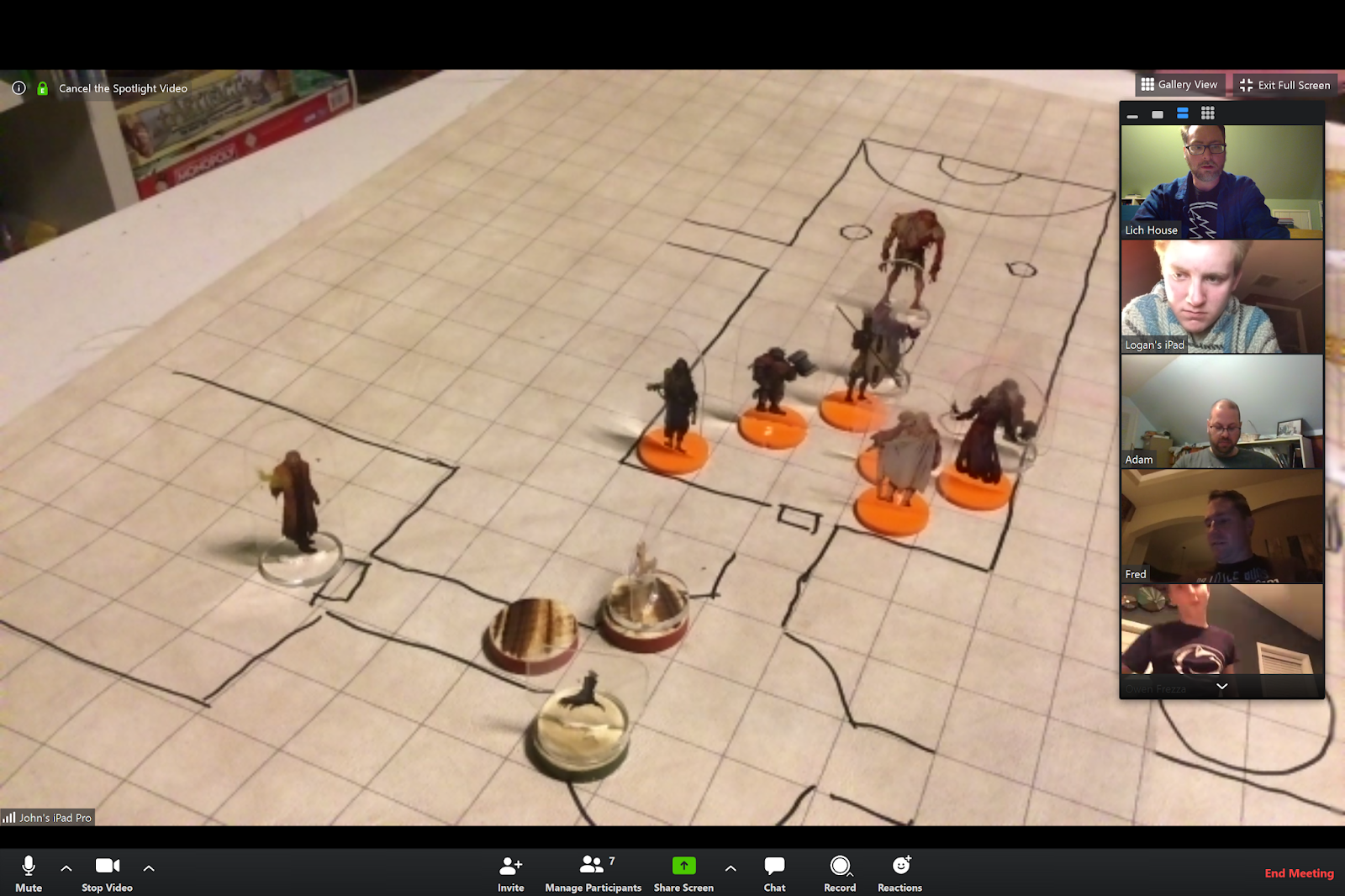
On Saturday, I did a technology test with each player, made sure their device of choice (either PC or iPad) had the Zoom client, good sound and microphone, and could see the map.  On my side, I used an iPad with a permanent view of the battle-map and a laptop camera to engage with the players.  We were ready for regular Sunday night gaming.

The players appoint a traditional caller and mapper each night; the mapper drew on regular graph paper and held their work up to the camera for the other players to see when they needed to make a decision.  During combat, I put the initiative order on my DM screen like always, and called on the players in turn; I was remote hands to move their miniatures on the battle mat as they took their turns and described where they wanted to move.

Here are some pictures.  The top one is the group in "gallery view".  Voice and video were very clear on Zoom, and the players can see gestures, body language, smiles, the whole thing.  One warning is you need a paid license for Zoom ($15 for the host for a month).


Zoom has a spotlight feature where you can make one of the videos persistent and large sized - this let the players make the camera on the battle mat larger size and zoom in to see more of the battle mat.


Stay safe everyone and cherish your loved ones through this mess.  If like me, getting together with your friends and playing some D&D games online offers solace and normalcy during the chaos, I hope our approach gives you some ideas on making it work.  Feel free to ask questions in the comments.  Be well.


Monday, March 16, 2020

Kickstarter Alert - Flat Plastic Miniatures Hardbound Support

I'm a big fan of Flat Plastic Miniatures (FPM) and have been using them for a couple of years now.  I love the fact that I can store a thousand miniatures in a few small binders.

The idea behind this particular kickstarter campaign is pretty cool - it'll provide every miniature you'd need to run a published 5E adventure.  This is the first campaign, and it's for "Last Mine of Phandelver", the first adventure that appeared in the D&D Basic Set.  The main tier ($60) gets you 84 miniatures, bases, and a carrying case.  It's got 4 days to go at $29,700 and I'd love to see it hit $30k and unlock the extras.  I'm expecting this will be the first of many "hardbound support" campaigns, they've hinted next up could be Storm King's Thunder.  The link to the kickstarter is here:  Hardbound Support

Here are some pics of FPM in use last night (they've been regulars in my Chult campaign).  These are from a crypt on level tomb of the Tomb of the Nine Gods in Tomb of Annihilation:


And here's a picture of one of the carrying cases (a mini "Flexxfolio" from Ultimate Guard).  They are super easy to haul around in little binders:


Sunday, August 13, 2017

Flat Plastic Miniatures - and GenCon


I'm off to Gencon in a couple of days after taking a couple of years off.  I don't have a rigidly structured agenda; a friend registered us for a bunch of roleplaying games, and I'm sure I'll get into one or two M:TG (Magic) tournaments with my buddy the Magic player.  We'll have 8+ dads and kids out there, so there will be plenty to do.  One of the things I'm going to check out in the expo area is the "Flat Plastic Miniatures" (FPM) booth.

I got out of collecting miniatures several years ago, and was using wooden blocks when we needed to use a grid vs "theater of the mind" style resolution.  I imagine other DM's are the same - based on the tactical complexity, and the amount of preparation that went into it, we'll decide on the spot whether to run combat on the grid or without miniatures.  I do mix both styles.

I discovered Flat Plastic Miniatures early this year and they've worked well.  Here's a shot from a recent game on how they look on the table:


They feature hand drawn artwork, laser printed onto thin plastic, and inserted into a plastic base.  The pieces feel way more durable than paper or cardboard, and they're a fraction of the cost of 3-D pre-painted miniatures (like the WOTC or Wizkids offerings).  FPM might end up $.25 to $.33 per figure, while the (admittedly) beautiful official Wizkids pieces are $3-$4 per figure.  So FPM is way more budget friendly (although not nearly as friendly as wooden blocks).  When all is said and done, I'll probably spend a few hundred dollars to get a gigantic mini collection with the flat minis, whereas an equivalent collection of painted figures would be minimum several thousand dollars (and, you know, a divorce).

I also like that Flat Plastic Minis are easy to store - I've got several hundred figures in the binder pictured below:


You can get this type of zippered binder at an office supply store.  Since the figures can easily slide out of the binder if it tilts upside down (a mini apocalypse), a zippered binder ensures you're not going to lose anything.  The sleeves are card sleeves, available at a game store or baseball card shop.  At some point the organization compulsion will take me over, and I'll put little label stickers on the sleeves to make it super organized.

Visiting the Flat Plastic Miniatures booth at Gencon is one of my Gencon goals.  They have a ton of sets I don't own, and maybe they'll have some Gencon deals?  I saw LOTFP will be there as well, and I'm sure I'll do a bunch of board game demos too.

Anyone else going, and what kind of stuff do you have planned?

PS:
Here's the link to the store for the guys that sell Flat Plastic Miniatures:  Arcknight.  The store doesn't seem completely up to date, as they've been doing various Kickstarters and so forth.  That's another reason I'm curious to see what's at their Gencon booth.