Showing posts with label Reviews. Show all posts

Friday, January 7, 2022

Let's Look at Dungeon of the Mad Mage

In the city of Waterdeep rests a tavern called the Yawning Portal, named after the gaping pit in its common room. At the bottom of this crumbling shaft is a labyrinthine dungeon shunned by all but the most daring adventurers. Known as Undermountain, this dungeon is the domain of the mad wizard Halaster Blackcloak. Long has the Mad Mage dwelt in these forlorn depths, seeding his lair with monsters, traps, and mysteries—to what end is a constant source of speculation and concern.  (From the back cover of Waterdeep: Dungeon of the Mad Mage.)

Waterdeep:  Dungeon of the Mad Mage by Wizards of the Coast picks up at 5th level, slotting in as a nice follow up to Waterdeep: Dragon Heist or one of the introductory adventurers like Lost Mine of Phandelver, or Dragon of Icespire Peak.  It covers 23 dungeon levels, taking player characters from level 5 up through level 20, and it weighs in at 320 pages, one of the larger adventure books on the WOTC 5E shelf.  (On cursory glance, only Rime of the Frost Maiden also has 320 pages; most of the adventure books like Tomb of Annihilation, Curse of Strahd, Descent into Avernus, et al are 256).

Dungeon of the Mad Mage has an impressive room count as well - 535 encounter areas across its 23 levels, including over 1220+ rooms.  That hearkens back to the 1,000 room dungeons of the olden days (back when druids were true neutral and elven fighters maxed out at 7th level, the way Gary intended).

Most 5E adventure books start with level 1 characters and take the party up to level 10 or so; there are a few outliers like Avernus and Princes of the Apocalypse that cover a 15 level span ( 1-15).  Dungeon of the Mad Mage is the only official campaign designed to challenge 20th level characters.  We shall see if it proves a challenge, when we get there!

It's fine as far as printed megadungeons go.  The levels are interesting and varied, and each is preceded by 1-3 pages of narrative laying out factional conflicts and politics for that level.  I may complain about the Fifth but I generally enjoy Chris Perkins' work as the lead adventure designer, and he did a nice job adapting and updating Undermountain.  There's some history of Undermountain up front - it's a long abandoned elven dungeon, and then a dwarven dungeon, and then a mad wizard's dungeon and all of his apprentices, down through the years.  One of the deeper levels has a portal to an asteroid in outer space!  The room descriptions are brief and use effective bolding to highlight important information for usability.  The text is not hard to run at the table.

The maps are another issue.  The map quality is fine, but the maps themselves are strewn through the text and it's unwieldy to run at the table without a lot of flip-flip page flipping.  Back when I started Undermountain with an Adventurer's League group pre-pandemic, I used the optional "map pack" accessory that includes separated glossy map pages so you can reference the book text and have the correct map side by side behind your DM screen.  Selling an "optional" map pack accessory was some shrewd capitalism by the WOTC overlords.  Of course since the pandemic we've been 100% online anyway.

I am not enamored with the Forgotten Realms.  Years of running published 5E campaign hardbacks set in the Realms have done nothing to dim my smoldering apathy towards them.  (I have a Drizzt Do'Urden voodoo doll in my desk drawer).  But I have learned to appreciate the special charm of having a sprawling megadungeon right under the player's home base city.  It's cool that a raucous adventurer's tavern surrounds the entrance to the dungeon, and rowdy tavern patrons place wagers as adventurers get lowered out of sight into the underworld.  We've gotten some excellent mileage out of those scenes.  The Realms may be bland to me, but putting your giant dungeon under a tavern - ten out of ten, Ed Greenwood, ten out of ten.  (You can't see it, but I'm sending him telepathic heart emoji's.  With my mind).
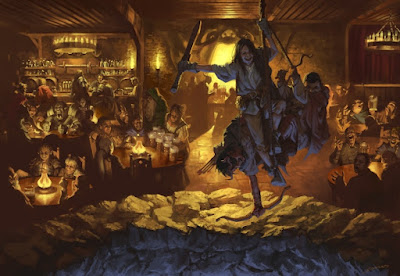
The Yawning Portal dungeon entrance - doesn't that look fun?

There is a significant issue with experience points and pacing with this 5E version.  It's been optimized for a party of 4 players, and there's just enough combat experience, if the players complete every room, to allow this 4-person party to level at the requisite pace.  That's terrible.  It's terrible in so many ways.  As we work through how I've tweaked Dungeon of the Mad Mage for my play style, we'll address the experience point problem right away.

There are essentially no wandering monsters.  On the first two levels, there are a few text blurbs about monsters that wander the levels, but that guidance stops from the 3rd level onwards.  Did Chris Perkins get tired of writing or just run out of space?  We may never know.  What I do know is that you'll be making your own wandering monster tables if that part of the dungeoneering experience is important to you.

Don't let these quibbles dissuade you from checking out Waterdeep: Dungeon of the Mad Mage.  There is no such thing as a perfect WOTC adventure module; if they published one, the world would stop.  Be thankful for their imperfect products with correctable flaws.  Mad Mage is one of the good ones.  In posts to come, I'll lay out tweaks I've made to operate the adventure more to my liking, striving even for an "old school feel" (whatever old school means), and then I'll do some recaps of our play through.  It will be fun.

Happy New Year and thanks for reading.

Sunday, August 16, 2020

LOTFP Review: Fermentum Nigrum Dei Sepulti


A strange stone, tumbling through the void of endless space and into the secret history of the world… the cursed legacy of a doomed witch’s family… a terrified abbot whose desperate plea has gone ignored by Rome… a vile conspiracy of whispers, visions, and delusions among drunken, stumbling brothers… and a black secret, black as the bubbling foam that gushes forth from the ale-barrels and the corpses of the fallen alike…

That's the evocative blurb from the dust jacket on LOTFP's recent book, Fermentum Nigrum Dei Sepulti (Black Yeast of the Buried God).  The adventure is site-based, and kicks off when the adventurers are staying at the inn near the monastery; an overnight massacre happens within the monastery walls as the monks devolve into armed conflict with each other, and fires break out in several buildings.  As the adventurers respond to the chaos, they get drawn into an unfolding horror, which ultimately leads them into exploring the catacombs beneath the monastery.  I should warn you, like any review there's the risk of spoilers if you are a player.

Fermentum is written by Gord Sellars, supported by some recognizable names on Team Raggi (Alex Mayo, Jacob Hurst, and Gonzalo Aeneas as the artist).  Like every LOTFP book I own, it's A5 sized, and the production values of Fermentum as an artifact are impressive.  It has a textured, foil cover (although it does look like on my purchased copy, the foiling didn't reach the bottom cover text.  Jim!).  The pages are heavy weight and feel good to touch, the spine is stitched, the layouts and text are all well done.  I look with dismay at my shelf of falling apart 5E books, broken spines and pages falling out, and wonder why a small publisher in Finland can figure this out but Hasbro's quality is trash?  These LOTFP books are meant to last.  Naturally, they are a little pricier than disposable mass published books.

Here's a view with the layout, art, and feel of the text.

I'd never heard of Gord Sellars; the wise Google indicates he is a professional writer and teacher, not a professional RPG author.  As such, he makes different choices than what you'd see in a traditional dungeon crawl.  (There have been a few cases where Jim Raggi went with non-traditional RPG writers for his books, they don't always work out, but Gord has done a great job with Fermentum).  There's a cinematic quality to the adventuring party exploring the devastated monastery, walking in the wake of the carnage, as the knowledge they gain ratchets the tension like a horror movie plot.  Furthermore, as the adventurers reveal the secrets of the monastery, they become embroiled in the mystery themselves - they become infected.  The central twist is the monastery is the site of an alien infection, and as the players piece together the horror that befell the monks, they risk falling victim themselves.  It's a spectacular premise for a horror story, and works equally well here in a site-based exploration adventure.  Incidentally, the monastery locale covers about 50-60 keyed areas (the above ground monastery and underground catacombs), some new monsters (the GarĂ¼nger), a rival adventuring party, a couple of unique magic items, including a cursed grimoire, and new rules for managing the rising infection afflicting the characters.

I was intrigued by Fermentum because it revolves around a Medieval monastery, with brewing monks and a nearby tavern - the kind of locale you should be able to drop unobtrusively into almost any fantasy campaign (and certainly the early Medieval home brew, pun intended, I've been building out for myself).  LOTFP's adventures frequently take place in a pseudo-historical early 17th century milieu, but you could easily change place names and religious institutions to reskin this for a standard fantasy realm.  Furthermore, the monastery and nearby inn make an excellent locale to put into your sandbox early in a campaign, so it's a well-known and safe stopping point for your players.  This would create even more contrast with the terror during the night the monastery falls.

The book is written for the LOTFP rules.  It's been a while since we talked about them much here, since I've been running the 5E for my gang, but LOTFP is basically a customization of the old BX 1980's rules with stylistic updates.  You could run Fermentum with BX or similar old school rules sets.  In LOTFP, the spell lists are curated so magic is less flashy than core D&D (no fireballs or lightning bolts or raise dead).  It has a solid d6 skill system, an improved thief (the specialist), and strong niches for the core classes and demi-humans.  Stylistically, the LOTFP rules assume a setting like early modern earth, with a silver coin standard, and equipment you'd find in the 16th or 17th centuries, including simple one-shot firearms.  There's definitely a market niche for class-based adventuring rules (D&D style) but using adventures that deliver into horror and weirdness, borrowing from the Call of Cthulhu color palette.  LOTFP fits that niche well and this is an adventure that hits the right notes of D&D style exploration, lots of opportunities for roleplaying and combat, and mounting dread.

If you can't tell, I enjoyed the book a lot and look forward to running it.  This is a great little horror-themed exploration and dungeon crawl, with escalating tension as the players hope to discover a resolution while facing rising infection and loss.  The beer and brewing theme is fantastic, and I can imagine unnerving the players with Guinesses or stouts all around as we sit down to play this one (except maybe sodas for the kids).  Cheers!  Salut!  (It's available here at the LOTFP web store).


Tuesday, February 18, 2020

Open World Building - Arbitrate Your Sandbox

Last year I picked up a kindle book written by Alexander Macris called Arbiter of Worlds, a general collection of essays on how to build and run an old school campaign, and why this is the most satisfying and memorable approach to adventure gaming due to emergent story.  Honestly, if you're still out here reading OSR blogs, even that of a 5E adopter like myself, it's stuff you probably already know (albeit collected into a handy guide and presented in a conversational tone).  A lot of it's right there in the 1E Dungeon Master's Guide, nestled among all the purple prose and Gygaxian expository.  Alex, incidentally, is the developer of the Adventurer, Conqueror, King system (ACKS), a BX-style retro-clone with the campaign and worldbuilding elements dialed up to 11, with an especial focus on economics, domains, and warfare.

Both ACKS and Arbiter of Worlds suggest a campaign building approach called "top down, zoom in" that mirrors how I like to approach campaign building, so I'm going to give the methodology a try as I start working on "Erda".  Like it says in the name, you start with the world concept, develop a large area map, establish some broad brushstrokes around the history of the setting, and craft some notes on culture.  Then switch to the local area where adventures will start for the "zoom in" portion, creating a small area hex map, points of interest, settlements, dungeons - the detailed sandbox area.

It's a rational model and mirrors how I think about world-building.  I like to start with the big picture, but it's important to shift gears quickly into the pragmatic stuff that's actually going to matter at the table in the first few game sessions.  Following a constrained methodology will help stay on a plan.  With than in mind, as I develop the campaign setting and megadungeon for the Harrowdale campaign, I'm going to test-drive this "top down, zoom in" system and post the progress here.

As for the rest of Arbiter of Worlds, the essays are good.  I'll pull it out to refresh and see which ones warrant discussion out here on the interwebs.  I read it on the iPad during some air travel last year in a 3-4 hour burst - I get in most of my pleasure reading on work trips.  (I'm currently working on Ovid's Metamorphoses, a gap in my classics knowledge).  Arbiter of Worlds is a $5 kindle book over at Amazon (link here).  However, if you already own ACKS, much of the top down/zoom in approach is already laid out in the campaign building chapter (Secrets).

I'll be back soon with more notes on the Erda campaign, and updates on my Adventurer's League gaming: Descent into Avernus - blech, and the start of Dungeon of the Mad Mage campaign - two thumbs up!!  Plus my home game has started their exploration of Acererak's "Tomb of Annihilation" in Chult.  We'll have stories.

Saturday, January 25, 2020

Play Report of Descent to Avernus Chapter 1

I wrote a review of Descent into Avernus last fall when it came out, and I don't believe I was kind to it.  I recently finished running the first chapter, and my opinion remains unchanged.  The first chapter (which covers character levels 1-5) has problems.

It's fair to ask, if I knew it started as a train wreck, why would I run it?  Two reasons - player empowerment, and I'm still expecting the epic second half of the campaign, rumbling around hell on Mad Max infernal machines, will pay off as gaming bliss.  By empowerment, I gave my Adventurer's League regulars a list of the 5E Campaigns I owned, and they all voted on their top adventure choice - Descent into Avernus was the winner.  My players can all go to hell.  (That joke never gets old).

So what's egregious in Descent and how do we improve it?  The background is that the nearby city of Elturel has completely disappeared, and refugees have swarmed to Baldur's Gate.  Chapter 1 starts with a railroad-like press gang forcing the characters into the watch, which launches them into a series of scenes (picture a flow chart) that guides them from site to site until they claim a key MacGuffin (an infernal puzzle box).  Along the way, they learn that the city of Elturel has been dragged to hell, and the actions of the players avert a similar disaster happening to Baldur's Gate.

Once the players have the infernal puzzle box, they learn it can be opened by a sage in distant Candlekeep.  You have to hope the players are curious about the contents of the box, or make a "pretty please" style request from an NPC authority figure; there's not much "what's in it for me" for the players to go to Candlekeep.    The box holds an infernal contract which confirms their suspicions - Elturel is sitting in hell.  The sage offers to send the player characters to hell, too, just to check it out.  There's no discussion about whether the city can be saved, undoing the curse, or finding a way back to the world.  How do we get back?  "Good luck with that, maybe you'll find a way while you're in hell".

In hindsight, the player characters need starting motivations that predispose them to care deeply about Baldur's Gate and the missing Duke, Ulder Ravenguard, who was in Elturel when it got dragged under.  Knowing what I know now, I'd start a future version of this campaign with a session zero "social contract" conversation.  First, let everyone know this is an adventure path, so you're signing up to follow clues so you can experience the author's story - don't go off script, it's not a sandbox.  Second, your characters need to have intrinsic motivations - you are either deeply, personally loyal to a beloved noble in the city (the missing Duke Ravenguard), or you are strongly motivated by "doing the right thing at great personal cost".  This is a fine adventure for heroes and goodniks.  Mercenaries, rogues, and typical power hungry self-interested D&D characters, maybe not so much (but see Snake Plissken, below).  Adventure paths can work fine as long as everyone is on the same page at the outset and you set good expectations for the table.

In addition to starting with the right type of party, I'd also provide a stronger clue to the players that the beloved Duke is alive (once they find out he's in hell with the city).  Maybe some type of divination, Commune or Contact Other Plane, or similar lore-based magic can indicate the Duke is alive, so a rescue mission is not a blind shot in the dark.  The players should also have access to some kind of way back, so they're not undertaking a suicide mission.  I'd either give them a Plane Shift scroll, or have the arch mage that took them to hell promise to return them (even if he ditches them in hell, at least they agreed to go with a faint hope of return).  Getting back is never addressed in the book.  I'm a big fan of Escape from New York, doesn't Escape from Hell sound even better?  That's another way to level up your Descent into Avernus chapter one - once you realize it's going to be a "rescue the MacGuffin leader", get your players to channel their inner Snake Plissken:

You better hope I don't make it back.
Despite the plot issues, we did have fun.  There are murders happening in Baldur's Gate to start the game; I embellished the murder sites into ritual killings (like the zodiac killings, Manson murders, and Jack the Ripper all mixed together) and gave the players the opportunity to join the watch as deputies in order to find and stop the killers.  It was a more indirect way of getting them onto the clue path.  There's an opportunity to fight some pirates early on in a tavern; not only did they win the tavern fight, they scouted the pirate ship in the harbor and took it from the other pirates, too.  As they continued to follow the chapter 1 path, they fixed up the ship, hired a crew, and turned the ship into an ongoing base; it became a great source of engagement and running jokes.  Then when it became time to leave the city and go to Candlekeep, they set sail on their ship instead of leaving the city on foot.  Wind in your sails and sea spray off the bow - even a railroad is great fun when you get to blow the whistle, make choo choo sounds, and look out the window.

We're still going (every other Tuesday), I'll be back in a few months with observations on how the chapters in hell are turning out.

Wednesday, December 18, 2019

Dragon Heist Retrospective and Review


A friend of mine is the admin for a local Adventurer's League store, and I've been helping out as a guest DM since this summer.  When the new "season" started in September, I began running a pair of the 5E hardcover books on alternating weeks - Waterdeep: Dragon Heist one week, Baldur's Gate: Descent into Avernus the following week.  Dragon Heist is a compact story and we finished it this week after 6 four hour sessions.  Here's a recap of our experience as well as a capsule review.

The Dragon Heist Experience
With Adventurer's League, a referee needs to anticipate transience with the weekly players.  An ongoing campaign needs to gracefully handle characters coming and going.  For Dragon Heist, the players created an adventuring company called The Misfits; by the second chapter, they owned a tavern in Waterdeep, and any transient characters were heretofore unseen members of The Misfits who helped run the business when not adventuring.  It worked well.

The principal group consisted most nights of Dmitrighor (dragonborn barbarian), Whistler (kenku monk), Kal (tiefling warlock), Trick (human sorceror), Mr Gloom (halfling rogue), Dick (gnome wizard), and Rycroft (human druid).  Misfits indeed.  Dragon Heist provides the opportunity for characters to be approached by factions and form allegiances with them; the Misfits had one member become a Zhentarim, and several members join the Grey Hands, an adjunct to an adventuring company called Force Grey.

The players were all experienced and competent, made good choices, and blazed through the campaign smartly.  We only lost a single player when an encounter with an assassin, Urstul Floxin, went poorly.  (Dick the Gnome Wizard was a replacement character).  However, the campaign didn't lack drama.  There's a tense battle with an intellect devourer at 1st level, and plenty of powerful, high level NPC's throughout the chapters that can lay a smack down (including death by immolation if they run afoul of a 17th level gold dragon).  One of our capstone battles involved the players fighting Meloon Wardragon, a high level fighter possessed by an intellect devourer.  There's a mind flayer and intellect devourer sub-theme in Dragon Heist, since one of the crime syndicates is run by a Beholder and employs a mind flayer and intellect devourers to infiltrate organizations in the city.

The summary of the campaign goes like this:  a previous lord of the city embezzled a half million gold pieces ("gold dragons"), and hid the money in a secret vault in the city.  A magic key to the vault has resurfaced, and the crime syndicates are fighting each other to be the first to secure the key and locate the vault.  The players become embroiled in the gang war, learn about the key, embark on a chase all over the city to claim it, and eventually become the group that discovers the lost vault.  The treasure is ultimately guarded by an adult gold dragon.  There's no chance of winning a combat against the dragon, so the players either need to think quickly and win a high stakes social encounter, or run for their lives.  The Misfits had negotiated events to that point such that they were accompanied by a doppleganger ally; they convinced said doppleganger to assume the form of the original lord's adult son and heir, Renaer Neverember, and used an extremely well-forged document to pass title of the treasure as an inheritance to their fake heir.  It was a classic heist movie moment.  Sidebar:  Heist scenes like "Ocean's 11" can be hard to pull off at the table in real time, so I let the players do flashbacks while in the vault if they think of something they should have planned for - such as the the forged documents, wearing the right uniforms, that kind of stuff.  Here's a good post from DM David that describes the technique of using flashbacks to support a heist session - good stuff!

However, our particular campaign ended with the villains getting the last laugh, and ensuring there will be a future reckoning.  Dragon Heist has four sets of antagonists, determined by the time of year you set the campaign.  The Misfits chose "summer".  Their secret adversaries were powerful devil cultists called the Cassalanters.  When Victoro Cassalanter learned his agents lost the vault key to the players, he ingratiated himself to them, portraying himself as a victim of a diabolical plot; the souls of his innocent children were forfeit to Asmodeus unless he and his wife could produce a million gold pieces by mid-summer.  He needed the gold to ransom his poor children.  The heroic instincts of The Misfits predisposed them to ally with the Cassalenters to "save the children", and they won through to the gold on Victoro's behalf.  The players were later invited to be guests of honor at the Cassalanter's mid-summer gala, rubbing shoulders with well-to-do nobles from Waterdeep's upper crust, while the Cassalanters threw a sumptuous spread for many poorer residents of the city out in the courtyard of the villa.

The Cassalanters and their children
It was a giant trap.  The player characters, along with the stunned noble guests in the main house, watched in horror as the courtyard full of peasants died at midnight to a horrific time-delayed poison, "midnight tears", an exotic toxin.  The players learned, too late, there were two parts to the Cassalanter's bargain with Asmodeus; the Cassalanters needed the gold, but they also needed to sacrifice a hundred souls in order to void their original contract.  Victoro and his wife black-mailed the nobles in attendance as accomplices to the horrific crime, ensuring they'll be able to cover up their misdeeds and continue their social advancement through leverage on several well to-do families.  The Cassalanters also had enough "muscle" present to dissuade the player characters from starting a brawl on the spot.  Victoro reminded the Misfits that they did indeed "save the children", even if it was based on half-truths and deception.  Victoro had bribed the characters with magic items and promises of future payments for their help, and he upheld his side of the deal.  In future games, Victoro will attempt to compel the Misfits to act as agents of the Cassalanters, the way a crime lord will exact service when he has some dirt on a mark.  It's good to have villains the players really despise.

Capsule Review of Waterdeep: Dragon Heist
I provided a summary of the campaign up above.  Besides the five chapters covering the main story, Dragon Heist includes a gazetteer of Waterdeep, detailed lairs for the 4 antagonist organizations, the usual appendices of magic items and new monsters, and a pull-out poster map of the city.

Like any plotted adventure, there are connecting points between chapters that can be missed by the players, and the game master needs to be ready to nudge the action if advancing the story line is important.  For instance, our sorcerer had joined a magic guild called the "Watchful Order"; a fellow member of the Order suggested they pursue a Speak with the Dead spell as an option to learn information about a crime, thus revealing a clue to the next adventure site.  Ideally you'd like the players to consider these options themselves, but a plotted story may require the referee to prompt them with a friendly NPC here and there to keep the narrative on track.  Plotted stories are not my favorite style of play, but this one offers several patterns that made it quite memorable.

At the end of the first chapter, the players can take ownership of an abandoned tavern, Trollskull Manor.  Chapter two is all about deciding what to do with the place and exploring the neighborhood.  This was one of my favorite elements in Dragon Heist; I've found through the years many of my player groups have loved establishing a home base, an identity, and a brand for themselves.  The Misfits turned Trollskull Manor into a gambling hall and gin joint, and promoting their business (while adventuring) became a running theme throughout the campaign.  Through research and good play, they befriended the ghost of the deceased owner and own Waterdeep's first "haunted tavern" where a poltergeist helps tend bar.

I mentioned during the recap the players joined "The Grey Hands" and "The Zhentarim".  The factions provide the party with side quests and advancement opportunities that give the campaign a "world in motion" element while advancing the story themes.  The Grey Hand side quests in particular built on themselves nicely.  Dragon Heist provides some replay value because a second group could be presented with different faction choices (as well as picking a different master villain) and the pivotal chase sequence in chapter 4 changes based on the villain.  If my home group wanted to experience Dragon Heist, I wouldn't say no since the experience would vary quite a bit.

Chapter's 5 through 8 detail the lairs and organizations of the 4 principal antagonists of the campaign - the Xanathar Guild, the Cassalanters, a drow mercenary named Jarlaxle, and a Manshoon clone leading a Zhentarim branch.  It's unlikely these secret lairs will matter much during a run-through of the main story line, but I'm sure they'll see use in a long term campaign in Waterdeep - especially if the referee continues on to Dungeon of the Mad Mage, a megadungeon based in Waterdeep that picks up after Dragon Heist when the characters are 5th level.

Overall I liked Dragon Heist.  The home base, the faction missions, the big chase sequence, the "heist", all present interesting urban play patterns that provide a change of pace from exploration-based hex and dungeon crawls.  The plotted scenes weren't hard to keep on track; the Trollskull Manor side business and faction side quests were great fun.  Chapter 4 is a gigantic chase sequence composed of a handful of connected vignettes.  The chapter is okay, and moves along nicely.  There are several breaking and entering "heist" style capers that can devolve into fiascoes - infiltrating Gralhund Villa and breaking into the main vault to confront the dragon.  However, to get full value out of the book, I'd recommend it for referees interested in running a Waterdeep campaign, to take advantage of the full content.  As for my group, we'll be starting Dungeon of the Mad Mage sometime in January and I'd expect the lairs in chapters 5 through 8 to become relevant in a long term campaign.


Artwork copyright Wizards of the Coast

Sunday, December 1, 2019

Get Your Mythology on with Odyssey of the Dragonlords - A Review


Odyssey of the Dragonlords kickstarted earlier this year, and the digital rewards were delivered in October.  With the long holiday weekend, I was able to finish my read through and reflect on the work.  It's impressive.  You'll see below I call out several things I see as problems, but the vision and scope of Odyssey of the Dragonlords is inspiring.  It's broken new ground for 5E.

Like most reviews, there are could be some spoilers ahead.

What is It
The Behemoth, a giant monster
Odyssey of the Dragonlords is essentially a massive "adventure path" that takes a group of characters from 1st level up to at least 15th level, and probably closer to level 20 (or immortality, whatever comes first.)  Along the way, it details a setting heavily inspired by Greek mythology, called Thylea, with analogs to Sparta, Athens, Atlantis, the underworld, and many island stops reminiscent of the Odyssey.  For inspiration, it felt like reading a mashup of The Iliad, The Odyssey, the Metamorphoses, Percy Jackson, Clash of the Titans, Xena Warrior Princess, The 300, Dragonlance, and the Godzilla series.  (There are lots of giant monsters).

It comes with an extensive player's guide (freely available:  here) which includes Greek myth inspired races, new class archetypes, a setting guide, and a new type of background called an "epic path".  The epic paths are optional additions that give the character another connection to the setting, and establish a potential story-line and destiny for the character.  They reminded me of 4E's "epic destinies" but you establish them during character creation instead of waiting for "Tier 4".

Who Made It
The writers are credited as James Ohlen and Jesse Sky in partnership as Arcanum Worlds with several other creative contributors; the kickstarter listed them as fans of Dungeons & Dragons, long time campaigners, and possessing many video game creative credits (Dragon Age, Knights of the Old Republic, those types of games).  The setting, characters, and plot-lines all point to professional writers, backed by a serious publishing house (in this case - Modiphius Entertainment, publisher of a wide range of RPGs and board games - Vampire the Masquerade, Star Trek, Conan, Acthung! Cthulhu, and more).  The cadre of artists they assembled did a fantastic job bringing Thylea to life.
The Mossy Temple

What Was Awesome
I loved the setting of Thylea. As the campaign develops, the authors incorporate the major themes and elements from mythology or the secondary material, while retaining the core of the D&D game experience.  Plus dragons.  There weren't any traditional dragons in Greek Myth (Ladon, or maybe the serpent of Pythia) so the dragons of Thylea arrived from the outer lands as invaders.  It wasn't lost on me that Odyssey of the Dragonlords has similarities to the Dragonlance series of the 80's; both lay out an epic storyline for the player characters with world-shaking implications, they involve reintroduction of lost or missing gods, and plenty of dragons to battle and ride.  There's even an Orb of Dragonkind as a potential treasure, like an Easter egg pointing towards Hickman and Weis.

Kentimane:  the campaign's hundred-handed one, an Elder Titan
Odyssey of the Dragonlords is epic in scope.  The central conflict regards a 500 year peace between the ancient Titans and the gods that is about to end, plunging the world back into a divine war.  The oracle identifies the player characters as the heroes that can forge a new peace by confronting and defeating the Titans, after a series of quests and journeys to arm themselves and build their power.  However, confronting the ancient Titans is only the first domino; there are older and more dangerous forces in the cosmos, and where this particular campaign shines is it's willingness to up the ante and push the high-powered characters into conflict with larger and stranger primordial threats.  The capstone involves 4 terrible "weapons of the gods", giant monsters from the dawn times, awakened and rampaging across the land all at the same time.  One of them is the Tarrasque.

I already called out a reference to Dragonlance; the campaign also reminded me quite a bit of Mystara, another gem from the 80's.  There used to be a boxed set called "Wrath of the Immortals" that featured a world-spanning divine war.  This campaign is just as gonzo as anything published for Mystara.  One of the potential end-games for the characters is to ascend to immortality themselves and become a new pantheon.  Great stuff, absolutely bonkers - like those 70's campaigns where the players killed Thor with Stormbringer and then used Mjolnir to smash Cthulhu (because Deities and Demigods was a monster book, right?)

Thylea is a self-contained "world" that supports a game master putting the continent and islands of Thylea into an existing game setting - there are plausible explanations regarding why outsiders can reach Thylea.  This explains why they setting has some elves, halflings, dwarves, and dragons, mixed in with the satyrs, centaurs, nymphs and sirens.

Problems
Any long time reader here knows I favor sandbox settings - hex crawls and megadungeons.  Give me the lego blocks, let me build my own thing - don't give me a 300 page story to follow.  Odyssey of the Dragonlords is a 300 page "adventure path".  The action is especially forced in the first few chapters, getting the players to board the train and leave the station.  However, once the characters are engaged with the main story-line, the world opens up significantly and the players get real choice on how to attack the remaining story-line.

Similarly, the player characters are the snowflake chosen ones, right from the start, assuming they chose an epic path.  It's in keeping with the source inspiration - if you're a demigod learning to grow into your power, this is a fact that oracles and the great powers can learn.  Kings have heard of you, the gods know about you.  You can't play as Achilles, Hercules, or one of the Argonauts without having some degree of destiny and fate surrounding your character.  But this is much different style of play than the zero-to-hero approach in our OSR games.  That being said, the authors implemented the "epic paths" well here - they don't constrain agency, they just give the players some narrative juice and built in goals they can pursue (or not).

There's a lot of redundant read aloud text.  An entry may go like this:  After fighting the big evil thing, the characters are compelled to visit the city by a summons - immediately followed by read aloud text that says "After you fought the big evil thing, you and your friends are compelled to visit the city by a summons..."  I'm being pedantic, as this is stuff you can fix at the table with your own presentation (ie, I personally don't tend to use read aloud text).

Overall Recommendation
I highly recommend this one.  It's massive, thorough, lovingly developed, interesting, and breaks cool new ground for 5E.  I only bought into the digital rewards, and I'm regretting I didn't order the hardcover - this one would be fun to have.  The care in the world and setting building, and love for elements of mythology comes through in droves.  There's a dearth of 5E adventures that push into levels 15-20; Odyssey sits in rarefied territory, with meaningful challenges for 18th level characters.  I like the thematic similarities to Dragonlance and the gonzo elements of Mystara's "Immortals" campaigns.  The material is so compelling I'll smooth out any early issues with the plotted sections.  Once this campaign gets moving, it's going to be a tour-de-force.  When my players finish Tomb of Annihilation, I'm going to ask them if they're up for trying this one.

Unfortunately, hardcover books aren't available yet - the kickstarter updates claim they'll ship in January.  Besides the free player's guide on DriveThruRPG, the only way to get a copy of this campaign is doing a late pledge via the kickstarter rewards page - here.


Any art used in this review is © James Ohlen 2019, © Jesse Sky 2019 

Saturday, October 19, 2019

A Look at Matt Colville's Strongholds and Followers

My roots in the roleplaying game hobby go back to the 1970's - the late 1970's, mind you, but I was still old enough to crack the Holmes Basic and fully embrace the game by the time the Moldvay boxed sets were on shelf at Toys R Us.  It would still be a few years before I started collecting those storied hardcovers for AD&D and we embraced "Advanced Dungeons & Dragons".  One of the things we noticed as we matriculated to the 1E Player's Handbook was this concept of "name level" - a 9th level character could clear some wilderness, build a stronghold, and attract followers.  AD&D characters had an end-game that transcended dungeon crawling.  Hitting 9th level was the big time.

Both AD&D and Basic embraced this end-game in subtly different approaches.  AD&D was supplemented by war-gaming based miniatures rules called "Battlesystem".  The Basic and Expert boxed sets went on to have Companion, Masters, and Immortal sets (we abbreviate the lot of them as BECMI), and BECMI introduced domain-level game play, threadbare economics and taxation, and several abstract war simulations known as War Machine, Siege Machine, and Sea Machine (naval battles, yo).

I loved BECMI.  The BECMI rules were compiled into a single volume as the Rules Cyclopedia and I've worn out several copies.  Plus the bindings were terrible on Rules Cyclopedia.  Unfortunately, domain level play and mass warfare is not something 5E has embraced, it's been overlooked by the benevolent WOTC overlords.  Enter a character named Matthew Colville.  He is a frequent Youtuber, game designer, and fellow child of the 80's.  His show "Running the Game" is a great resource for new dungeon masters embracing the hobby.  I'm a fan.  Sometime in the past couple of years he took a stab at rectifying Fifth Edition's lack of domain play and published his take on the subject, Strongholds and Followers.


Physically, the book is really nice.  The artwork is good, the layout is clear and simple.  It hearkens back to D&D's roots in pseudo-European fantasy, which is fitting for a book that's about castles and strongholds.  40% of the book is dedicated to strongholds and what characters can do with them; the rest of the book is a sample adventure (based in Matt's homebrew world), a bestiary of monsters from his home setting, and then an appendix that presents a simplistic mass-combat system "Warfare".  I like the book, but there's stuff missing to fully embrace domain play, and the sample adventure and bestiary are basically filler.

The principle sections of the book are the rules and systems for establishing strongholds.  The basic stronghold types are Keep, Tower, Temple, and Establishment, with variants for all of the character classes.  Barbarians may establish a Barbarian Camp in lieu of a Keep; a Paladin would have a Chapel, a Warlock a Sanctum instead of a Wizard Tower, that kind of stuff.  There are simple rules on building strongholds, recovering them from ruins, and even joining forces with your fellow player characters to build an amalgam.  It's all good stuff, simple and easy to execute, and fun.  Attracting followers and amassing units and troops is tied into the stronghold rules.

5E is "player-character-centric" with combat abilities being the principle reward as characters gain levels.  Matt's chosen to attach mechanical benefits to owning a stronghold that enhance a character's abilities.  There are demesne effects, stronghold actions, and class feature improvements that come along with owning a stronghold and surrounding territories.  Conceptually, demesne effects and stronghold actions are reminiscent of lair actions that monsters get; the class feature improvements are straight power boosts.  For instance, the fighter gets to turn one or more of his attacks into an automatic critical as a reward for owning a stronghold.  Once used, these abilities don't return until the character spends some extended time at the stronghold (a new type of rest called "extended rest").  I don't love the class features, they're what we called a dissociated mechanic in the 4E days, "I can hit you really hard because in a remote land somewhere, I own a castle!", but I can see how they would create a pull for reticent players to dip into domain ownership.  I always viewed the domain game as an end in itself, a chance for high level characters to shape the world and campaign setting, but Matt's approach probably casts a wider net by appealing to both power gamers and the story people that care about campaign effects.

I don't have much to say about the adventure; "Siege of Castle Rend" is fine, and it does put a ruined castle in the hands of mid-level characters and give you the opportunity to start using the domain rules ahead of the end game.  The monsters in the appendix are also fine; most of them are based on planar factions in Matt's world and tiered to interact with low and mid-level characters.  There are lower level angels (the Celestial Court), chaos lords from the Court of All Flesh, fey lords from the Court of Arcadia, that kind of stuff.  Not bad, just nothing I needed in a castle book.

The Warfare rules are only about 7 pages in an appendix, but hearken back to War Machine from the old Companion Rules box set.  Essentially, the prep work is creating a "Unit Card" for each group of soldiers in your army, and then calculating some unit attributes off of the unit's equipment, training, size, and characteristics.  The warfare resolution rules use simple percentile dice, orders, and some battlefield factors.  I loved War Machine, this is very reminiscent of War Machine, and definitely something we'll use - or at least try them out and see how they work at the table.

Overall, I will absolutely be using Strongholds and Followers in my campaigns.  I don't love the class features that give the characters combat abilities because they own a keep somewhere, but I can see how they fit the 5E Ethos and will motivate players to establish bases.  We live in a world where a Bard can heckle someone to death with a Vicious Mockery magic cantrip, after all, so amping your combat juice because you have a distant lair isn't that egregious.  However, to do the domain game well, there's a lot missing that has traditionally been included in these types of rule - economics, taxes, wealth from the land, population growth, and guidelines on generating rival domains, army units, and their high-level rulers.  In other words, this is no ACKS (Adventurer Conqueror King) for 5E.  I have seen rumors that Matt was working on a follow up book actually called Kingdoms and Warfare, which would seem to fit the bill.  I haven't been keeping up with Matt's Youtube channel to know if it's a project he's actively talking about or working on.  I hope so - Strongholds and Followers is promising, and I'm certainly part of the target audience.  I like that designers are reviving game elements from earlier editions that have been ignored by the crowd in Renton.  (Edit:  I found out today, 10-21-19, the kickstarter for Kingdoms and Warfare is live.  Very nice, I'll definitely be backing it!)

You can get a copy of the book here.  (It seems lazy to do a review and not link to the store!)  It's only $30 for both the hardcover and PDF, I found this to be a fine value when so many 3rd party hard covers seem to be $40-50.


All art copyright 2018 MCDM


Sunday, September 22, 2019

The Road to Hell is an Adventure Path


A Review of Descent into Avernus
Baldur's Gate:  Descent into Avernus is the latest hardcover campaign for Dungeons & Dragons.  It has problems.  The premise is spectacular; an entire city has been pulled into Hell (to Avernus, the first level of Hell, to be specific) and the characters get the chance to traverse the Hellscape, wrestling with themes such as dark pacts, corruption, choosing a lesser evil, and redemption.  There's a scene where the fallen city, suspended in the sky above Hell, is inexorably being pulled down into the River Styx by massive hell-forged chains.  You can almost hear the screams of the innocent and the forsaken from above.  Unfortunately, in order to reach the payoff of the premise, the game master will need to overcome flaws inherent in the adventure path format, flaws that are expressed egregiously at times here.  Mild spoilers to follow in the review.

The adventure begins in the city of Baldur's Gate, in the Forgotten Realms.  A flood of refugees from a nearby kingdom, Elturel, have reached the walls of Baldur's Gate telling woeful tales -  the holy city of Elturel is wiped off the face of the earth, a gaping crater where the city once stood.  There is chaos at the city gates as the watch is overwhelmed with the refugee crisis at the walls.  The characters begin the game impressed into service as deputies by the watch to perform side missions while the watch is occupied with the border crisis.

The problems with Descent begin up front.  The players are ordered to go talk to someone to learn a clue by the watch captain.  If the characters don't do it, the captain sends a patrol to rough them up; then it's a second patrol to rough up the characters further, and so on, until they comply (or perhaps bag the adventure entirely?)  From that point, there is a tortuous series of events and encounters the players need to follow to learn the dark secret behind Elturel's disappearance.  Secret doors that if the player's fail to find them, the dungeon and campaign are over.  An evil NPC set up as a villain to slaughter, but if the player's don't accept his surrender, they'll miss his monologue with the clues to the next scene.

These types of issues aren't fatal to the adventure, but they're distasteful for a referee to negotiate.  "Oh, you killed the important NPC and missed his info-dump?  I guess the guard captain asks for the body to be retrieved and arranges a Speak with Dead so he can deliver the info-dump".  I can put a neon sign on the important secret door.  I can have a frank talk up front with the players, out of game, that the campaign starts as a railroad and ask them to agree to limit their choices for the good of the story.  Be warned, however, that most of the campaign is driven by flow charts that map out a path the players must follow to advance.  I expected more from a professionally produced campaign, as the hardcover campaigns produced by Wizards of the Coast have consistently gotten better since the first few.  This is regression.

Once the story moves to the wastes of Avernus, player choice expands and the themes of the campaign take prominence.  Avernus is presented as a large sandbox with a map; the characters are still required to follow a flow-chart along the adventure path, but the execution is more naturalistic and forgiving for players that want to go 'off road'.  The overarching story involves the ruler of Avernus, a fallen angel named Zariel; the players piece together the angel's fall from heaven by encountering locales that hold echoes of Zariel's past.  Along the way, the characters will likely be rumbling across the wastes of Avernus in souped-up, wheeled death tanks (infernal war machines) straight out of a Mad Max movie, either chasing, or being chased by, warlords of Avernus in their own death machines.  Yes, the wastes of Avernus are as cool as they sound.  Queue your "Fury Road" sound track or your Ronny James Dio albums.

In addition to visiting locales that delve into the angel's past, the Avernus sequences put the players into contact with demon lords, arch devils, movers and shakers in the cosmos and the war between the Abyss and the Nine Hells.  The player choices are consequential and the end-game is wide open.  They could attempt to redeem the fallen angel, join her, defeat her, save the fallen city of Elturel, or condemn it.  One way or another your version of the Forgotten Realms will be different after this campaign.  Failure is an option.  The wide open nature of the end-game here is the best attribute of this campaign.

I looked at the writing credits, and it's an ensemble cast on both the story and the writing.  Eleven story creators, fifteen writers, a handful of editors.  Is it any wonder they needed to present a scene-based adventure path?  An adventure path is a sensible way to atomize the work, but leads to tenuous plotted connections between scenes.  Stylistically this puts Descent into Avernus closest to the maligned 5E adventures, Hoard of the Dragon Queen and Rise of Tiamat, also adventure paths, and in contrast to the excellent open world sandboxes of Tomb of Annihilation and Curse of Strahd.

I had already committed to one of my Adventurer's League tables to run Descent into Avernus as a bi-weekly game, so I'll need to make peace with the problems and position the story as best I can. It seems that if a referee can elide the early issues, the heart of the campaign in Avernus promises a spectacular mid-game and end-game, and the high level arc is especially consequential and wide open. However, due to the early problems, I'm finding it difficult to give an unqualified recommendation without actual play.  I'll circle back in several months to confirm whether my concerns about plot and player choice were founded, and how difficult was it to improve the experience.

Images: Wizards of the Coast (cover art by Tyler Jacobson)

Saturday, September 14, 2019

A look at the D&D Essentials Kit


The D&D Essentials Kit is a boxed set published earlier this summer - I picked one up at the local Target.  I didn't need the rules, although the set does come with a sturdy rulebook, a flimsy Dungeon Master's screen, dice, and accouterments.  I picked up it because I was intrigued by the rules for "sidekicks", and I heard good things about the adventure module.

Sidekicks
Sidekicks are non-player characters (NPCs) that accompany player characters - the typical retainers and henchmen of old school games.  They use 5th edition "monster" stat blocks in lieu of a full character sheet, with simplified abilities, making them easy to run at the table as a complement to a player's regular character.  Ostensibly they're in the game to support solo adventuring (one DM and one player, with a few sidekicks) but we immediately started using them for old school style henchmen.  Emporo the Mighty and Josh, both fighters, are accompanying players in my Chult campaign as sidekicks.  There are three flavors - a spellcaster sidekick (clerical or arcane), a warrior sidekick, and an expert (rogue) sidekick.  There are tables for leveling sidekicks so they maintain parity with their patrons.  Sidekicks only take up two pages in the rulebook but were completely worth it.

The Dragon of Icespire Peak
The adventure that comes in the set is "The Dragon of Icespire Peak".  It's 64 pages - 50 pages or so of adventure, the rest is a bestiary.  It describes a sandbox region around the village of Phandalin in the Forgotten Realms, consisting of 14 adventure locales - dungeons, ruins, and other adventure sites, providing enough action for a party to go from level 1 through 6.  It has everything you need to launch a fun campaign - a home base, wilderness locales, dungeons, and even a bit of overarching plot (a dragon recently came to the area, setting things in motion).

A few additional things I really enjoyed about the adventure; first, since there is an actual Dragon of Icespire Peak, it flies around marauding in the background, providing nice verisimilitude before the characters gain enough experience to go confront it.  It can show up early in the campaign as a wandering monster, too, driving home the point that the world is dangerous.

There is progressive quest guidance that provides the players options on where to seek adventure, while ramping up the danger as they range farther from home base or begin to target the dragon; it's a style that appeals to old school gamers.  Phandalin is the same village described in "Lost Mine of Phandelver", the introductory adventure in the first starter set, allowing a DM to combine both adventures into a broader sandbox campaign.  I'm looking forward to starting a new campaign (after Chult) and merging Icespire Peak/Phandelver into a sprawling sandbox game (although I'd 99% ditch the Forgotten Realms and transpose the village and surrounding locales to a homebrew setting or Greyhawk).

Our Amazonian capitalist overlord sells the Essentials Kit for about $15-16, $24 at retail.  I wouldn't normally recommend a starter set (unless you're a boxed set maven) but I've been a fan of this material; I'm making heavy use of the sidekick rules, and Icespire Peak is a fine sandbox adventure to get a new game started the way the founders intended.  (Good job, Wizards).

Sunday, August 13, 2017

Flat Plastic Miniatures - and GenCon


I'm off to Gencon in a couple of days after taking a couple of years off.  I don't have a rigidly structured agenda; a friend registered us for a bunch of roleplaying games, and I'm sure I'll get into one or two M:TG (Magic) tournaments with my buddy the Magic player.  We'll have 8+ dads and kids out there, so there will be plenty to do.  One of the things I'm going to check out in the expo area is the "Flat Plastic Miniatures" (FPM) booth.

I got out of collecting miniatures several years ago, and was using wooden blocks when we needed to use a grid vs "theater of the mind" style resolution.  I imagine other DM's are the same - based on the tactical complexity, and the amount of preparation that went into it, we'll decide on the spot whether to run combat on the grid or without miniatures.  I do mix both styles.

I discovered Flat Plastic Miniatures early this year and they've worked well.  Here's a shot from a recent game on how they look on the table:


They feature hand drawn artwork, laser printed onto thin plastic, and inserted into a plastic base.  The pieces feel way more durable than paper or cardboard, and they're a fraction of the cost of 3-D pre-painted miniatures (like the WOTC or Wizkids offerings).  FPM might end up $.25 to $.33 per figure, while the (admittedly) beautiful official Wizkids pieces are $3-$4 per figure.  So FPM is way more budget friendly (although not nearly as friendly as wooden blocks).  When all is said and done, I'll probably spend a few hundred dollars to get a gigantic mini collection with the flat minis, whereas an equivalent collection of painted figures would be minimum several thousand dollars (and, you know, a divorce).

I also like that Flat Plastic Minis are easy to store - I've got several hundred figures in the binder pictured below:


You can get this type of zippered binder at an office supply store.  Since the figures can easily slide out of the binder if it tilts upside down (a mini apocalypse), a zippered binder ensures you're not going to lose anything.  The sleeves are card sleeves, available at a game store or baseball card shop.  At some point the organization compulsion will take me over, and I'll put little label stickers on the sleeves to make it super organized.

Visiting the Flat Plastic Miniatures booth at Gencon is one of my Gencon goals.  They have a ton of sets I don't own, and maybe they'll have some Gencon deals?  I saw LOTFP will be there as well, and I'm sure I'll do a bunch of board game demos too.

Anyone else going, and what kind of stuff do you have planned?

PS:
Here's the link to the store for the guys that sell Flat Plastic Miniatures:  Arcknight.  The store doesn't seem completely up to date, as they've been doing various Kickstarters and so forth.  That's another reason I'm curious to see what's at their Gencon booth.

Monday, January 18, 2016

A Review of Dwimmermount

After writing a few blog posts about Dwimmermount, and running over 10 sessions of the adventure for various local players, it's time to pull it all together into a review.  The short version:  Dwimmermount is very, very good.

The hardcover of Dwimmermount is a hefty tome, weighing in at 428 pages.  It represents an entire campaign and setting in a single volume; the contents include a sprawling 13 level dungeon, surrounding lands as a hex crawl, a nearby settlement and home base, and tons of supporting materials - new monsters, magic items, other planets, detailed histories, and plenty of supplementary rules.  Dwimmermount comes either in a Labyrinth Lord compatible or Adventure, Conqueror, King (ACKS) compatible version; for reference, I've been using the ACKS version at the table.

As an adventure,Dwimmermount does some things really well.  The setting of Dwimmermount draws direct inspiration from early 20th century pulp fantasy authors like Abraham Merritt and Edgar Rice Burroughs, and it hearkens back to the free-wheeling fantasy settings of the 1970's.  The campaign is a fantastic vehicle for experiencing pulp and science fantasy adventure, and seeing the many inspirations of 1970's Dungeons & Dragons realized in a modern setting.

Dwimmermount is the Axis Mundi, the mythic center of the world of Telluria.  All the major historical events of the game world involved the dungeon, and exploration of the dungeon is exploration of the secret history of the world.  There are enough secrets, twists, and reveals, to sustain an entire campaign centered on exploration of the dungeon.

Not only is Dwimmermount practically textbook-sized, it can function as a textbook example on how to conceive, create, and run an old school style mega dungeon campaign.  There have been larger dungeons in terms of maps and rooms, but none have brought Dwimmermount's literary sensibilities, depth, and execution.

However, there are some issues to consider before running a game there.  First, the campaign is heavily tied into the world of Telluria, the setting of Dwimmermount. Telluria has a unique view on elves, dwarves, the planets, and the gods.  The history of the world is specific, and this specificity is striped through every aspect of the dungeon.  This tight integration between the dungeon and setting is fantastic if you want to run a full Dwimmermount campaign on Telluria, but would generate a lot of work for a referee trying to insert the dungeon into a preexisting setting.

The inspiration, vision, and draft of the campaign came out of the notes and home campaign of James Maliszewski, and the actual book was then developed, embellished, and produced by the staff at Autarch.  Dwimmermount demonstrates the challenges inherent in transforming raw game notes from a lengthy campaign into a fully realized and published game book.  For various reasons, the project ran late, and utile features like an index didn't make the cut.  It can be hard to find obscure references in a 400 page book while using it at the table.  I've found myself employing sticky notes and tabs to keep track of frequently referenced pages.  One item that's improved the table experience is the Dwimmermount "Dungeon Tracker", an add-on product that makes Dwimmermount easier to run at the table by providing handy versions of the maps and level keys.

My overall stance on Dwimmermount is that it is very impressive.  I love the literary allusions and pulp fantasy vibe, and the campaign has fired the imaginations of the kids and dads in my local play group.  I've had more fun running this campaign than any game I ran in the past year, and that's perhaps the best praise I can give any game book.  I highly recommend it.

If you want to know more, here are other recent blog posts (at the Lich House) involving the dungeon:


Monday, December 1, 2014

Summoned Back... by Silent Legions


RPG gaming has been on a hiatus for me this fall.  I have a family commitment most Sunday nights, Friday night is usually tied up playing Magic, and it's been hard to make Saturday's work.  Still, kid's soccer season is done, I'm wrapping up the summer home remodeling projects, and there's renewed hope we'll be able to reform the group as my weekends get clear.  Cold, wintry nights in the northern hemisphere are well spent around the gaming table.

And then the kickstarter for Silent Legions showed up in my inbox.

I'll reserve a complete rundown for an actual review, but Silent Legions is a blend of game rules and campaign creation to create your own sandbox horror setting.  It's ostensibly set in the modern day, but after a quick read, it seems like it could be easily adapted to an earlier period.  In fact, that's what I'll be trying to do here on the blog.  I like the blend of D&D and horror, and Silent Legions uses a class and level system with strong OSR roots.  Putting it in a setting with fighters, clerics, and magic users is easy.

The elevator pitch for the book is something like this - many horror writers have created their own settings and horror mythologies as a backdrop to their stories - HP Lovecraft's New England, Stephen King's Maine, or Ramsey Campbell's Severn Valley all spring to mind as authors I've enjoyed.  Silent Legions provides systems and tables to guide the referee through creation of their own unique pantheon of elder gods, alien races, cults, artifacts, and grimoires to populate their own weird horror setting.  It offers a framework for creating flexible investigative scenarios to funnel adventurers into the stories through creation of scenario templates.

Anyway, this book had me at 'horror sandbox'.  Working through the material should be a fun project, and I don't see why I can't post any creations to the blog as I make my way through the book.  Stay tuned, it starts this week.

Meanwhile, what's been going out on the OSR blogs that I've missed?  From a cursory scan, the honeymoon between OSR gamers and 5E appears to be going strong.  Do we like the system that much?  I've maintained some distance and skepticism from the WOTC RPG team, but with the holidays looming, this seems like a good time to put the books on some wish lists and jump in.  I'll be sure to check out any play test reports I come across - let me know if you have any over at your own blog or web space I should check out.

Tuesday, October 7, 2014

Playtest Review: Icons, The Assembled Edition

At Gencon last August, I had a mission:  to find a super hero rules set that would work well for a game inspired by the anime and manga loved by the kids in the gaming group.  Furthermore, I wanted something that didn't have too many rules, was easy to learn and run, and had a tremendous amount of flexibility to bring to life the crazy trump-filled battles you see in manga-inspired anime shows.

We settled on trying Icons as the rules set, and I couldn't be more delighted.  Here's a look at the game.

As a physical artifact, the Icons Assembled Edition book is nicely done  - it's comic sized, smaller than a typical hardcover, with mid-sized print making it an easy read.  Icons is written by Steve Kenson, the author of Mutants & Masterminds.  You may wonder why a writer would put out two competing super hero rules sets.  Mutants & Masterminds has all the crunchy bits and levers to fine tune character building and optimization for the d20 crowd.  It's a much different experience than the fast and loose character generation and game play of Icons.  The Icons material has a distinctive art style by Dan Houser, reminiscent of Bruce Timm's work for various animated DC properties that brings to mind high-paced animated adventures.

The actual game mechanics are simple, using a scale of 1 - 10 for most abilities and one or two 6-sided dice for the dice rolls.  The core dice mechanic involves opposed rolls, combining an ability and a d6 roll versus an ability and d6 roll from the opponent.  I have no prior exposure to the mechanics of the Fate system, but it's mentioned a few times that Icons borrows from "Fate Core".  There is also a standard list of super powers in the core book, along with a large set of proposed extras and limits to customize the powers.  The centerpiece of Icons is the flexible use of Qualities and Determination Points to fuel creative expansion of character abilities and super powers during play.

Qualities were the most difficult thing for my players to develop for their characters, and after two game sessions, they're still trying to refine them as they elaborate their characters.  Qualities are descriptive phrases about the character - why they're special, or what motivates them,  their catch phrases, things like that.  If you read comics or watch the super hero movies, it's easy to identify qualities for your favorite characters or teams:

  • The Dark Knight
  • The World's Greatest Detective
  • Faster than a Speeding Bullet, Able to Leap Tall Buildings with a Single Bound
  • Last Son of Krypton
  • With Great Power Comes Great Responsibility
  • I'm the Amazing Spider-Man
  • Children of the Atom

For the anime fans, a popular character like Naruto could be expressed like this:

  • I'm going to be Hokage someday, believe it
  • I never go back on my word, that's my ninja way
  • I carry the chakra of the Nine-Tailed Fox sealed inside me

A lot of the game play during an Icons adventure involves using Determination Points (a limited, expendable resource) to creatively extend the character's abilities for single-use advantages, and accepting problems thrown at the character by the referee to get more Determination Points.  It's an improvisational, back and forth mechanic, which allows the game to represent an endless number of maneuvers, powers, capabilities, weaknesses, and vulnerabilities without laboriously documenting them in the rules and power descriptions before game play.

Icons has measured up well to our expectations.  As a fan of old school games, I love that it uses a random character generation method.  Nothing forces a player to engage creatively more than having to make sense of a pile of random abilities and super powers.  That being said, the character generation supports tailoring the character once the basics are rolled randomly, so it's definitely possible to nudge them towards a vision.  For the faint of heart, there is a point-buy option.

Icons uses qualitative descriptors for abilities that hearken back to the halcyon days of TSR's Marvel Super Heroes game.  We have characters with Great stamina, Amazing strength, and Incredible awareness.  It's a small thing, but I appreciate the tip of the cap back to the earlier days of the hobby.

The author calls out repeatedly that this was developed as a "beer and pretzels" super hero game - well suited to one-shots and pick up games.  We'll see how it goes for a few weeks before I gauge whether the players want to run a regular campaign with Icons (versus the dungeon crawling we were doing earlier in the summer).  All signs point to yes.  There are some basic advancement rules to support campaign play and character development.  Game balance with the random characters is a consideration for campaigns as well.  We have one character nicknamed "Kid Galactus" - the kids in the group refer to him as "totally OP, man".  A future house rule could be to add a range limit to the character's point totals, so that there isn't a wide a gap between the player character power levels if one of the random characters seems overpowered.

We've run two games in my anime-inspired FFA setting - Future Fantasy America.  I've also been calling it American Ninja Cowboys.  The players have been having a good time.  The 'American Ninja Cowboys' (or Rangers) of "Orca Team 6" from Pine City have been battling the evil Replicant Dioxide, an artificial life form built by the Ancients in the time before the current age.  I'll post game reports and additional notes on the setting later this week to provide more insight into what we've been able to do with the rules.

Monday, June 23, 2014

Review - A Single Small Cut

Last week's travels gave me a chance to catch up on some reading; one of the smaller items in the queue was A Single Small Cut, an 8 page adventure from LOTFP.  What kind of adventure can you pack into 8 pages?  This one includes a thievery fiasco gone awry, a prosaic locale, and an interesting monster \ artifact pair that adds some ongoing potential to your game.  For a mere 8 pages, this one punches way above its weight class.

A group of mercenaries hired by an ambitious sorcerer, Eutaric, break into a church, slaughter the mid-day worshippers, and begin looting the crypts beneath the church seeking an artifact the sorcerer has traced there.  When they find the artifact, horror ensues, and the players arrive at the church just in time to get swept up the mess.

The centerpiece of the adventure is a magic item, the Red Bell, which summons an extra-planar monster - the Corrector of Sins.  The Corrector forms a body from any nearby corpses and presents a frightening combat challenge as well as a gruesome, horror-themed opponent that crawls up out of the crypt.

I really enjoyed this one.  Horror is typically a "conservative genre", where dabbling with things best left alone or blatantly grabbing for power frequently rebounds on he who overreaches.  Many times there's an element of just desserts in horror stories.  The horror is deepened when innocent bystanders are caught in the crossfire.  In this adventure, the players represent the innocent bystanders that get caught up in a heist gone awry.  It's a classic horror situation, and this one has a potential nasty twist and second act lurking.

The ostensible plot hook is that the players are going to this church for healing, but it'd be easy to expand the role of the Red Bell in a campaign.  The author alludes to a set of similar items; perhaps there's a concerted effort to recover them, and Eutaric the sorcerer is part of a larger cabal.  Establishing a prelude where the players track Eutaric and his gang to the church, or a postlude where the players pick up the quest to recover the remaining Bells, would work well for an ongoing campaign involving monster hunters, and such an order is even hinted at - the Order of the Kite.  There is a lot of potential for enhancing a campaign present here.

A Single Small Cut was written by Michael Curtis, a seasoned vet in our OSR space - he's written things like Stonehell, The Dungeon Alphabet, and a number of adventures for Dungeon Crawl Classics.  I'll be frank, I loved Stonehell, so I was a fan already.  A Single Small Cut is a $2 PDF at the usual suspects, and at that price there's no reason not to check it out if your tastes bend towards gruesome monsters, weird objects, and a bit of the horror.  I should mention - it's set for characters in the 3rd or 4th level range.

As for the title… it's a clever allusion to the player's chance of reading the situation before the chaos starts.  Well titled indeed.

Wednesday, April 30, 2014

Review of Scenic Dunnsmouth

Scenic Dunnsmouth is a recent game book published by Lamentations of the Flame Princess, written by Zzarchov Kowoslki.  I had the chance to read it on my flight west.  It's a curious offering.  The centerpiece of any adventures in the book is the backwater village of Dunnsmouth.  The book provides the referee tools to create the titular village of Dunnsmouth before play.   Through a combination of tossing dice and using a deck of playing cards, the referee creates the map, selects the inhabitants, and determines many of their dark secrets.  Dunnsmouth will be unique to each campaign (and potentially let you use the material multiple times).

As the title alludes, the village is a blatant homage to Dunwich and Innsmouth, two infamous locales in HP Lovecraft's New England (albeit with nary a tentacle in sight).  There's the opportunity for folks to have a more fantastic version of the 'Dunnsmouth Look' for instance, and the old families of Dunnsmouth with their dark secrets are well described; the moral decay adds a gothic atmosphere to the proceedings.  There's even an homage to one of my favorite Magic cards from back in the day, Uncle Istvan.

However, I tend to think this style of village adventure would be very challenging to run with the assumptions normally brought to a D&D game.  It's not like ordinary villagers are going to accept a heavily-armed party of 6-10 adventurers to go knocking door to door in full panoply, and still engage in regular conversation.  Yet the referee  needs to provide a plausible plot hook for the players to sojourn to remote Dunnsmouth and talk to everyone.   Ferreting out the secrets of Dunnsmouth represents social challenges, investigation, and plenty of roleplaying - the opportunities for dungeon crawling are thin on the ground.  Some of the suggested hooks include going there as tax collectors (no kidding), or seeking a magical artifact (getting warmer).  There are plenty of mysteries that weave their way through the village that would only manifest through careful interviews.

Scenic Dunnsmouth reminded me quite a bit of the books from Chaosium's Lovecraft Country line.  The little character sketch portraits were a fine touch.  That's where I’d leave the review; if you like the investigative and social aspects of Call of Cthulhu style gaming (without the sanity loss), more talking and less sword fighting, sending your adventurers to Dunnsmouth to snoop around, flip over rocks and check under the carpets, is right in line with those expectations.  I enjoy Cthulhu investigative games quite a bit and look forward to giving this a play when we get back to some horror gaming.