
There are bright spots to the pandemic lock down and switch to online remote work. I'm saving time by not having to don corporate America's "casual business attire" every day and migrate to the office - time that's being redirected to hobbies and hanging out with the kids. From the perspective of self-improvement, I'm trying to get better at chess, learning a little Spanish, and reading more books.
My wife's been working through a series called The Kingkiller Chronicles, by Patrick Rothfuss, and she says they're quite engaging. The first one is called The Name of the Wind. I picked up a lengthy series called The Malazan Book of the Fallen. It's been languishing on my reading backlog. It's a 10 books series, clearly not for the faint of heart, and so far I've only read the first two books - Gardens of the Moon and Deadhouse Gates.
The world of the Malazan Empire started as a shared roleplaying campaign world in the 1980's. The referees each went on to write two entire fantasy series in their shared campaign world - the two authors being Steven Erikson and Ian C. Esslemont. It sounds like they dabbled in Dungeons & Dragons but ultimately landed on GURPS as their preferred system. Curiously, wasn't Westeros also based on an early GURPS campaign? Unlike George RR Martin, the Malazan guys don't seem reticent about discussing the gaming roots of their fantasy creations.
Here's a brief overview of what I've observed, 20% of the way through the series. The Malazan Empire, which calls to mind Imperial Rome or similar pre-modern empires, sprawls across multiple continents, with armies deployed far and wide to conquer new cities in the name of the Empress, or garrison distant places and stifle revolution. Most the main characters are military people, and the books very reminiscent of Glen Cook's The Black Company - fantasy through the lens of soldiers on the march.
Erikson has integrated magic into the everyday life of the army, very much taking what we'd call a "high magic" approach to world building. It's common for army units to have a "cadre mage" if not an entire unit of spell casters. Battlefield communications through magic is a thing - telepathy between mages or warlocks, or the Malazan equivalent of "sending stones". There are demi-planes called "warrens", from which a mage draws power, that can also be used for limited forms of fast travel. There's an element to each battle where enemy mages face off and attempt to neutralize the magic on the other side, before the grim work of the foot soldiers can take place.
There are gods and clerics in the world - both elder gods and "Ascendants", humans who have used magic to transcend to a demi-godlike state. I'm not familiar enough with GURPS to know if it had options for apotheosis, but BECMI certainly did - all of the "immortals" of the Mystara setting were transcended humans, great heroes of the past. A Malazan-like setting could be done well with BECMI. I'm greatly enjoying how Erikson works the machinations of the Ascendants into his series - although some of the Ascendants have recognizable goals, their appearances are mysterious and terrifying.
The world of the Malazan empire is ancient, with a history going back hundreds of thousands of years. Both Erikson and Esslemont have backgrounds as archaeologists, and it comes through in the way secrets related to ancient, inhuman races emerge to trouble the current age. There's not an elf, dwarf, or halfling in sight.
One of the most gameable concepts I plan to lift is the maxim "power attracts power". The idea is that in a world with ancient and powerful entities, a certain "low profile" should be maintained because powerful forces attract powerful opponents, like a natural law. In a game like Dungeons & Dragons, where player characters inexorably rise in levels, the maxim "power attracts power" provides a rationale why your epic characters attract high level trouble as they move around or create domains. "Of all the gin joints in all the towns in all the world, the Queen of the Demonweb Pits walks into mine." Play it again Sam.
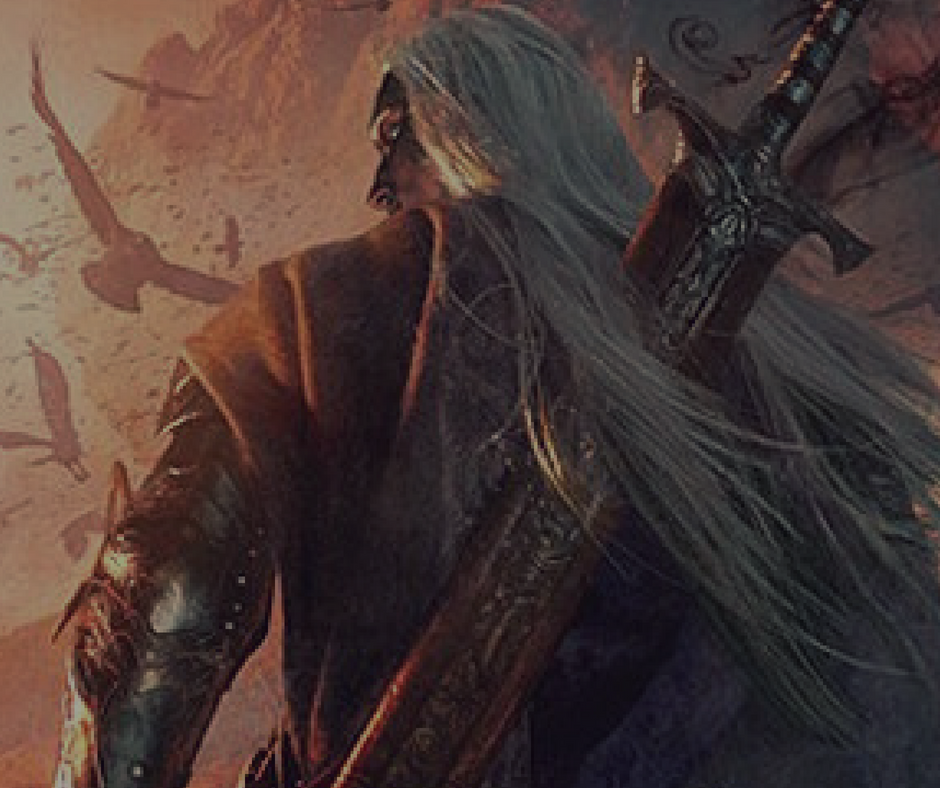 |
| Not Elric or Drizz't... it's Anomander! |
There's much I've been appreciating as a gamer and world builder. I usually have distant or absent deities in my settings, but Erikson strikes a good tone with meddlesome gods and machinations of the "Ascendants", as well as his portrayal of priests and clerics as agents of their respective deities. Because many of the gods were recently mortals, they have scores to settle with human empires. I also like the portrayal of how ordinary soldiers and people get caught up in events with these terrifying immortals or ancient powers - they enter a scene, wreak some havoc, and take their struggles elsewhere. It's almost like getting the view of New York City from ordinary folks after the Avengers have had a giant battle in the city - but a fantasy world equivalent. There are techniques to be learned here on presenting your high fantasy, high powered gaming setting. Here's my list of game-able elements gleaned from Malazan, that have kindled my imagination:
- Meddlesome gods and Ascendants
- Clerics as divine instruments
- Magical healing as a military resource
- The importance of warfare and political scheming
- Mages in the military, and practical magic
- Horrifying pre-human cultures and ruins
- Orders of assassins - the Talons and Claws
Has anyone else read this series? Would love to hear whether you borrowed any of Erikson's ideas, or perhaps Glen Cook's Black Company, for your game world. (I can't speak to Esslemont's writing yet). It also makes me want to look at more contemporary fantasy fictions and see what else is out there. Erikson's approach is so transparent with tropes taken from the world of gaming, it raises a new question - have forty plus years of Dungeons & Dragons so thoroughly influenced fantasy literature the genres are betimes indistinguishable?


