Sunday, November 11, 2012

The Twilight Zone Sandbox… with Pirates


Earlier in the week, Talysman over at the Nine and Thirty Kingdoms mused how the old Twilight Zone episodes were like mini weird tales, featuring a strange or horrific twist at the end.  It got me to thinking how easy it would be to 'file off the serial numbers' and use the weird element from the episodes for a short game situation.

I've been spending a lot of time here thinking out loud about Arthur, and Britain, and Feudal Japan, but I never really stopped kicking around ideas for a Colonial or Caribbean themed game (Goblins of the Spanish Main?) with privateers or buccaneers in the 1600's, and I'm slowly building out notes for using it for a setting - I have a kick-off adventure for the campaign already outlined.  If I were to build a Caribbean saltbox/sandbox area, could some of the encounters use weird twists inspired by the excellent writing from The Twilight Zone?

So that was the experiment - I scanned only the first 10 or so episodes of The Twilight Zone season 1 (which I had watched earlier this year) and picked out a few where I got an immediate hit on an adventure hook to see if the idea would work as a weird vignette in a nautical sandbox.  Consider there are over 150 episodes to mine for inspiration!

Here are some ideas:

Mr Denton on Doomsday
This is the episode where the two gunfighters confront each other, and realize they're both using the same steady-hand / speed elixir from the snake oil salesman; there's also a theme of fate intervening.

Sandbox:  A patron is obsessed with finding an old hermit in the mountains of Hispaniola to learn the secret of finding the legendary crystal skull, lost oracle of the Maya.  The one-armed hermit offers dire warnings about seeking the relic and receiving its visions, but the group sets off for the Yucatan coast, avoiding Spanish forts to land on the deserted coast and hunt for the crumbling Mayan ruin.  The group guides the patron to the chamber of the skull, and the patron loses his hand in a gruesome way, just like the old hermit, a heavy price for consulting the pagan oracle.

Escape Clause
This one involved a hypochondriac guy who makes a deal with the devil for immortality, but then gets life in prison for the murder of his wife.

Sandbox:  A timid man who became immortal and then turns into a daredevil / thrill seeker makes for an interesting recurring character - he's long since bored and his death-wishes constantly endanger everyone around him.  He may start out like a 'normal man' sailor who always seems to come out of scrapes okay, no matter how dangerous the assignment for which he volunteered.  The only thing that frightens him is the prospect of captivity - life in jail, in fact.

The Lonely
A convict consigned to a distant planet falls in love with an android.  His rescuers shoot the android in the head when they come to get him.

Sandbox:  Marooning and madness are fantastic pirate themes.  This vignette involves finding a castaway that doesn't want to leave the island without his "wife", although the players can't find any evidence of her during the day.  Wifey only shows up in the dark of night, when it's time for her to feed - and she doesn't want her "husband" taken away from her, either.

Time Enough At Last
Poor Burgess Meredith is finally left alone with all those books, only his glasses break.

Sandbox:  This one made me think of the The Curse of the Black Pearl, that first Jack Sparrow movie - the theme involves wanting something really bad, paying a heavy price to get it, and then not being able to enjoy it once you have it through irony - like the pirates claiming the cursed Aztec gold.  I could riff off a similar theme around wish fulfillment.

Judgment Night
This was the u-boat captain who wakes up on board a merchant ship, and keeps relieving a u-boat attack from the other perspective.

Sandbox:  My first thought was to have an exploring group discover a careened ship, and a broad trail leading to a nearby fort where the crew has set up defenses; they urge the party to join them in the defense, because some horrible pirates will be attacking soon.  As clues pile up, the party realizes their fellow defenders were all vicious pirates themselves, now strangely humbled; perhaps only the pirates can see and experience the ghostly attackers?  I don’t know yet, just thinking out loud, but I like the thought of simulating what it would be like to get pulled into someone else's nightmare.  In fact, all of the defenders are phantoms.  The party spent the evening in the company of ghosts consigned to relive the hellish horrors they themselves inflicted on others, after they were cursed by a powerful Obeah woman murdered on their last raid.


Saturday, November 10, 2012

Black City Game 11 - Kneel Before Odin

I hate having two game recaps in one week - as other bloggers can attest, they tend to be the least read, and understandably so, unless you write like Hemingway or something.  I put them out here mainly to keep a campaign log for the players, although from time to time they spur some useful discussions on choices I made, mistakes, and lessons learned.  Since I already spent much time regaling the awesome duel from last game (Game 10), this one is bare bones, just to get it done before tonight's game and provide a recap.  I'm behind on game reports because I lost that week of power and internet due to the storm.

Agnar negotiated with the Byzantine visitors to Thule, learning that the detachment commander, Valens Lascarius, served Himerius the High Hermite and Thaumaturge of Constantinople, a wizard of some repute.  At Himerius' request, Valens and company hired a longship to guide his group and some Varangian guardsmen to distant Thule.  The players secured the services of a magic user and a trio of Russian elves, members of Valens' detachment, who needed guides into the city.  The party was desperately in need of magic muscle and this worked as a way to introduce some new and exotic PC's.

Treasure was disposed of, taxes were paid, and time was spent negotiating with Shafat's servant, Milkyaton, to buy a pair of rare and enchanted blades from far off Carhedon.  Shafat is the eccentric wizard outside of Trade Town who lives in an onion-domed tower in a nearby ravine; Milkyaton frequently points out how the master's genie servant whisks him away each night to the desert lands of North Africa from where he returns the next day laden with wonders from those distant bazaars.  When the group set out again days later, they had a scimitar made in remote India by the Moghul's wisest, featuring a cobra skin handle and a blade imbued with basilisk venom; the other weapon was a Viking style broadsword engraved with the name of the legendary smith, Ingomer, and forged of the crucible steel.

The players were spoiled for choice on where to go and what to do, but ultimately decided to investigate a lonely spire in the south part of the city.  This basalt tower was sealed by guardians, but since they had enough orange passkeys for all, they slipped past the watchers without incident and explored the interior of the tower; in my notes, it's called The Tower of Astronomy.

Within the tower, they fought an otherworldly spirit monster that looked like a man in faded Renaissance finery; good thing they had a few enchanted weapons, this one could have been ugly.  They messed with arcane machinery and summoned an eldritch horror from beyond space and time, the Opener of the Way; fleeing the iridescent globular tentacles of the Opener , the party retreated higher into the tower, escaping through a magic portal to find themselves in Asgard, far above the world and facing the starry void, standing before a 7' manifestation of Odin himself.

At least, that's how the figure identified itself.  Let's see how it goes tonight.

DM's note:  The party was "this close" to stepping through a dimensional portal to Carcosa from within the tower; at times I think the only way this campaign could get any cooler, would be a side trip to Carcosa and return with laser guns and blasphemous rituals.

:sigh:  Another time.


*If you're going to have an Odin show up in a gonzo D&D game, of course it should look like Kirby's rendition from Marvel comics - pictured.

Friday, November 9, 2012

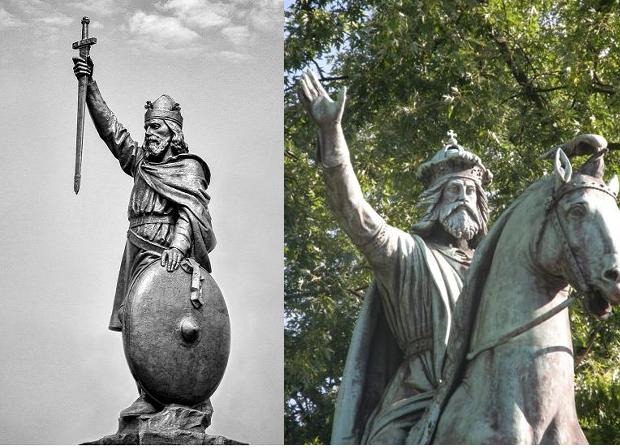
Charlemagne vs King Arthur


Both of these legendary kings feature prominently in the medieval romances and tales of adventure as related in the Matters of Britain and France; and in both sets of stories, the realm of Fairy and the influences of enchantresses are keenly felt.

In the stories of Charlemagne, there is a clear frontier beyond which dwells barbarians and pagans; this is the Saxon frontier, and the peers of the realm campaign across the Rhine with Charlemagne for a period of almost 20 years.  For D&D purposes, it sets up a fantastic borderlands and wilderness, clearly demarcating the realms of Law from the realms of Chaos - there's a visceral sense of crossing a no-man's land when the Franks leave civilization behind and enter the pagan realm.  In Three Hearts and Three Lions, the frontier is further mystified by placing the Twilight Realm there, the  land of Fairy from which the forces of Chaos contrive to return the world to eternal gloom, banishing the sun.

Arthur's land of England has no such frontier of evil; there are conflicts with Saxons, the Orkneys, and Cornwalls, on the fringes, but encounters with magical realms happen nigh anywhere on a quest, usually when a knight is deep in a forest, or conveyed by boat to a strange place across water.  Chaos is very much where you find it, as if commonplace and ordinary woods and lakes can transform overnight, thrusting a questing knight into contact with the numinous or the enchanted.

So here's a fine question for a Friday - in which legendary realm would you rather place your D&D style adventures?  The enchanted forests of 5th century Britain, last haunts of the druids, or the dark, brooding woods past the Rhineland, home to pagan barbarians beyond the very frontier of civilization?

Wednesday, November 7, 2012

D&D is the Search for the American Dream


We hold these truths to be self-evident, that all men are created equal, that they are endowed by their Creator with certain unalienable Rights, that among these are Life, Liberty and the pursuit of Happiness.

In other words, heavily armed strangers ought to be allowed to wander the countryside, look for ruins to explore, monsters to kill, and treasures to loot.  I don't need a white picket fence and a backyard barbecue, I just want to get to name level, build a castle, and attract 5-50 followers.

On Ken and Robin Talk About Stuff, they talked a bit about historical role playing and why people choose to play in fantasy settings instead of the real world; this loose paraphrase of their convesation sums it up for me:  "People want to play in a historical setting like the dark ages, but they don't want serfs, they don't want an all powerful Church dictating the rhythms of daily life, they don't want any social constraints on free movement and agency.  They want to play Vikings and still let that one guy in the group be a ninja.  They want the wild west, with swords."

It summarizes quite well why I mentally come back to the Age of Sail as the consummate historical era for gaming, even though D&D's technological sweet spot is hundreds of years earlier.  It's why my current game is built around free-wheeling Vikings.

The past is a nice place to pretend to visit, but we wouldn't really want to live there.

Black City Game 10: Rocky Balboa vs Clubber Lang


Relating the ongoing adventures of a group of Vikings, the Spitsberg Pirates, as they attempt to plunder a frozen alien ruin on the shore of distant Thule, in the land of the midnight sun.


There was high drama during this game.  The party was challenged to a duel by an irate ship captain, a fierce, hulking Viking named Sturla the Berserk Killer, "I will break you", setting up the Rocky Balboa versus Clubber Lang situation when they sent their much smaller fighter out to battle him.  We live near Philly, and the Rocky theme is pretty much the local anthem, so of course the boy started humming the Rocky music in the buildup to the big fight, getting some of the adults to join in.  The players had a lot of silver coins on the line in side bets, counting on their underdog to pull off a big upset.

But I'm getting ahead of myself a bit - the group was still in the dungeon at the start of the session, ending last week shortly after they defeated the "psionic ghost of the hive mind" and smashing the mummified remains of the alien psion.

The players chose to camp their characters right in that domed structure where they defeated the psionic ghost; one of the henchmen was at zero hit points, so they needed magical healing in the morning (from the PC cleric) to get her back on her feet and moving.

The dome proved to be a secure campground; both the dungeon entrance (down the shaft) and the surface entrance (past a pair of stone "watchers") required orange passkey gems to enter, so the chance of wandering monsters was low.

There were  a lot of "toys" to play with in the dome, various pedestals and podiums topped by crystalline structures and beds of lights; the details of all the tinkering, pushing, and prodding are dull to relate, but one of them proved to be quite entertaining - it had a number of colored stones matching the light spectrum - red, orange, yellow, green, etc… up to violet.  Touching a stone seemed to open up a two-way communication to similar posts throughout the deeper dungeon levels, giving the players an interesting sneak peek of "things to come" - and in some cases, deeper denizens got a good look at them!  Romanoid Praetorians, the Dreaming Hyperborean, the Secret Masters, the Devil Wasps, offspring of the Dark Goddess...there were a few times they had to "change the channel" really quickly when they came to the attention of something really gruesome from the dungeon depths.

I can't emphasize enough how much this opens the door for me to have excursions from the depths as these malign hidden forces send probing search parties to the upper levels.  Here are some quotes from one of my favorite TNG episodes expressing my sentiments about the players revealing themselves to the deeper horrors in the undercity:
Q:  You are about to move into areas of the galaxy containing wonders more incredible than you can possibly imagine - and terrors to freeze your soul...
Picard:  Perhaps what we most needed was a kick in our complacency - to prepare us for what lies ahead...   They will be coming.
Guinan: You can bet on it. 
The next day was the long trip out of the dungeon.  They'd been exploring for 5 days, covering a lot of dungeon ground, and leaving a number of hard-to-carry treasures scattered around.  So now they spent  time tracking down hidden caches and hoping to avoid wandering monsters.  A few of the items were gone, perhaps evidence that other adventurers had come along.

Lots of things happened back on the beach when they finally returned to Trade Town.  The most exciting thing was being challenged to a duel by that furious captain, Sturla the Berserk Killer, as I foreshadowed in the opening.  You have to understand, the group has frequently encountered hostile groups of explorers in the ruins, and many times these meetings end up in brutal combat; when NPC's surrender to the player characters, they make them swear loyalty oaths to the Isgerd's Fury and join the crew.  It’s the pirate way!  In this manner, they've replaced retainers and lost seamen with capable members from other groups, while making enemies among the other crews.  Sturla was one of the captains that had enough.

Sturla got right up in the grill of Agnar, the party leader, calling him a coward and declaring that the men of the  Isgerd's Fury had tainted his warrior's honor by stealing members of his war band.  Sturla is a striking figure, draped in a raven feather cloak, bristling dark beard, a robust mountain whose fat hides piles of knotty muscles.  A crowd had formed from nearby ships and crews, because everyone wants to watch a fight.

Agnar is charismatic and strong himself, and ignored Sturla a bit, playing to the crowd; as the challenged side, he could name his champion and the terms.  "We accept your duel, Sturla, but seeing as this whole matter is beneath me, my champion will be him…" and he gestured to Mustafa, the group's scrawny desert warrior.  There were gasps from the crowd at the insult, and Sturla was livid that Agnar wouldn't do the fighting.  "Furthermore, it will be wooden weapons, to the first knock out - I don't want my man spoiling his blade on your blood".

It was totally on.  Mustafa was quickly established as a 3-to-1 underdog, as tough Northmen warriors from some of the nearby ships sized him up, some going so far as pinching his biceps and shaking their heads at the lightweight matching scimitars he favored, over a sturdy axe or heavy broadsword.  Sturla was going to crush him.

A formal duel was big news on the strand, and the jarl's men got involved to make sure it would run according to custom, in a large dueling ring outside the town.  That evening, the offended parties attended the jarl at his hall, reaffirmed their grievances and intent to fight, and enjoyed the jarls's hospitality.  Agnar told some tall tales about the group's exploits in the dungeons, to help unnerve Sturla, who glared from across the hall.

The duel itself happened the next day.  Skoldig, a retainer-thief with a fair amount of charisma, was tasked with laying bets on Mustafa amongst the crowd, putting down 500sp of hack silver in various side wagers with other captains.  The jarl himself presided, since the first formal duel of the season was a big event and promised rich entertainment for the rowdy crews.  Sturla stared across the sandy field at Mustafa from behind his shield and heavy club, who warmed up with a pair of lighter clubs so he could mimic his dual-scimitar fighting style while in the arena.

Ship captains are typically 3rd level fighters, with some of the larger longships commanded by 5th level fighters; Mustafa was only 2nd level.  However, he has an 18 dex and really high defense, whereas Sturla was stronger and heavier (higher strength and con, but low dex).  It was a classic fight between a faster, lighter, combatant, and a big bruiser with twice the hit points.  Sturla strode right out across the arena when the horn was blown, swinging wildly with his heavy club.

Besides his speed, Mustafa's other big advantage was "Bless".  We're using the LOTFP rules, and a number of common spells have been changed, sometimes subtly, sometimes not; Bless no longer gives a short term bonus, it gives the blessed person actual points to spend at any point throughout the day.  Mustafa had something like 12 bless points stored up, after getting a couple blessings from the clerics, to spend on rolls (saves, attack rolls, that kind of stuff) - the key factor is that the player must decide to spend the points before they make the roll.  It’s a neat, strategic take on the Bless spell.

Mustafa was spending a point or two of Bless per round, while using called shots (-4 to hit) to try and knock Sturla in the knee to slow him further; once he laid a good crack on Sturla's knee, he switched tactics to circling and swinging at Sturla's head to improve the chance of a an immediate knockout.  After a few rounds of inconclusive fighting, Sturla was only softened a little, and then he landed a crushing blow on Mustafa, taking him from 13 hit points to 3 hit points with a bruising 10 point smack.  The next shot would knock Mustafa out cold.

A few of the players put their foreheads on the table at this point.  They were about to forfeit 500sp, lose a good retainer, and also become the laughingstock of the camp.  It's fine to talk a big game, after all, but you have to be able to back it up.

And here is why you don’t fudge dice in these games, why you roll in the open.  Groans escaped from the  players when Mustafa lost initiative next round, and the group waited for defeat as I shook the attack dice and tumbled it across the table… only to see Sturla's attack roll (my roll) miss horribly.  Mustafa had a chance.  The player decided to use all of his remaining Bless-points on one final attack, trying to strike Sturla on the side of the head while he was over-extended from a big swing… everyone leaned in anxiously to watch the player roll… and it was a natural twenty.  20!  The bless points weren't even necessary.  Double knockout damage from the head shot, and Sturla crumpled to the sand after Mustafa cracked him across the temple with a telling blow that echoed around the stunned dueling circle.  The table erupted in cheers.

You just don't get the same sense of immediacy when the DM acts like a puppet master, hiding rolls behind the screen and keeping open the possibility he's ignoring the dice arbitrarily.  Let the dice fall, win or lose, and whatever emerges is usually pretty dang interesting.  In this case, the legend of Mustafa, the wiry desert man who knocked out the Berserk Killer, was born out of improbable odds in front of an assembled mass of incredulous Vikings.  Good for the players.

In addition to tripling their money, the morale amongst the henchmen and retainers was high, and Agnar now had the ear and goodwill of the jarl.  The players have been working on a long term project to start a gambling ring on the beach, and now the jarl is willing to provide some muscle and let them give it a try, as long as he gets a piece of the proceeds.  "Pig Knuckles" is in business.

Other news in the camp was that a foreign ship had arrived in the same fjord as Trade Town, and rather than beaching near the fort, the foreigners made a remote camp across the sound.  Rumor was that they included Byzantine warriors, and Varangian guardsmen from the distant empire.  During the council session in the jarl's hall, some voices counseled sending a war party to crush them as interlopers, whereas others called for envoys to open talks and declare the jarl's law.  Agnar and the players agreed to be those envoys, further cementing their good name with the local boss, but placing themselves in harm's way on a potentially risky mission confronting a large party of outsiders.

As usual, the game report is getting long, so I'll tell you how the visit with the Byzantines went… next time.  After many excellent sessions of play, here is how the party composition now looks - surviving PC's are level 2, and a few of the zero-level men matriculated to level 1 fighters.   Players needing new characters introduced some of them in session 11.

Cast of Characters
Agnar Beigarth, a Northman fighter (L2)
Mustafa of Arabia, a scimitar wielding desert warrior (L2)
Brutok the Strong, a dwarf (L2)
Borghild, a Norse cleric of Odin (L2)

Fighting men retainers:
Ayerick the Young (L1)
Bjorn Fjordrunner (L1)
Grimson (L1)
Fafnir (L1)

Other retainers:
Skoldig (specialist L1)
Brick Bunnybreaker (halfling L1)
Bottvild (cleric L1)
Halam (cleric L1)
Ivar the Bow-bender (specialist L1)


*The picture is Rocky Balboa vs Clubber Lang from Rocky 3, a classic underdog vs big uncouth bruiser - you've got to have the eye of the tiger, brother!

Tuesday, November 6, 2012

Feudalism Ate My Sandbox


You are not a beautiful and unique snowflake.  You are the same decaying organic matter as everyone else, and we are all part of the same compost pile.
--Fight Club

Desperate rogues and cutthroats swigging ale in a smoky tavern, pouring over old maps, and swapping tales of plundering ancient ruins is the meat and drink of the D&D experience.  This vision of freebooters is quite removed from the feudal manorial system, where the majority of people are tied to the land as servants or defenders, and there are no inns and taverns for hard luck adventurers to plan their next delve.

Of course it’s odd, because the default tech levels in D&D reflect the early medieval world, and tales of knights, chivalry, and adventures with the fey realms would be ripe for inspiration.  I loved Poul Anderson's Three Hearts and Three Lions, and it certainly seemed inspirational for many elements in D&D.

The good life
Joking about running feudal era characters, someone posted this on the RPGsite as a potential character background table:

Roll d10,000:
1 nobility
2 clergy
3-6 merchant
7-15 craftsmen
16+ serf

The point is well taken; running a dark ages campaign has always seemed problematic because of the social conventions.  Who would be the typical D&D style adventurers in such a setting?  Desperate outlaws that slipped their manorial bondage to live in the woods as bandits?  Everyone else is too tied to the system.

HR2 Charlemagne's Paladins, the 2E era historical reference for 8th and 9th century France, puts the characters in the role of members of a noble household - sons, daughters, and fosters of a Frankish count.  I've been reading Pendragon lately, the Arthurian game, and it's somewhat similar - everyone starts the game as a newly made knight, owner of their own manor and possessing a fair amount of starting wealth - at least by 1st level D&D standards.  Even a poor knight in Pendragon starts with armor, weapons, a pair of riding horses, a squire, a warhorse, and a sumpter pack horse, along with a small manorial holding and annual income.

That's one way of solving the problem of a feudal setting - letting everyone start the game as a noble with a degree of standing, and not a hard luck scrabbler eager to mug some goblins for their coppers.  Dark ages nobles were a rough and tumble lot, required to defend their small manors and support their lieges with military power, so it's not a bad role model.  But it turns the D&D end-game on its head, since knights are usually represented by mid-level fighters or higher, and the typical D&D character doesn't get property until name level.  It also undermines the desperate need for that next pouch of drinking money that underpins swords & sorcery and picaresque adventuring.

I ran a dark ages sandbox some years ago, with the players starting as members of a noble's household, and it left me a bit unsatisfied as a sandbox; too many of the adventures were "what is the noble count going to send them to do now?", since the players were essentially vassals (like everyone else in the setting) and it ended up more like 'mission of the week' and less like the players planning their own delves.  You need to be able to turn the keys over to the players, put them behind the wheel.

Another approach would be to cheat the historical aspect a bit and slide in some market towns and the occasional inn and tavern, de-emphasizing the feudal manor as the starting point.  There's an old school sensibility to the idea that knighthood and standing is something earned during play by proving one's worth through feats of arms (instead of being born a snowflake).  In the chaos of the dark ages, shrewd counts and kings will elevate tough and worthy warriors to the nobility through enfeoffment.

The feudal world has been on my mind lately, as one of my kiddos has been reading King Arthur stuff, and I had picked up Pendragon before the storm.  I tend to think if I did a feudal sandbox, it would be the latter approach, allowing the players to exist outside the manorial system and move into the ranks of landowners later in the campaign.  The dungeons and adventures in such a setting are topics for another day.

How about you, have you run a sandbox game in a feudal setting, and if so, how did you reconcile the freedom and autonomy inherent in a D&D style sandbox?

Sunday, November 4, 2012

Today in D&D School


I had the thought to do this article before the big storm, so it's been sitting on my computer while the power was down, waiting to post.  The moms of one of our players said something nice to my wife: "Your husband is doing a good job with the D&D game, the boys are learning so much about history while they're playing".

So I asked the kiddo what kinds of things he's learned in our current campaign.  Here's what he had say:

Real vikings didn't wear horned helmets.  The vikings went everywhere and drank beer or mead - Russia, England, France, and even Canada.  They ate dried, salted, or smoked fish in the winter,  and lots of pickled stuff, like pickled cabbages.  But if you didn't eat fresh stuff every few weeks, from hunting or fishing, you could get scurvy.  Their boats are called longships or knarrs.  The men are either jarls, karls, or thralls depending on whether you're a noble, freeman, or slave.  They do crafts during the winter in those big halls and drink more beer (beer was like food you could store all winter).  They used cone helmets with nose guards, wooden shields, and axes.

I'm sure he knows a lot more, like how island shelters are constructed, how names are formed, what everyday life is like back home, that kind of stuff.  We also watched the recent Nova episode that showed the forging of an Ulfberht sword and the guys talked about it during one of the games, so he now knows a bit about how crucible steel is made and why it was superior to local steel.

I had overlooked this as a benefit of a setting based on real-world history - I like getting ideas from real myths and legends, using real maps and place names, but there's this huge educational upside to also consider if you game with kids.  Besides, if you like history, the research and reading inherent in preparing the setting is pretty dang fun.  The real world is endlessly strange and fascinating.

My home library is slowly accreting 'day in the life' books, like The Time Travelers Guide to Medieval England, Everyday Life in Viking Times, or A Day in the Life of Ancient Rome;  I appreciate the modern approach to scholarship that's painting these vivid pictures of ordinary life by piecing together bits from anthropology, literature, archaeology, art, and written history.  As Black Vulmea said over here - Booke Faire - many children's history books also feature curious bits about everyday life to help kids place themselves in the period;  these sources are really fast and accessible for the harried game master.

I've actually had a few  parents on the block wrinkle their nose when their kid went home and asked if they could sit in on one of the kid-focused D&D games during the summer - like it's the late 1980's again, and D&D is only something for... I dunno, weirdos or something.  Meanwhile, they don't blink when their kids play gory TV-MA video games and blow the heads off zombies or loot bodies in Skyrim.  I'll stop judging.

TL;DR version:  You can slide in plenty of historical knowledge into your tabletop game, ninja-style, the way some moms are known to puree healthy stuff like carrots and mix it into their kid's food sight unseen.