Wednesday, October 10, 2012

Black City Game 9: Visions of the Future


The game has been going on for a few months now; here's a quick background for anyone new that would like to start following our weekly campaign recaps.

The Black City is my home brew mega dungeon - it's a ruined alien city, on a frozen island far above the world, and the characters are all Norsemen who've come by ship to explore the ruins.  Each summer, dozens or more long ships beach on the shores of Thule Island, a seasonal trading post called Trade Town is established, and many doughty parties of warriors head into the ruins, excavating, fighting monsters, and claiming artifacts and rare pieces to sell in the southern markets.

The players have been focused on slowly exploring the dungeons beneath the city, entering via a huge hole in the ground called the Well of Woe, and working their way north in the sprawling tunnels beneath the city.  When last we broke, they camped over night in the third dungeon they've discovered beneath the city, which they've been calling 'The Mist Dungeon' since it was full of fog and mist when first discovered.

You can also just filter on The Black City Campaign label and browse past Black City posts (both game reports and content) that way.

CAST OF PLAYER CHARACTERS
Mustafa of Arabia, a scimitar wielding desert warrior
Dag the Unwashed, a fighter
Brutok the Strong, a dwarf
Shamus, a Gaelic wizard
Gareth, a Fighter
Borghild, a Norse Cleric
Brick Bunnybreaker, a Halfling

HENCHMEN:
Fighting men:  Bjorn Fjordrunner, Ayerick the Young, Agni, Grimson
Others:  Skoldig (specialist), Bottvild (Cleric)

Last game, the group covered a fantastic amount of ground, mapping a large portion of the south eastern Mist Dungeon.  Strange and wondrous sights were discovered; a gigantic 4-armed polar bear, with a scintillating unicorn horn, apparently preserved in suspended animation behind a glass enclosure; they fought one of the city's massive furry snakes, a monster-sized constrictor that tried to eat them; in a side room, they found the head to the big robot.

Regular readers may remember they found a large metal torso in one of the rooms; in another chamber, they used an alien token to view a holographic projection crystal where one of the city's ancient residents, resembling our modern depictions of 'grey aliens', apparently demonstrates the functioning and control of the large metal automaton of which the torso belonged.   Keyser, one of the players, calls it the "new employee orientation video".  Finding the head vindicated their belief that scattered around the dungeon, they might find the parts to the big metal man, and be able to put it back together.

The level of play was sharp last game!  The group safely eradicated a nest of hairless, mutated giant shrews, using their levitation belt to scout the nest safely from above, and then destroy the monsters with flaming oil from above.  They avoided a nasty slide trap that could have dropped part of the group down into the deeps below the transit tunnels, a level of danger far beyond their 1st level characters.  And they managed to turn the tables on the Dokkalvir (evil faeries) that had kidnapped and  stolen one of the player characters (Agnar the fighter), off the faerie realm of Svartalfheim, a few weeks ago.

The Dokkalvir were met again, chiefly as a wandering encounter, while the party puzzled over a series of heavy duty hatches and levers far to the south in the Mist Dungeon.   The evil elves had come to tell them that their Queen would be returning Agnar to the mortal world in a few days, and that they'd be stranding him in the dungeon - the leader of the Dokkalvir, Aelfwyn, gave the group a crude map on where to retrieve Agnar.  Borghild, who had some previous dealings with the dark elves, had "lent" them some silver and jewels, and used fairy logic and the knowledge that they fey can't break a promise, to compel Aelfwyn to guide them back to his camp and return the treasure.

Just an aside to readers, one of the factors in the Black City is that 'mythological creatures with relationships to the Vikings' - the dark elves, the Dverge (evil dwarves), the Asgardians, and so forth - have sent their own groups to scout parts of the Black City as well, out of curiosity aroused due to their spying and dealings with the Norse.  It's allowed me to have a peculiar and diverse bestiary, doubtless.

Protected by faerie invisibility, the party accompanied the Dokkalvir on a journey that took them far away, out of the Mist Dungeon, and up the large subway-style tunnel that extended far north under the city - much farther than the group intended, I'm afraid.  Stranger sights were seen - the group narrowly avoided detection by a trio of floating "Winged Hunters", flying lobster creatures armed with high tech weaponry and glowing antennae.  The Dokkalvir pointed out where the Winged Hunters had burrowed smooth circular tunnels through the stone with their fell weaponry, granting egress to float up to the surface world and down to the deeper caverns with their otherworldly levitation.

Finally, near the small side room where the Dokkalvir had a camp, a shambling party of Gjenganger attacked.  The gjenganger are dead Norsemen, returned to unlife by unknown properties within the dungeon; the monsters were dispatched after a short combat, with no serious losses to elves or men.

Finally, the elves performed the ritual that opened a way to Svartalfheim, and Agnar was returned to the mortal world.  Knowing this was upcoming, I developed a table for fairy abductions a few weeks ago, and Agnar's result was 'Visions of the Future'.  In his short time as play thing to the Queen of Air and Darkness, she revealed chilling views into upcoming events.  We ended the session then, because we were over time, but I can tell you all one of the visions Agnar will proclaim:  the adventurers all came to Thule as crewmen on a ship called The Isgerd's Fury; in a few short months, Isgerd's Fury will be completely destroyed in a conflagration, stranding them on the island.

More revelations to come.

Tuesday, October 9, 2012

Mundane Adventures


We use plenty of inadvertent oxymorons in the game - war games, realistic simulations, living dead, giant dwarves, little giants, chaotic organizations, and plenty of random logic.  Here's another one to put in the mix - mundane adventures.

Have you ever run an adventure, where the characters get hired to do something, and no fantastic elements make an appearance?  They rob the rich merchant, and get away with all the loot without triggering any magical countermeasures; they escort the caravan to the next city for mere mercenary wages, and no monsters attack from the hills?

There's a principle of contrast to consider - the weirdness of monster-filled adventures juxtaposed against the banality of everyday life.  But I question if anyone bothers worrying about creating such a contrast when table time is limited.  I recently reviewed Death Love Doom, where the group believes they're going to loot an abandoned mansion, and instead it's all blood, horror, screaming and running.

A setting or gaming milieu can be so removed from the player's everyday experience that nothing seems banal even though it's mundane… Traveller attempted to get away with games lugging trade goods from one star system to another via arbitrage as an 'adventure'.  How'd that work out?  No, seriously - if you were a big fan of classic Traveler - did the rules lead to interesting games because everything else was so extraordinary?

I spent most of last week down in Williamsburg, VA, taking in all the exciting historical sights (and sites) - Jamestown, Yorktown, Colonial Williamsburg - it's truly spectacular.  The notebook I'm using to keep my  Colonial Hex Crawl notes has gotten some heavy work!  Adventures in the setting will be in the horror / weird fantasy vein, and less of an ongoing campaign, more like one shots.  But it got me thinking about a game set along the eastern seaboard in the early 17th century and the types of mundane adventures had by the explorers of the time - scouting the frontier, prospecting for resources, trading or negotiating with Indians, dealing with pirates and foreign agents.

The "problem" of introducing mundane adventures primarily shows up in a sandbox game, particularly a game set in a low-fantasy or historical setting where the fantastic is less commonplace and verisimilitude would dictate a percentage of opportunities that having nothing to do with supernatural intrusions and the blood, horror, screaming and running.

I've been equivocating myself - on the one hand, there's the Call of Cthulhu model; it's a historical game, but we don't run mundane scenarios and players rarely have a wide range of choice among plot hooks; regardless of milieu, it's a given that every COC scenario is going to cause some character-sanity damage and result in the screaming and the running.  Like Scooby and the Gang, no matter where the party goes, they happen to be the "lucky ones" that uncover all the eldritch horrors.

Opinions or examples of how you've used or avoided mundane adventures are most welcome, as I work through the pro's and con's myself.  Like most things at the table, the social element favors not making such a decision unilaterally, but consulting with the players around their preferences as well.

Monday, October 8, 2012

Monstrous Monday: Children of Mukade


Mukade was a gigantic centipede monster living under the bridge Tschitta, in Totomi.  It was said to have glowing eyes that could boil a man's blood, and venomous breath.  Mukade was dangerous enough to hunt dragons, and was eventually killed by the hero Hidesato with an arrow through an eye.

Children of Mukade are monstrous centipedes descended from the legendary demon.  They don’t fear man and frequently attack on sight.  Provincial lords pay a bounty to any hunters that return with dead Mukade, as nests of the beasts disrupt travel and can make remote bridges unusable.  This is a monster I'll eventually use in the Spirit Island campaign - and probably create a gigantic demon centipede for use in the Night Lands.

Children of Mukade
AC as chain, HD 4, Attacks 1 bite, Damage 1-8 plus poison, MV 18, ML 9, AL N

The children are 12' long monstrous centipedes, with red legs, a green body, and red head and mandibles.  They are extremely swift, quickly attacking from beneath a bridge or ruined habitation.  Their virulent poison is strong enough to kill a man.


The image is from an interpretation of Mukade by Arta01 over on deviant art.

Sunday, October 7, 2012

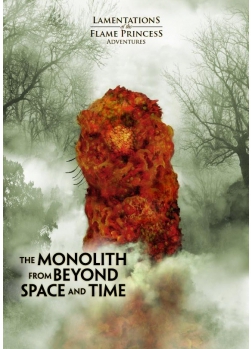
Review: The Monolith from Beyond Space and Time


Part 4 of my Tour de LOTFP, reviewing the recent spate of adventure modules by LOTFP

I had saved reading The Monolith from Beyond Space and Time until last; when this adventure was released, I remember seeing some reviews here and there that blasted it as a railroad with encounters that were patently unfair or poorly designed, so I wanted to wait and let things settle.  I finally took the time to read it last week.

The premise of the adventure is that a mysterious valley has appeared within the milieu; if/when the player characters choose to investigate, they have the chance to encounter the reality-bending structure at the center of the valley, the monolith... from beyond space and time.  The core of the adventure is basically the following conceit; characters that manage to view the monolith are forever changed, and the only way to resolve the situation involves a monstrous choice.  In that regard, the adventure module is a fantastic success.  The monolith creates the kind of situation that the players will puzzle and equivocate over for quite a bit of time.  The 'agonizing choice' is a familiar trope in horror adventures, and this one presents an excellent dilemma.  For that reason, it's probably most important to place this adventure in an ongoing campaign.  It's unlikely many of the side effects of exposure to "beyond" would be noticed until leaving the valley of the monolith, compelling the characters to revisit the valley in search of answers or resolution.  Playing this as a one-shot misses out on the interesting campaign ramifications of the monolith.

The adventure includes rules for traversing the valley of the monolith, along with a handful of sample encounters to be had while there.  The encounters do a decent job of portraying the valley as a nexus where things from different times and places interact due to the presence of the monolith.  That being said, a few of them function more like traps, and not necessarily well designed ones, either.  The author encourages the referee to create additional encounters for the valley, and I would probably swap out or alter some of the ones provided.

Physically, the books is in LOTFP's now standard A5 format, with easy to read text in a two-column layout and simple design.  The art is fantastic, with many full page pieces by Aeron Alfrey.  Monolith weighs in at 46 pages.

So how would I rate this book?  It's another strong horror offering in the LOTFP line, but I place it behind Death Frost Doom or Death Love Doom.  Here, the horror issues from the alterations that happen to the characters, and the consequences that ensue; it's very personal and creates a significant quandary for the players.  That said, this adventure errs more on the side of "high concept" and seems to be a statement regarding what a referee should be willing to do to achieve The Weird Aesthetic ™.  Some of the encounters and situations are heavy-handed and push the artistic agenda more than I like.  I'd still rather have an intriguing adventure like this one, which breaks new ground and promises complex, messy situations, than a retread dungeon crawl.

Ostensibly, this is supposed to be the most "Lovecraftian" LOTFP adventure to date.  Post-Lovecraft myth makers introduced the motif that exposure to the "numinous beyond" spreads madness and corruption to those that learn the true nature of the universe.  In that regard, I'd consider this a modern interpretation influenced by post-Lovecraft writing and not a pastiche like many Call of Cthulhu scenarios.  The otherworldly encounters in the valley and monolith would seem equally at home in an episode of the Twilight Zone or Outer Limits, or reality-bending sci fi films like Solaris or Event Horizon.

Friday, October 5, 2012

Review: Death Love Doom


Tour de LOTFP continues this week with a third review, this time the controversial Death Love Doom adventure module.

The back of Death Love Doom indicates it's a limited printing of 200 copies, with a big red warning "18+ graphic content"; I imagine it's sold out at this time, but a review is worthwhile since you could still get the PDF.  This is a gruesome adventure guaranteed to horrify and frighten players just in time for Halloween.  The physical book is a 20 page A5 sized pamphlet, with a detachable cover so the referee can keep the maps handy at all times.  The detachable cover with maps hearkens back to those modules of yore; that's about the only thing in common with those 1970's adventures!  Like The Magnificent Joop van Ooms, I'm going to grumble the text is awfully small and cramped, zine-like, on the tiny pages.  Spoilers abound, so read no further if you intend to be a lucky player in this one.

The premise of the adventure is simple; word spreads around the London streets that something has happened to the household of a wealthy merchant, and his country estate is open for looting.  The characters are assumed to be one of the first or second groups of robbers that heads out to see if the rumors are true.  There is a great fortune waiting out there to be had, well over a hundred thousand XP or more by my quick count.

Shortly after breaching the grounds, it's very clear that something is wrong - bodies of the staff and family are found, gruesomely mutilated and altered.  And then the characters discover that not everyone is dead; some of the agents of destruction are ambulatory and actively searching for intruders.  Yikes!  This adventure is guaranteed to create delicious tension at the table; there is lots of treasure and loot lying around unguarded, but the players are experiencing mounting horror; how long will they continue to place their characters at risk of a fate worse than death, just to earn tons of easy XP? This adventure puts the risk-reward management firmly in the player's hands.

There are very few adventure modules in the D&D space that perfectly capture the tone of a horror movie, and that alone makes this an amazing piece.  For that matter, I can't think of many Call of Cthulhu or horror scenarios that do the job this well, either.  In most COC scenarios, the players are committed to see things through, and they march in stalwart fashion with grim resignation towards the end of their characters.  The players here completely control their decision to enter the mansion, and how long to stay, and the weight of choice makes all the difference.  Unfortunately, there are some pieces of information, once known, that can't be forgotten - and if the occurrences at the mansion are not resolved, the matter doesn't end just because the characters flee into the night.

There were some early reviews that flipped out about Kelvin Green's gruesome artwork in this book.  Yeah, it’s beyond the pale for a typical fantasy gaming book; once you recognize that this is a horror adventure, and compare it to equivalent properties in the horror genre, it's not much different from what you'd see in the Hellraiser or Exorcist franchise of movies.  Creepy mangled humans, spider-walking backwards with their heads rotating around unnaturally… except the folks in the module are all naked and their "junk" has been messed up.  Pinhead and his Cenobite colleagues would be kin to the primary antagonist here (if Pinhead was buck naked).  So this is definitely not a book to leave lying around for the youngsters to leaf through.  Don't download it at work, either.  Or read it in a public place.  Your spouse may question your judgment, as well.  Beyond that, it's all thumbs up.  / grin /

Should you buy this one?  Like I intimated above, it's a fantastic horror adventure for your retroclone or D&D style game, and Halloween is coming up.  There is some solid refereeing advice on how to present the location and continually ramp up the tension for the players.  I would love to run this one at some point.  The biggest question to ask yourself is whether your players would enjoy setting out on a simple B&E caper, and could handle the mounting horror when they find themselves at the scene of 'My Bloody Valentine', with Pinhead's demon-possessed naked Grandma hunting them with a pair of freaky scissors?  Can a horror adventure actually get much better?

The defense rests.  Bravo, James & Co. - encore, encore.

Thursday, October 4, 2012

Review: The Magnificent Joop van Ooms


Part 2 of my reviews of recent LOTFP books while I'm off traveling and not working on my campaigns.

The Magnificent Joop van Ooms is a small pamphlet published concurrently with The God That Crawls, so it was an easy 'upsell' to add my order.  It's an 18 page A5 sized pamphlet, soft cover, with a basic two column layout.  Unfortunately, the text is rather small.

The book describes the studio and capabilities of Joop van Ooms.  He is indeed, magnificent; a 17th century creator with extraordinary talent, combining magical ability with great skill in the arts and sciences.  He's part Leonardo da Vinci, Jules Verne's Captain Nemo, Lovecraft's Randolph Carter, and Shakespeare.  He possesses reality altering powers like you might see in a Twilight Zone episode - his paintings become true, his plays can render magic inert, the angles of his architecture can kill his enemies.  There is horror here, too, lurking within Ooms' ability to paint a future that comes true..

The book does not contain an adventure; it describes Ooms and his oddball retainers, his studio, his amazing abilities and agenda, and then lists a page of plot hooks on how to use Ooms to generate plot hooks for your own adventures.  There's a little historical background on Holland for the early 17th century, and tables covering some Amsterdam encounters and black market trading to support player activities in Ooms' home city.

While this is a useful pamphlet, I can't recommend rushing out to get one shipped from Finland; if you're getting other stuff, it's a fine toss-in or PDF purchase - all the LOTFP books I'm reviewing this week are primarily available in the LOTFP online store.  A character like Ooms is a fantastic patron and a worthwhile addition to your campaign's roster of recurring NPC's, just remember that this book is an appetizer, and not a hearty main course like some of this author's published adventures.

Wednesday, October 3, 2012

Review: The God that Crawls


I'm traveling this week, so it's given me a chance to catch up on some reading - I've finished Night's Black Agents and a bunch of the recent LOTFP releases, so I'll be spewing forth opinions (ie, reviews) as time permits.  First up, let's take a look at The God That Crawls, the latest adventure for LOTFP.  As usual, there will be spoilers in the review.

Physically, the book is a pleasing quality - the pages are a nice texture, feature a distinctive edge fade, in two column layout.  Like most of LOTFP's publications, they're roughly 8 x 5 (paper size A5, I believe).  The maps are embedded in the text in greyscale, but there is a nice poster fold out of the maps at the end of the book, in color.  This project was funded as crowd-sourcing, and the publisher, James, doesn’t mess around with quality.

The premise of the adventure involves a winding labyrinth beneath an old church, inhabited by a monster with a shameful origin - the 'god that crawls'.  The villagers and priest, while not evil, are complicit in preserving the secret beneath the church.  Furthermore, the secret labyrinths were used by the ancient church as a sort of 'Area 51' for securing dangerous artifacts, so it's possible that adventurers that plumb the labyrinth could discover those forgotten, ancient vaults that still hold some bizarre and dangerous items.

Regardless of how the characters first get into the labyrinth, once they're in, they're likely trapped until they find an alternate escape route.  Similar to The Grinding Gear, this is a classic dungeon crawl that puts a lot of pressure on resource management, forcing players to choose between speed, encumbrance, careful searching, and time management, while they're tracked by 'the god that crawls' through the labyrinth.

I really enjoyed the atmosphere of the adventure module, and the interweaving of historical details to fully realize the features of the church and labyrinth. There's been a trend-line in the LOTFP catalog to place these adventures in a real world setting similar to 17th century England, and it works well to contrast the mundane details with the horrors of the adventure site.  My only criticism is that some of the weird items in the vaults are both too baroque and outlandish; they're almost trying too hard to be non-standard magic items.  Maybe they'd still be fun in actual play.

I highly recommend the adventure; every adventure in the LOTFP catalog promises a unique and memorable experience for both players and the DM, this one included, and that alone is a fantastic reason to pick this up for running. Like most of the modules in the LOTFP catalog, The God That Crawls is for fairly low level adventurers.  The author's decision to situate more of his published works into 'the real world' is worthy of a longer discussion, but it's a move that makes a lot of sense for the tone and themes of these LOTFP adventures.  I'll have the chance to post notes on The Magnificent Joop van Ooms, Death Love Doom, and The Monolith Beyond Space and Time in the next few days.